November 27, 2026 · Guides
Can a Multi-State Co-operative Society Accept Deposits?
Yes, but only from its own voting members, and only within the limits set by its bye-laws and the rules. A multi-state credit society that takes money from the public is breaking the law, however it labels the scheme.
Here is what section 67 of the Multi-State Co-operative Societies Act, 2002 says, and what the 2023 amendments added for thrift and credit societies.
In this guide
- Section 67: voting members only
- What changed in 2023
- An MSCS is not a bank
- Starting a credit MSCS
- How we help
- A worked example
- Monthly checks for the board
- FAQs
Section 67: voting members only
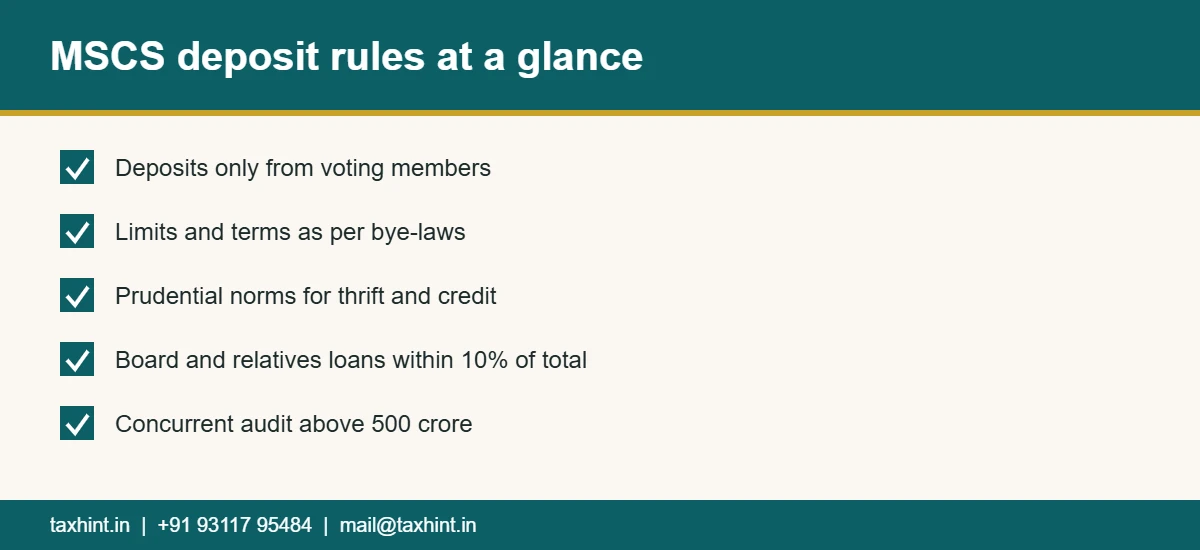
Section 67(1) lets a multi-state society receive deposits, raise loans and receive grants to the extent and on the conditions in its bye-laws. In 2019, the Banning of Unregulated Deposit Schemes Act amended it: deposits can be received only from voting members, and an explanation makes clear that deposits from anyone else are not allowed.
Nominal and associate members are not voting members. Taking deposits from them is exactly what the law closes off.
What changed in 2023
The 2023 amendments brought prudential norms for societies in thrift and credit. Under the Multi-State Co-operative Societies (Amendment) Rules, 2023, these societies are grouped as micro, small, medium and large by their deposits.
Loans to board members and their relatives cannot exceed ten per cent of all loans outstanding. A concurrent audit applies to societies with turnover or deposits above 500 crore rupees, by an auditor from the Central Registrar’s panel.
An MSCS is not a bank
A credit society cannot call itself a bank. After the 2020 amendment to the Banking Regulation Act, co-operative societies cannot use bank, banker or banking in their names unless allowed, and DICGC insurance does not cover deposits with them. Members trust the society, not a government guarantee, so governance matters.
Starting a credit MSCS
You need members from at least two states, 50 from each when all members are individuals, and bye-laws whose capital and prudential norms match the government guidelines. Our MSCS eligibility checker tells you if you qualify, and multi-state society registration covers the full process.
How we help
We draft deposit and loan bye-laws that fit the Act and rules, and handle yearly MSCS compliance. Our MSCS software keeps deposits, loans and member records in line with the norms.
A worked example
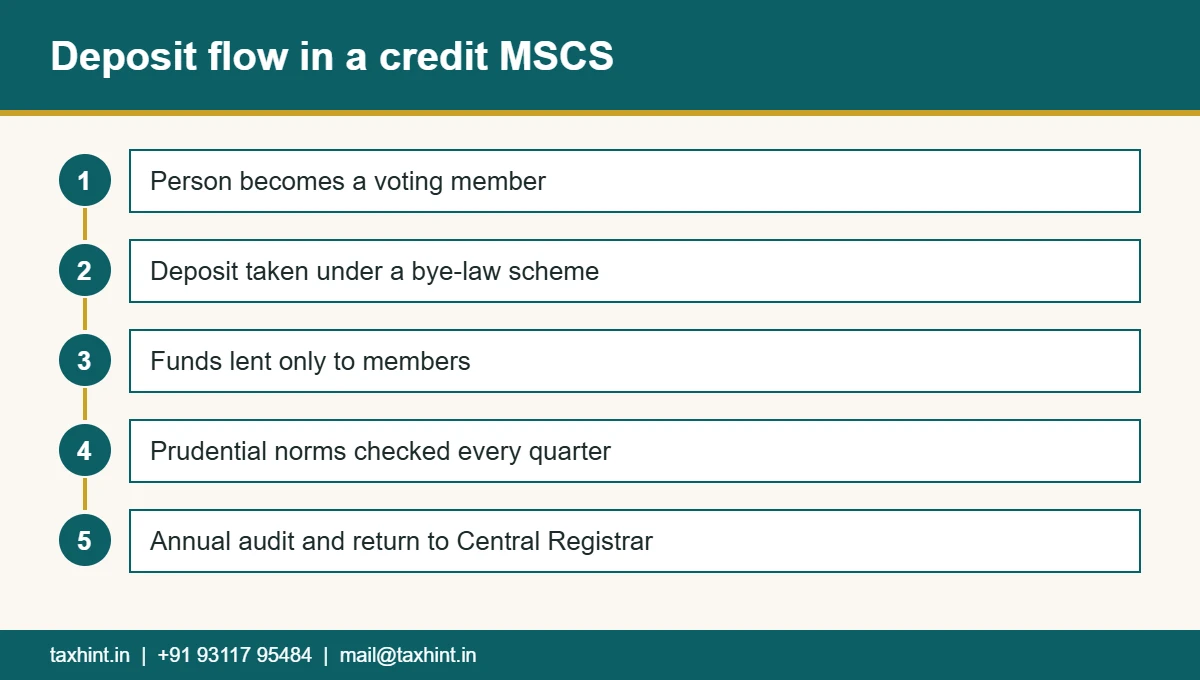
A credit MSCS has members in Uttar Pradesh and Bihar. A shopkeeper in Patna who is not a member wants to open a fixed deposit. The society must first admit him as a voting member under its bye-laws, with share money and KYC. Only then can it take his deposit.
If the society instead opens a scheme for nominal members to deposit money, it is taking deposits from persons who are not voting members. Section 67 does not allow that.
Monthly checks for the board
- All new depositors are voting members on the register
- Deposit schemes match the bye-laws
- Loans to board members and relatives stay within 10 per cent
- Liquidity and exposure norms are met
- Complaints from members are logged and answered
A board that runs these checks every month rarely faces trouble at audit time.
Frequently asked questions
Can an MSCS take deposits from the public?
No. Since the 2019 amendment, section 67 allows deposits only from voting members.
Can nominal or associate members deposit?
No. They are not voting members.
Are MSCS deposits insured?
No. DICGC cover is not available for deposits with co-operative societies that are not banks.
How much can board members borrow?
Loans to board members and relatives together cannot exceed ten per cent of total loans outstanding, under the 2023 rules.
Who audits a large credit MSCS?
Societies with turnover or deposits above 500 crore rupees also need a concurrent audit from the Central Registrar’s panel.
Need help? Planning a credit MSCS? Get Free Consultation or call +91 93117 95484.