Microfinance Software for MFIs and Section 8 Companies
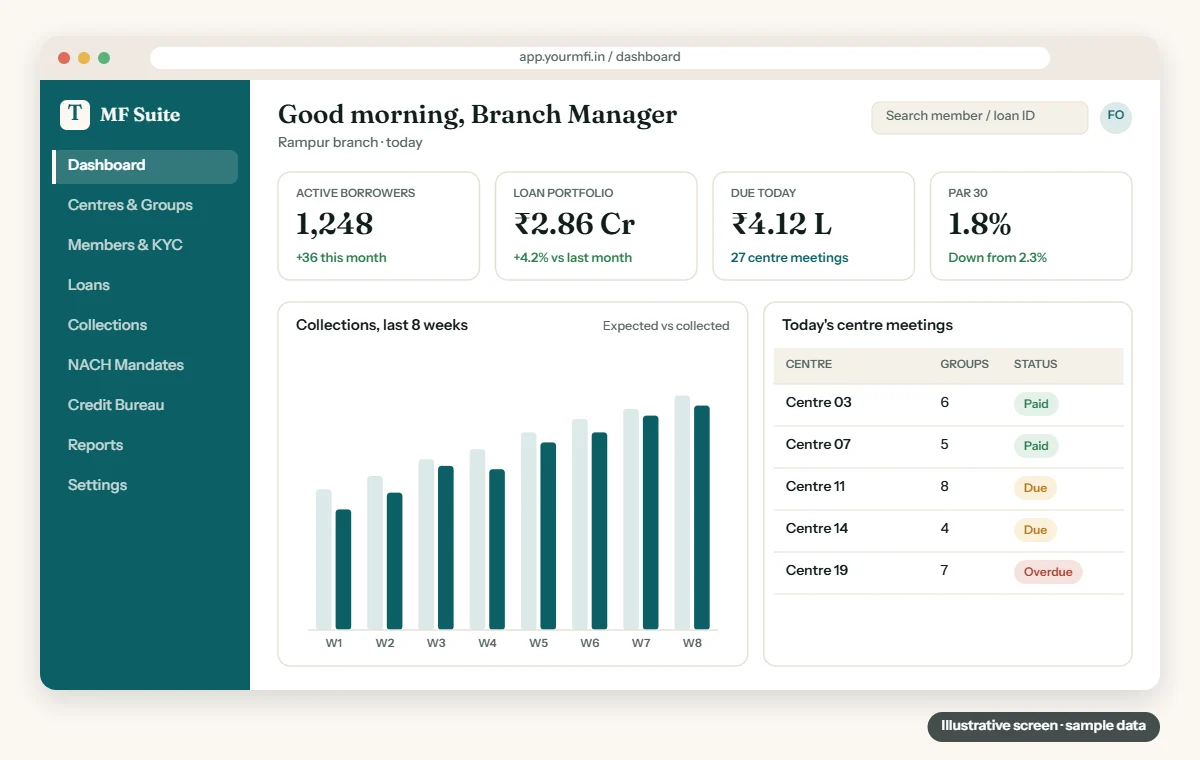
Taxhint’s microfinance software runs group lending, centre meetings and field collection from one cloud login. Branches, agents and borrowers each get their own access, and what the field officer collects posts straight to each member’s account.
Who this microfinance software is built for
Take a trust in Faridabad that turns its livelihood work into a Section 8 company. It gets its first fifty borrowers, and by the third month the field officer’s notebook no longer matches the bank passbook. That is usually the point where a promoter starts looking at microfinance software.
The same microfinance software is set up differently depending on what kind of lender you are. A microfinance loan, as RBI defines it, is a collateral-free loan to a household with annual income up to ₹3,00,000 (see the RBI FAQs on the microfinance framework). Who can give that loan, and on what terms, decides which modules we switch on for you.
Section 8 microfinance companies
Non-profit lenders running group loans in villages and small towns. A Section 8 MFC cannot take public deposits, so we keep the deposit modules off and set the software up around loans, groups and collections. Still at the paperwork stage? Start with Section 8 microfinance company registration.
NBFC-MFIs
RBI-registered lenders with more branches, more staff and more reporting. Branch-level accounts, multi-tier access and user activity logs matter most here. If the company is still being formed, see our page on NBFC-MFI and microfinance company registration.
Nidhi companies
Nidhis lend to members and also take member deposits, so savings, FD, RD and MIS modules come into play. We run a separate build for them: Nidhi management software.
Credit and thrift societies
Co-operative credit societies share a lot with MFIs (member shares, loans, field collection) but follow society law and their own audit formats. They have a dedicated product: credit and thrift society software.
Microfinance software features, grouped by the job they do
Feature lists on software sites tend to run to forty items and say very little. We have grouped ours by the work your staff actually does each week. Everything below is in the platform today.
A word on order. New lenders often want every module on day one, and we usually talk them out of it. Get groups, KYC and the collection app working first. Once two or three loan cycles have run cleanly through the microfinance software, add NACH, the member app and the extra reports. Staff learn faster that way, and mistakes in the early data stay small.
Group and JLG lending
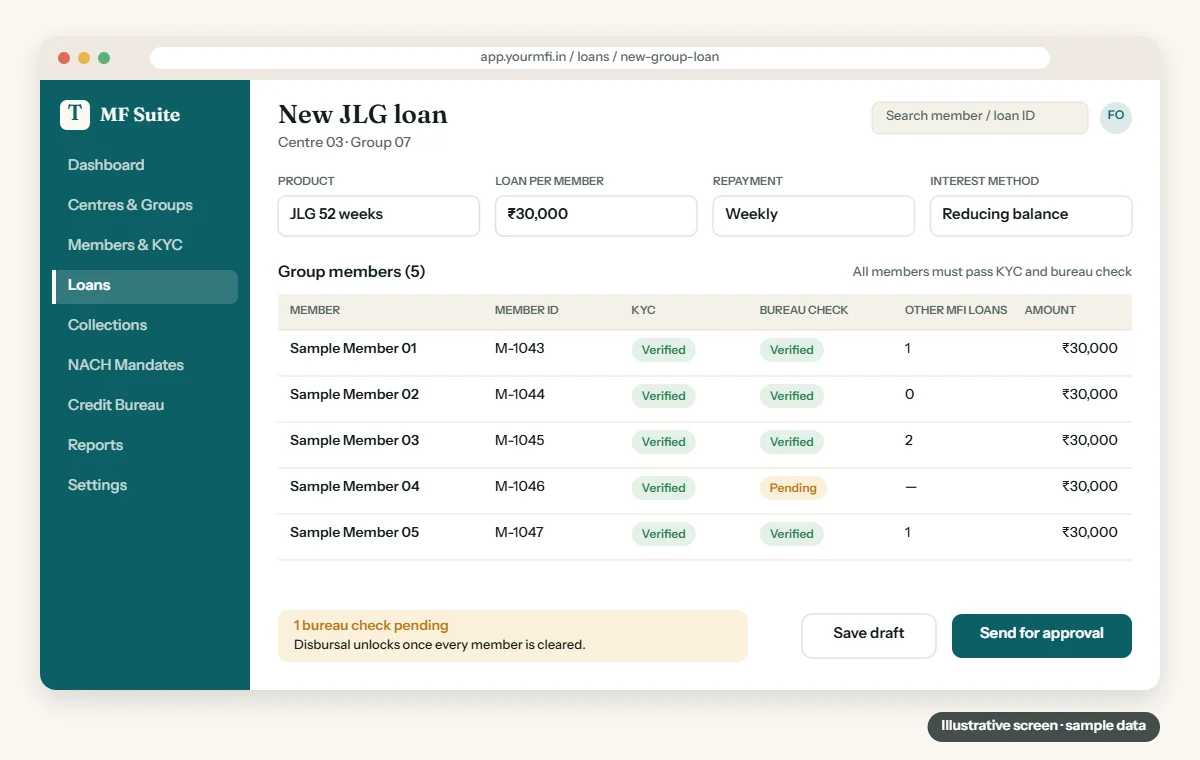
Set up groups and centres, add members with their KYC, and give loans to each member inside the group. When the field officer collects at the centre meeting, the agent app posts each member’s payment to her own account, so you see the group total and the individual dues from the same data.
If you are comparing JLG software from different vendors, ask to see one full meeting cycle, from group creation to the last instalment. We have written more on how group lending is kept in order in our JLG and SHG group lending software guide.
Field collection
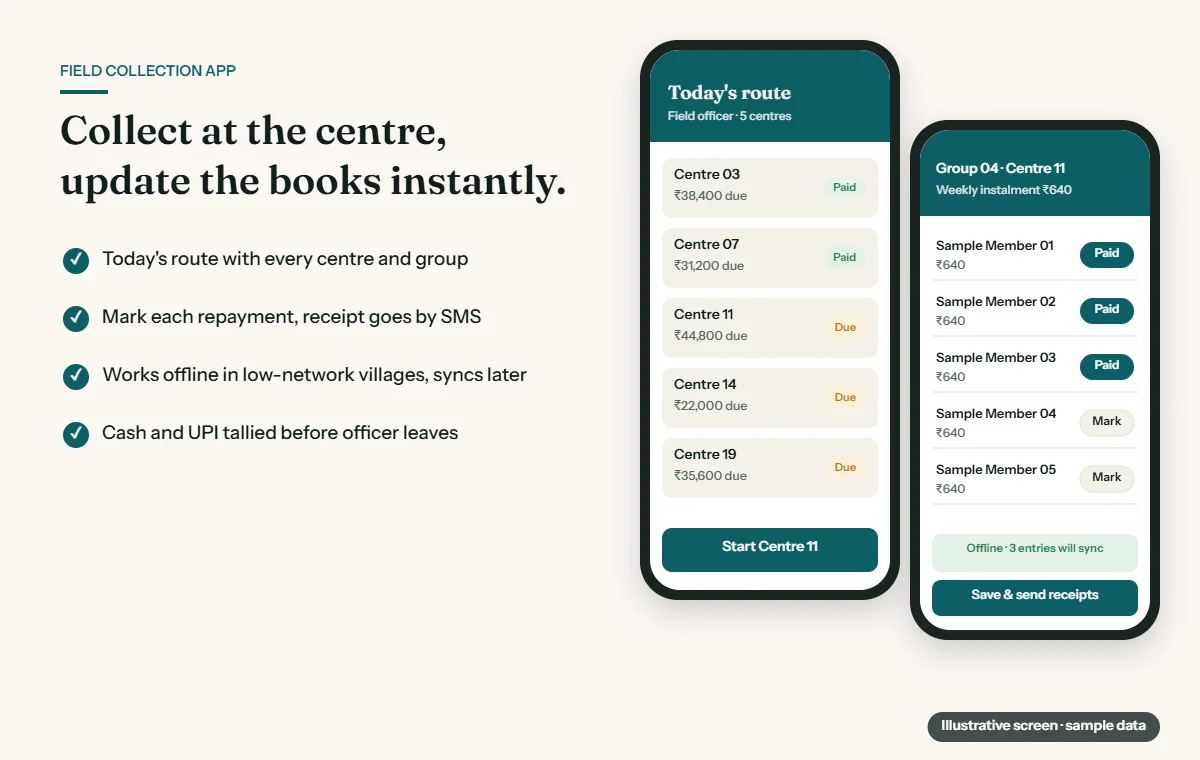
Agents log in to the collection app, see who is due, and record repayments on the spot. Geo-tagging can attach the location to an entry, and SMS notifications go out to borrowers. Agents get real-time data on pending payments, so nobody waits for the evening phone call to know who paid.
For a Bihar SHG cluster or a Palwal livelihood programme with officers covering ten villages a day, this is where the time goes. More on the workflow in our field collection app guide.
KYC and credit bureau
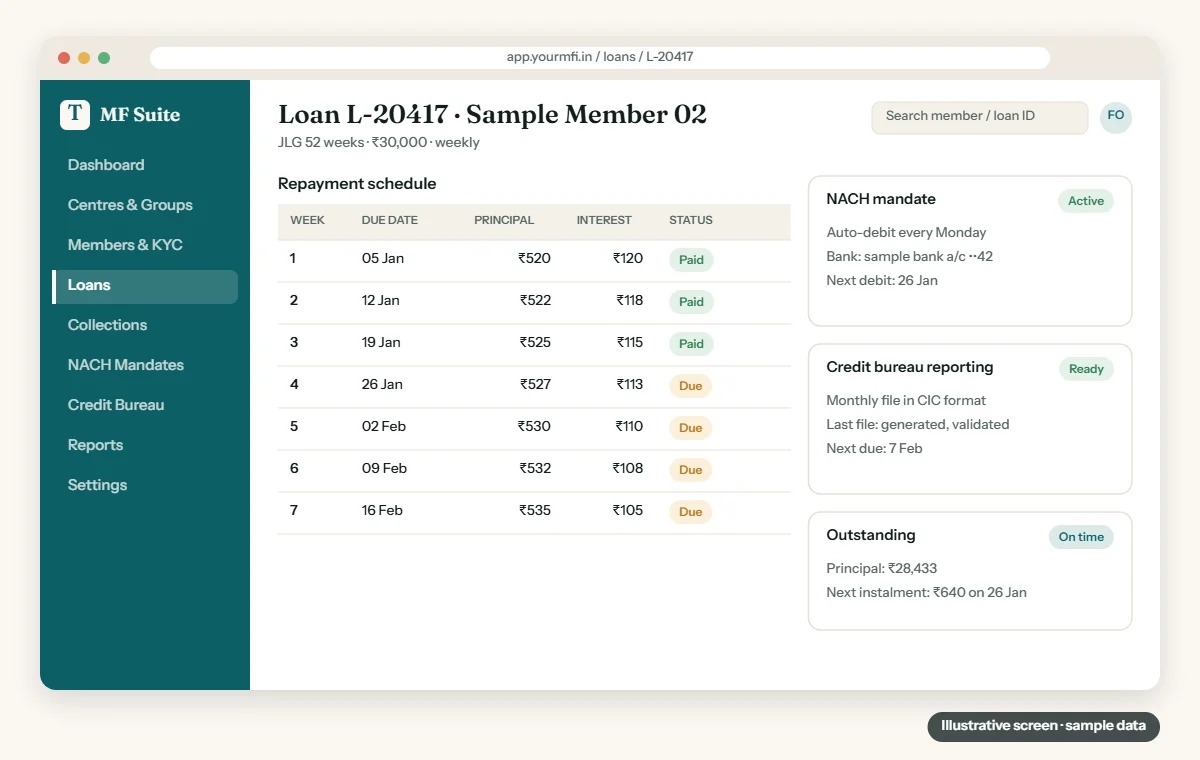
Aadhaar and PAN verification, CIBIL score check and upload, C-KYC upload, and a bank statement analyser for applicants who have one. All of it sits on the borrower’s record, so the next loan cycle does not start from scratch.
What to check before a loan goes out is covered in our KYC and credit bureau reports guide.
Accounts and money movement
Each branch keeps its own accounts, reports and disbursements. Member and share management, loans and advances, and customisable print forms are built in. For collections and payouts the platform has a virtual IFSC facility (IMPS, NEFT, UPI), NACH, e-mandate, payment gateway with QR code payment, and BBPS.
In practice, NACH and e-mandate are what cut down cash handling once a borrower has a bank account. We usually advise switching them on from the second loan cycle.
Reports, dashboards and overdue tracking
Business reports, customisable dashboards and analytics on performance metrics and trends, plus statutory compliance reports. With multi-tier access, a branch manager sees her own branch and head office sees all of them.
Portfolio at risk is the number most MFI boards ask for. If you track it in a set format, bring that format to the demo and we will show how the overdue data maps to it. Our note on collection efficiency and portfolio at risk explains how to read both.
Controls and security
Unlimited users with rights set per role, multi-tier access control, and separate logins for admin, branch, employee and agent. Holiday calendars can be set per branch, and logins can be restricted to specific IP addresses. User activity logs record what each user did, which helps when an entry needs to be traced.
Three apps: for agents, applicants and members
The web software is where branches and head office work. The three Android apps are for the people outside the office.
In our experience the collection app decides whether an MFI software rollout succeeds. If field officers find it slow or confusing, they go back to the notebook and the branch ends up typing everything twice. So during setup, agents get their own training on the app, separate from branch staff.
Collection App
For field agents. It automates repayment tracking and gives each agent real-time data on pending payments. Collections entered here post to the member’s account without anyone re-typing them at the branch.
User App
For loan applicants. They can apply, upload documents and check the status of the application without visiting the branch or calling the officer.
Member App
For existing borrowers. Loan status, repayment history, secure document upload and notifications. It also cuts down the “how much is left on my loan” calls to the branch.
Alongside the apps, the platform has SMS, email and WhatsApp integration, IVR calling and tracking, and an AI chat bot for routine borrower queries.
What it costs
Starting ₹15,000. The final figure depends on how many branches and users you have and which modules you need. A single-branch Section 8 MFC with three field officers needs a much smaller setup than an NBFC-MFI with twelve branches, and the quote reflects that. We would rather you start small and add branches later than pay for modules nobody uses yet.
The price includes access to the platform, configuration, data migration from your current records, training for each staff role, and ongoing support after go-live. We give you an exact quote after the demo, once we have seen your branch structure and loan products.
For a wider view of what microfinance software costs in India and what to compare between vendors, read our microfinance software cost breakdown.
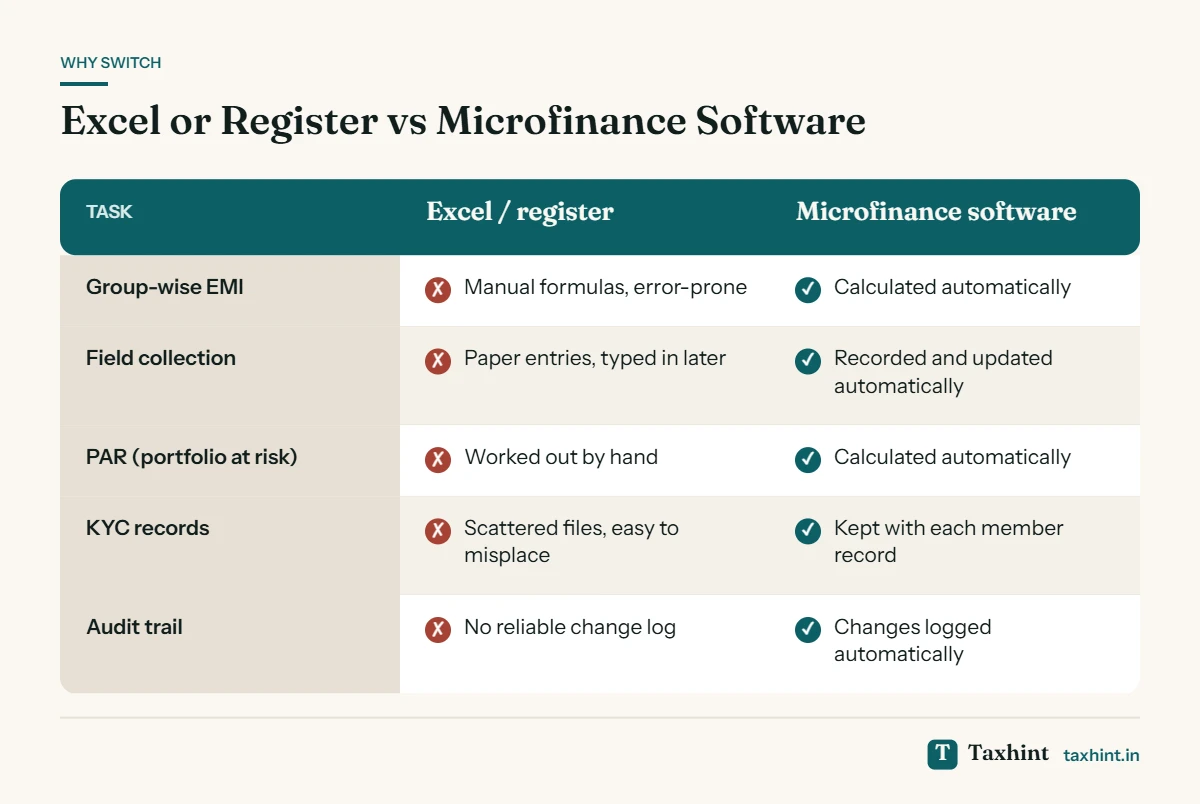
Excel and paper registers vs Taxhint software
Plenty of small MFIs start on Excel, and for the first thirty borrowers it works. The trouble starts when there are two field officers, one shared file, and nobody sure which copy is latest. Moving to microfinance loan software fixes most of that, because everyone works on one live record. Here is where the difference shows up.
| Task | Excel or paper register | Taxhint microfinance software |
|---|---|---|
| Recording a centre meeting collection | Officer writes it down, branch types it in later | Agent records it in the collection app; it posts to each member’s account |
| Knowing who is overdue today | Someone filters the sheet, if it is up to date | Agents see pending payments in real time |
| Borrower KYC and CIBIL | Photocopies in a file, score checked on a separate portal | Aadhaar and PAN verification, CIBIL check and upload, C-KYC upload on the borrower record |
| Repayment by bank | Borrower deposits cash, branch matches it by hand | NACH, e-mandate, UPI and QR code payment |
| Multiple branches | One file per branch, merged at month end | Branch-wise accounts and reports, with a combined view for head office |
| Who changed what | No record | User activity logs and role-based rights |
| Borrower updates | Phone calls to the branch | Member app, SMS, email and WhatsApp notifications |
Not registered yet?
Microfinance software comes after the company is in place. If you are still deciding the structure, the two usual routes are a Section 8 microfinance company and an NBFC-MFI. A Section 8 MFC is exempt from RBI registration when it gives only microfinance loans, holds a Section 8 licence, takes no public deposits and has assets below ₹100 crore. An NBFC-MFI needs ₹10 crore net owned fund and an RBI certificate of registration.
We handle both registrations, with a CA or CS on each file. Because the software comes from the same firm, the loan products you register for can go into the software as they are.
From demo to go-live
You get a dated plan before you commit to anything.
Live demo on your scenarios
We run the demo on your kind of loans and groups. Bring a few real cases with the names removed, say a group whose member skipped two meetings, and we will walk them through.
Configure
Branch structure, staff roles, loan products, print formats and holiday calendars are set up to match how you already work.
Migrate your data
Existing borrowers, groups and loan balances are moved in from Excel or your old system, then reconciled against your current records before anyone relies on them.
Train your team
Training goes role by role. The field officer learns the collection app; the branch manager learns approvals and reports; head office learns the dashboards.
Go live, with support
Cutover happens with our team on call. Support continues after go-live for questions, new users and changes to products.
Frequently asked questions
What is microfinance software?
It is the system an MFI uses to run its lending: borrower KYC, groups and centres, loan disbursement, field collection, accounts and reports. Taxhint’s microfinance software is cloud based, with a web login for branches and head office and Android apps for agents, applicants and members.
Does it handle JLG group lending and centre meetings?
Yes. Groups and centres are set up with their members, and collections taken at centre meetings are posted to each member’s account through the agent app.
Can a Section 8 microfinance company use this software?
Yes. Since a Section 8 MFC does not take public deposits, we leave the deposit modules switched off and configure the loan, group and collection side.
How much does microfinance software cost?
Taxhint’s microfinance software starts at ₹15,000. The final price depends on the number of branches, users and modules. It includes platform access, configuration, data migration, role-wise staff training and ongoing support after go-live.
How long does implementation take?
Most deployments go live in two to four weeks. The time depends on how many branches you have, how many records need moving and how many print formats need setting up. You get a dated plan before you commit.
Can we move our existing data from Excel?
Yes. Data migration is part of setup, and the migrated balances are reconciled against your current records before go-live.
Is it cloud based or on-premise?
Cloud by default, so branches and field staff can work from anywhere with internet access. If you need it on your own server, we can quote for on-premise on request.
Does it check KYC and CIBIL?
The platform has Aadhaar and PAN verification, CIBIL score check and upload, C-KYC upload and a bank statement analyser, all linked to the borrower’s record.
Do field staff get a mobile app?
Yes. Agents use the Collection App to see pending payments and record repayments. Applicants have a User App for loan applications, and borrowers have a Member App for loan status, repayments and notifications.
Is staff training included?
Yes. We train each role separately during setup, and support continues after go-live.
Software guides from our CAs and CSs
Buying microfinance software
What to ask in a demo and what to check in the contract. Read the microfinance software buyer’s guide.
Software cost in India
How vendors price MFI software and where the hidden costs sit: microfinance software cost in India.
Field collection app
How collection apps work on the ground, from receipts to day-end cash: microfinance collection app.
Software for Section 8 MFCs
What a non-profit lender actually needs, and what it can skip: software for a Section 8 microfinance company.
Microfinance company vs NBFC-MFI
How the software setup differs between the two: microfinance company vs NBFC-MFI software.
Related software and services
Loan Management Software
For individual lending without groups or centres. See loan management software.
Nidhi Software
Member deposits and loans for Nidhi companies. See Nidhi company software.
Credit & Thrift Software
Built for co-operative credit societies. See credit and thrift society management software.
Core Banking
For larger lenders that need full banking operations. See our core banking system software.
Section 8 MFC registration
Licence, incorporation and post-registration filings. See Section 8 microfinance registration.
Microfinance company registration
NBFC-MFI formation and the RBI application. See microfinance company registration.
See it running on your own numbers
Send us your branch count and loan products, and we will set up the demo around them. Microfinance software starting ₹15,000, with setup, migration and training included. Call or WhatsApp +91 93117 95484, or write to [email protected].