November 25, 2026 · Guides
Chit Fund vs Kitty Party: Legal Difference Explained
Both a chit fund and a kitty party involve a group, regular contributions and a payout that rotates or is decided by a method. They can look alike, but the legal position may be different.
This page is general information to help you ask the right questions. This is general information. Please verify rules with your CA or lawyer for your state.
In this guide
- What they have in common
- Where they may differ
- Questions to ask a lawyer
- Practical advice for participants
- If you want to run a registered chit fund
- FAQ
What they have in common
In both, members put in a fixed amount at regular intervals, and each period one member receives a lump sum. The group relies on trust that every member will keep paying.
The difference lies in how the arrangement is organised and regulated.
- Group of members
- Regular fixed contribution
- Payout to one member in each period
Where they may differ
A chit fund is generally a regulated business under the chit fund law, with registration, approvals, records and rights for subscribers. A kitty party among friends is usually informal, small and for social purposes. Whether a particular arrangement is treated as a chit fund can depend on its size, structure and the state rules.
If a person runs groups for many people as a business, the law may treat it as a chit fund even if it is called a kitty.
- Registration and approval
- Records and accounts
- Subscriber protection
- Penalties for unregistered business
Questions to ask a lawyer
Get the answers in writing and keep them with your papers.
- Does my arrangement fall under the chit fund law in my state?
- Do I need registration or approval?
- What records must I keep?
- What risks do participants face?
- What should the written agreement say?
Practical advice for participants
Before joining any group, ask who runs it, whether it is registered where required, what the written terms are and how disputes are handled. Do not join a group just because others have. Keep receipts for every contribution.
- Know the organiser
- Ask for written terms
- Keep receipts
- Avoid cash only arrangements without records
If you want to run a registered chit fund
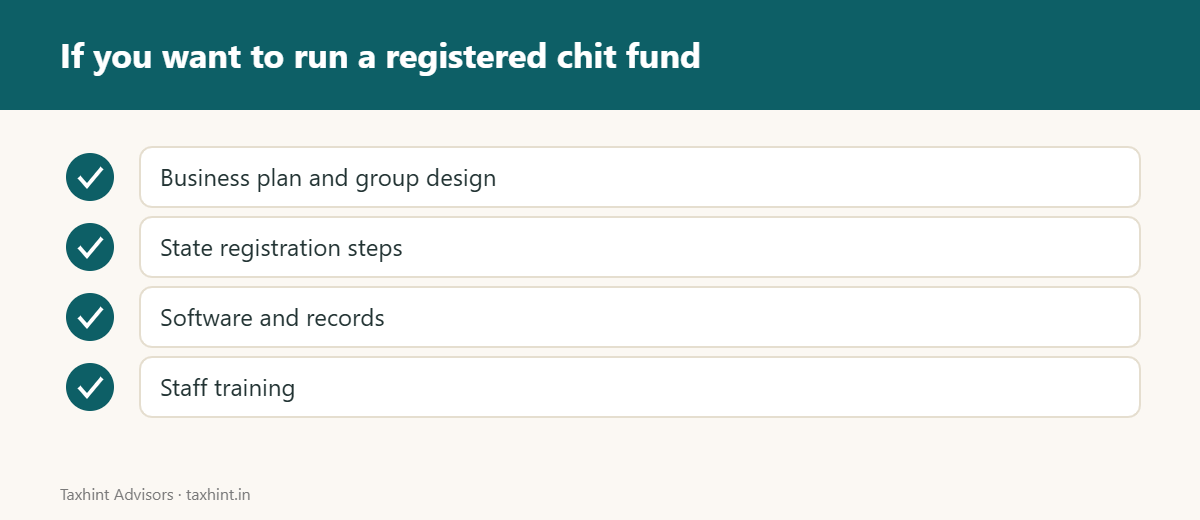
Taxhint helps with chit fund registration in all states and with chit fund software. Start with a clear business plan, then follow the registration steps for your state.
- Business plan and group design
- State registration steps
- Software and records
- Staff training
Warning signs to watch
Be careful if an organiser promises very high returns, refuses to give written terms, asks for cash without receipts or runs many groups without any registration. These are signs that you should ask questions or stay away.
If you have already put money in and have doubts, collect your receipts and messages and speak to a lawyer early.
- Promises of high returns
- No written terms
- Cash without receipts
- Many groups, no registration
Related: चिट फंड सॉफ्टवेयर (हिंदी) and how to start a chit fund business. Contact Taxhint: +91 93117 95484, [email protected], taxhint.in.
How to decide
If money is collected from many people and managed as a scheme, the legal position can be very different from a friendly circle. Ask a lawyer before you start. Please verify with your CA, CS or lawyer.
- Who collects the money
- How many people take part
- Is there a written agreement
Frequently asked questions
Is every kitty party a chit fund?
No. Small informal groups are usually different, but the law and state rules decide. Ask a lawyer.
Can I run a kitty as a business?
If you run it as a business for many people, it may need registration. Check with a lawyer.
Is a registered chit fund safer?
Registration brings legal protection and oversight, but you should still check terms and the organiser.
Does Taxhint help with chit fund registration?
Yes, Taxhint provides chit fund registration in all states and chit fund software.
For a demo or questions, contact Taxhint: +91 93117 95484 · [email protected] · taxhint.in