November 27, 2026 · Guides
Section 80P Deduction for Co-operative Societies (Now Section 149)
Section 80P is the main tax relief for co-operative societies. It lets a society deduct certain kinds of income before tax is worked out, so a well-run credit or marketing society can pay far less tax than a company with the same profit.
The law moved on 1 April 2026. The Income-tax Act, 2025 replaced the 1961 Act, and the 80P deduction now sits in section 149. This guide covers both, so you know which section your return will quote.
In this guide
- What 80P does
- Section 80P is now section 149
- Who can claim and who cannot
- Old regime or concessional regime
- Common mistakes
- How we help
- FAQs
What 80P does
Under the 1961 Act, 80P allows a co-operative society to deduct listed sums from its gross total income. The list depends on what the society does: credit to members, marketing members’ produce, processing, supply, and income from investments in other co-operative societies.
The deduction is not automatic for every rupee of profit. Each part has its own conditions, and some parts have a cap. That is why the books need to show income by activity, not one lump sum.
Section 80P is now section 149
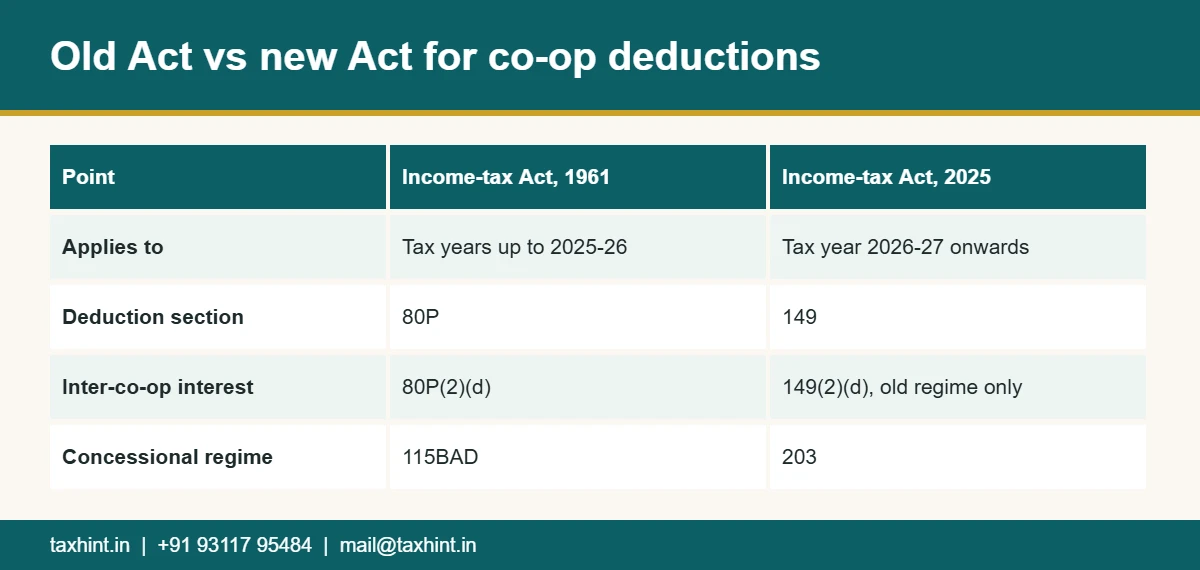
The Income-tax Act, 2025 came into force on 1 April 2026 and applies from tax year 2026-27. The 1961 Act still governs tax years up to 31 March 2026. So the return for FY 2025-26 still claims 80P, and the return for FY 2026-27 claims section 149.
Commentators read section 149 as the direct successor of 80P. The deduction on interest or dividend from investments in other co-operative societies moved to section 149(2)(d), and the Finance Bill, 2026 notes say that part is allowed only in the old tax regime. The new Act also names societies under the Multi-State Co-operative Societies Act, 2002 in its definition of co-operative society.
Who can claim and who cannot
Credit societies that lend only to members are the classic case. Marketing, processing and supply societies also have their own heads in the list. Co-operative banks are a different story: sub-section (4) of 80P kept the deduction away from co-operative banks other than primary agricultural credit societies. Check the matching clause of section 149 for the new years.
A credit society that takes deposits from non-members or behaves like a bank risks more than tax. RBI has warned that such societies are not licensed to do banking business.
Old regime or concessional regime
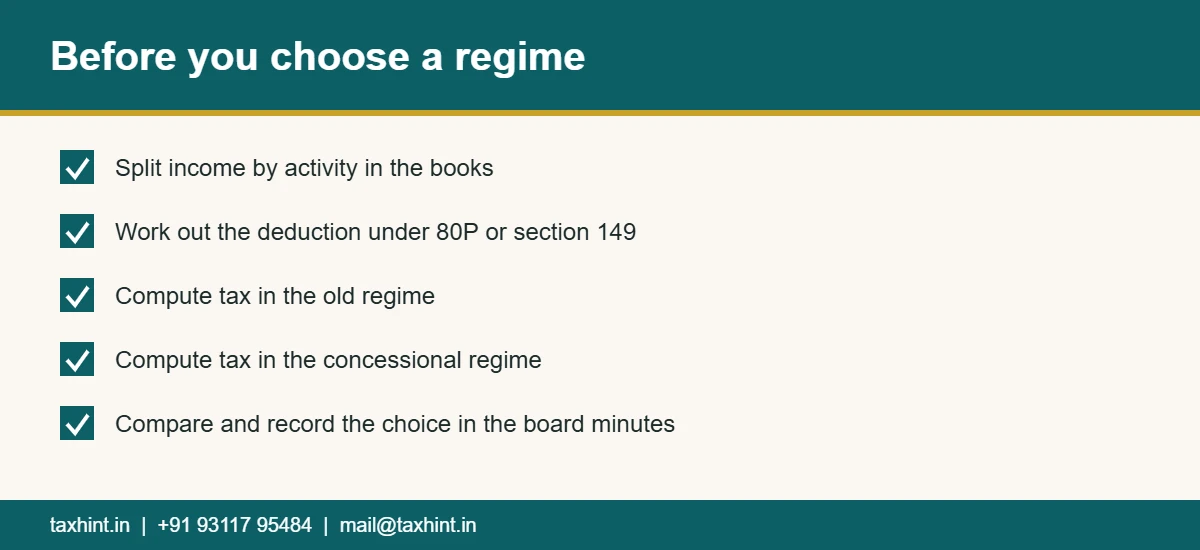
A co-operative society can choose the optional concessional tax regime, earlier section 115BAD and now section 203. The lower rate comes with a trade-off: most deductions, including the inter-co-op investment deduction, are not available in it.
The right choice depends on how much of your income 80P or section 149 actually covers. A society whose income is mostly from lending to members often does better in the old regime. Run both computations before you file.
Common mistakes
One lump of income. If interest from members, bank interest and other income sit in one ledger, the claim gets cut in assessment.
Quoting the wrong Act. From tax year 2026-27 the return and the audit papers should refer to section 149, not 80P.
Non-member business. Income from dealing with non-members can fall outside the deduction and draw the Registrar’s attention too.
How we help
We keep the books activity-wise, prepare the statutory audit papers and file the return with the right deduction. For a new society, see co-operative society registration; for yearly work, see annual compliance and co-operative society audit. Credit societies can read credit society rules next.
Frequently asked questions
Is section 80P still available?
Yes, for tax years up to 2025-26 under the 1961 Act. From tax year 2026-27 the same relief is in section 149 of the Income-tax Act, 2025.
Can a co-operative bank claim 80P?
Under 80P(4), co-operative banks other than primary agricultural credit societies could not claim it. Check section 149 for the new years.
Is interest from another co-op society deductible?
It was under 80P(2)(d). Under the new Act it is section 149(2)(d) and, as per the Finance Bill, 2026 notes, only in the old regime.
Should our society pick the concessional regime?
Only after comparing both computations. The lower rate removes most deductions.
Does a multi-state society get this deduction?
The new Act expressly includes societies under the Multi-State Co-operative Societies Act, 2002 in its definition of co-operative society.
Need help? Want your society’s return computed both ways? Get Free Consultation or call +91 93117 95484.