November 24, 2026 · Guides
Dealer Payout Tracking in Auto Finance: Keep It Clean

Dealers bring the files, so dealer payouts are a large and regular cost. When they are tracked in a notebook, disputes follow.
Link every payout to a loan file and a rule.
In this guide
Set the rules
Write them down.
- Basis of payout as agreed with each dealer.
- When it becomes payable, such as after disbursal or first EMI.
- Conditions such as early default.
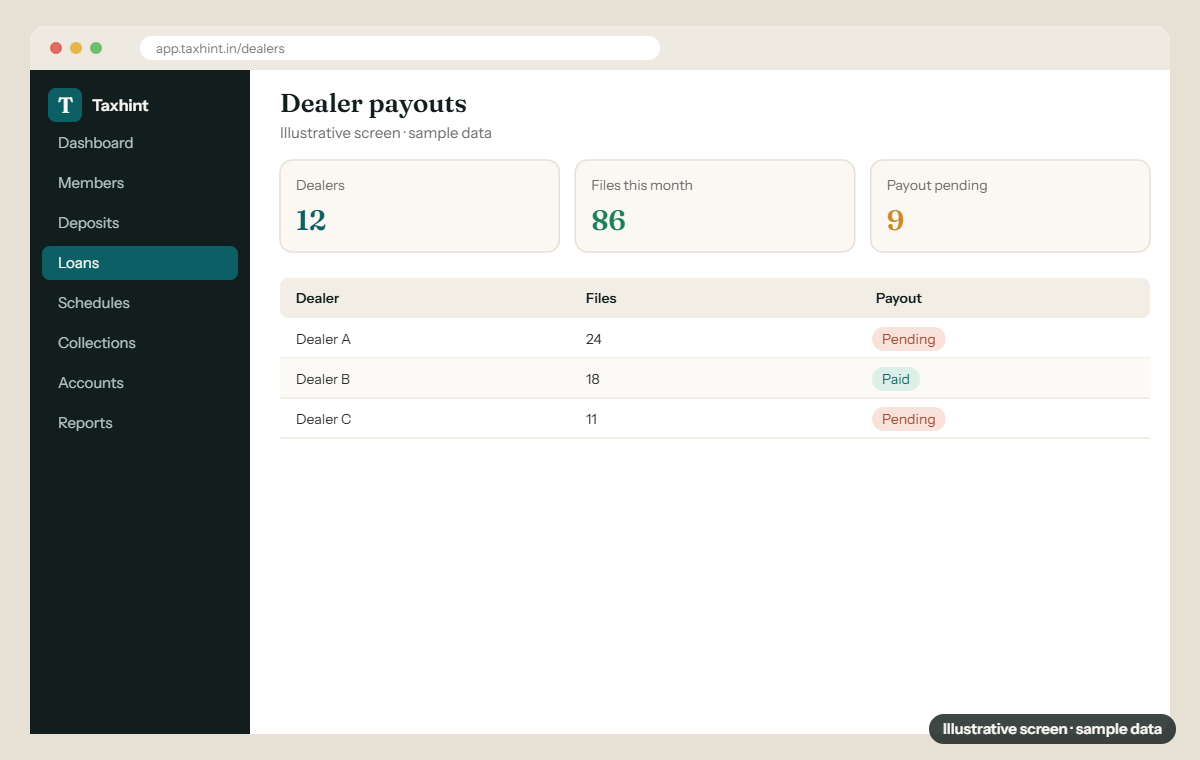
Track by file
No file, no payout.
- Dealer recorded on each loan.
- Payout computed by the rule.
- Approval and payment date noted.
- Statement shared with the dealer monthly.
Handle disputes
Use the record.
- File list and dates settle most questions.
- Adjustments logged with reasons.
- Review dealer quality by overdue rate.
Rules and practice differ by lender and state, so please verify with your CA before you finalise your policy.
| Item | Check |
|---|---|
| Dealer on file | Mandatory |
| Payout rule | Documented |
| Statement | Monthly |
Paying dealers correctly and on time
In auto finance, dealers bring the customers and may receive a payout for each loan. The payout depends on your agreement and on the loan being disbursed and sometimes on it staying good for a period. A clear tracking sheet or module prevents disputes and delays.
Illustrative example: a dealer sends twenty loans in a month. The system shows each loan, the payout rule applied, the amount due and the status, and generates one statement for the dealer.
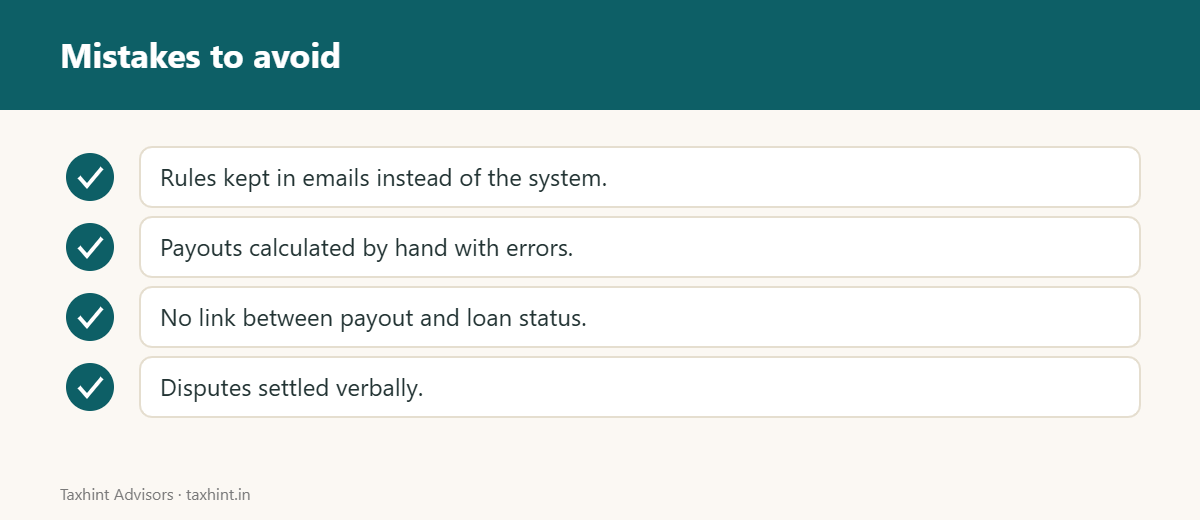
Mistakes to avoid
- Rules kept in emails instead of the system.
- Payouts calculated by hand with errors.
- No link between payout and loan status.
- Disputes settled verbally.
Steps to set it up
- Put the payout rules in a written agreement with each dealer.
- Enter the rules in the software.
- Generate monthly statements by dealer.
- Approve and pay with a record.
- Review the dealers with the highest overdue rates.
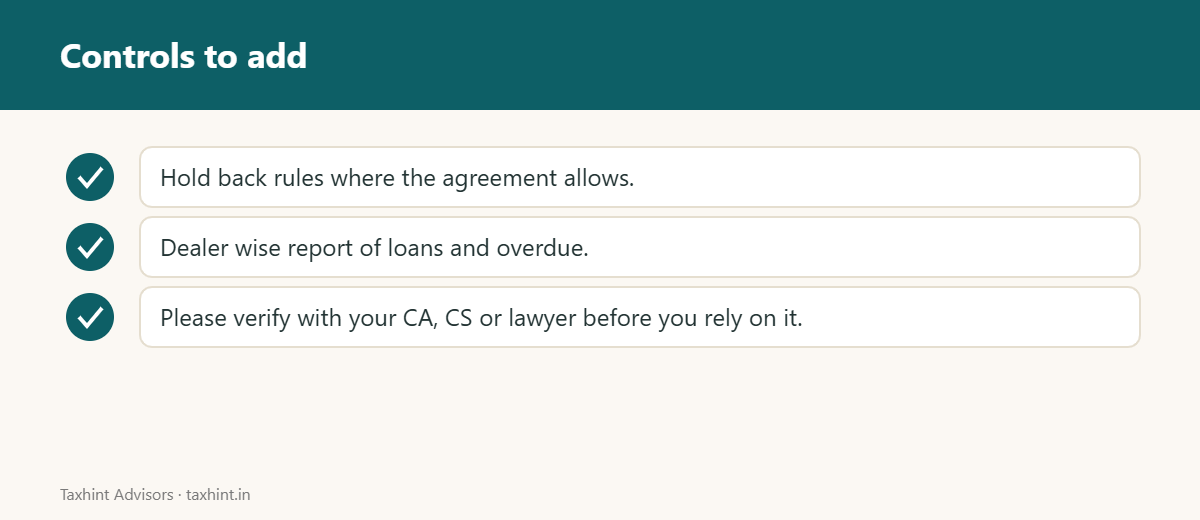
Controls to add
- Hold back rules where the agreement allows.
- Dealer wise report of loans and overdue.
- Please verify with your CA, CS or lawyer before you rely on it.
Keeping dealers informed
Send every dealer a monthly statement showing loans, payouts and any adjustments. Invite questions within a set number of days and answer in writing. A transparent process builds trust and reduces calls.
If a payout is held back, state the reason clearly with reference to the agreement.
- Monthly statement for each dealer.
- Questions answered in writing.
- Reasons stated for any hold.
When disputes happen
Disputes usually come from unclear rules, late statements or manual errors. Fix these three, and most disputes disappear. Keep every agreement version and note the date from which a new rule applies.
Where a dispute remains, a senior officer should review the loan records and the agreement and reply in writing.
Track how many disputes happen each quarter and what caused them.
A monthly closing routine
At month end, close the payout run: list loans disbursed, apply the rules, get approval, pay and send statements. Keep a signed copy of the approval. This habit makes audits easier and keeps dealers confident.
Compare the total payout with the total disbursal to spot any unusual changes quickly.
Reconciling with the accounts team
Share the payout statement with the accounts team before payment so that entries and tax treatment are handled correctly. Review this with your team once a quarter and update the checklist, because real cases always teach something the first draft missed.
- Statement to accounts
- Approval trail
- Payment reference recorded
FAQs
Why track payouts in software?
To avoid disputes and double payment.
Can I see dealer quality?
Yes, by overdue and default per dealer.
When should a payout be paid?
As per your agreement with the dealer.
Is there a standard rate?
No. It is a commercial matter between you and the dealer.
Want dealer wise files and payout statements? Book a demo of Taxhint auto loan software. Talk to Taxhint on +91 93117 95484 or [email protected], or visit taxhint.in.