November 24, 2026 · Guides
Loan Portfolio Concentration Limits: Track Exposure in Software

A portfolio can look healthy and still be risky if too much money sits with a few borrowers, one loan type or one village. Concentration limits keep that in check.
Some limits are set by the law or the regulator for certain lenders, so please verify yours. Others are your own policy.
In this guide
What to limit
Choose dimensions that match your business.
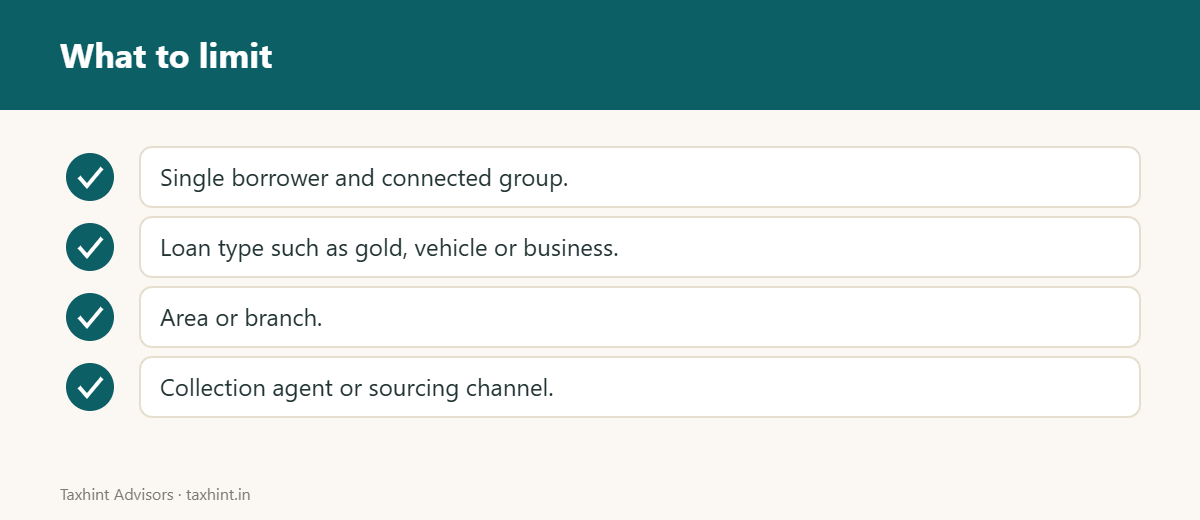
- Single borrower and connected group.
- Loan type such as gold, vehicle or business.
- Area or branch.
- Collection agent or sourcing channel.
Rules in this area change, so please verify the current position with your CA, CS or compliance officer.
How to set limits
Keep them simple.
- Look at current exposure by each dimension.
- Decide a limit as a share of portfolio or net worth.
- Record it in policy.
- Set warnings at 80 percent of the limit.
Monitor
Review often.
- Monthly exposure report.
- Alert on a new loan that crosses a limit.
- Approval needed for exceptions, with reason.
See MSME loan software and loan management software.
| Dimension | Check |
|---|---|
| Borrower | Top 10 share |
| Loan type | Share by product |
| Area | Share by branch |
| Agent | Overdue by agent |
Watching concentration in practice
Concentration means too much of your lending sits with one borrower, one sector, one area or one product. If that part goes bad, the whole book suffers. A simple report each month by borrower group, sector and branch shows where your exposure is building up.
Illustrative example: a lender finds that a large share of its book is in one trade in one town. It decides to slow new lending there and to grow in other areas until the share is more balanced.
Mistakes to avoid
- Tracking only the number of loans, not the amounts.
- Treating related borrowers as separate.
- No trigger for review when a share rises.
- Limits set once and never revisited.
Steps to set it up
- Decide the dimensions: borrower, group, sector, area, product.
- Set internal limits with your board or management.
- Build a monthly report in the software.
- Review any breach with a written note.
- Revisit limits every year.
Points to confirm
- Any limits that apply to your category under current rules.
- How related parties are defined for you.
- Please verify with your CA, CS or lawyer before you rely on it.
Keeping the board informed
Put a one page exposure summary in each management meeting. Show the top borrowers, the top sectors and the top areas, with the change from last month. A short, regular summary helps decisions and shows that the risk is being watched.
- Top borrowers and groups.
- Top sectors and areas.
- Change since last month.
A simple monthly routine
On a fixed date each month, export the loan list, group it by borrower group, sector and branch and compare the shares with last month. Write two lines on any change you notice and what you plan to do. Keep these notes together, because over a year they tell a clear story of how your risk has moved and why you made the decisions you did.
- Export and group on a fixed date.
- Two line note on any change.
- Keep notes in one folder.
FAQs
Why limit concentration?
One bad borrower or area should not hurt the whole portfolio.
Who sets the limits?
The law for some lenders, otherwise your board or policy. Please verify.
Can software block a loan?
It can warn or require approval above a limit.
How often should I review?
Monthly at least.
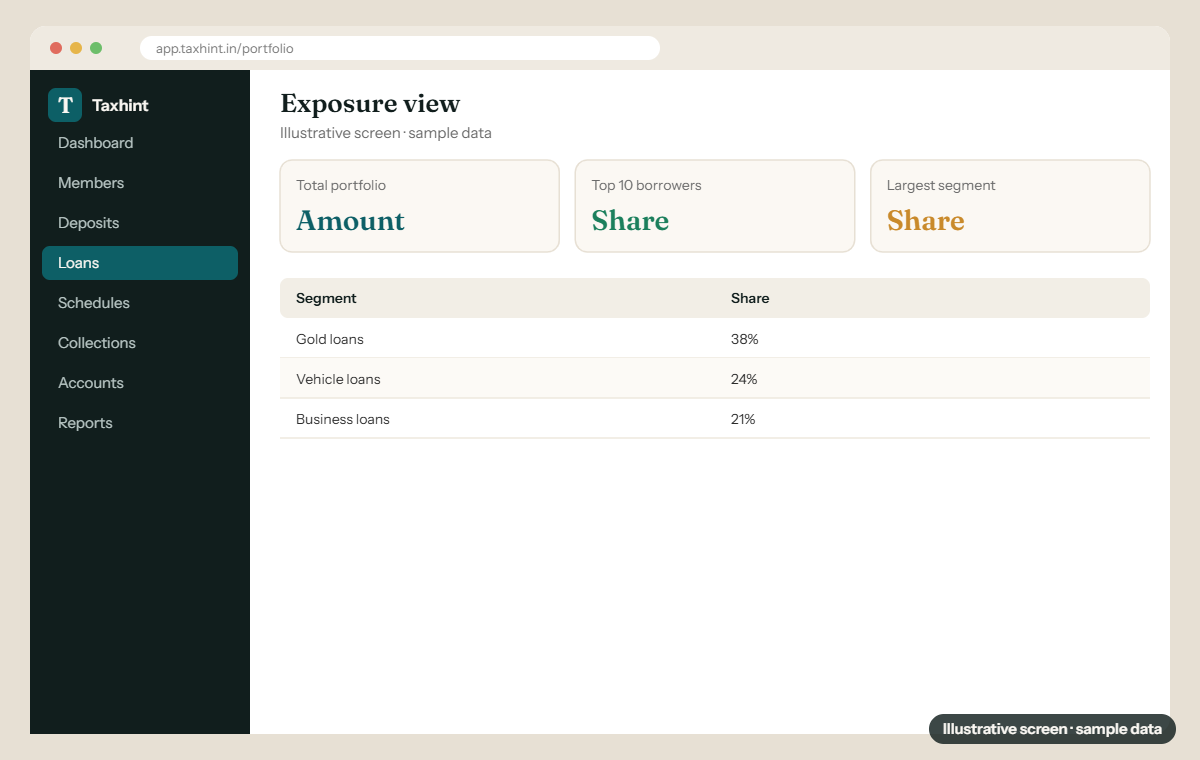
Want exposure by borrower, product and area on one screen? Book a demo of Taxhint loan software. Talk to Taxhint on +91 93117 95484 or [email protected], or visit taxhint.in.