November 23, 2026 · Guides
Section 8 Licence Revocation: What Microfinance Companies Must Avoid
Section 8 licence revocation is the risk a Section 8 microfinance company hopes never to face, because losing the licence also ends the RBI exemption that lets it lend without registration.
Here is what the law says, what follows a revocation, and the practical habits that keep a lender well clear of it.
Section 8 licence revocation is rare, but the habits that prevent it are the same ones that keep lenders and auditors comfortable.
In this guide
- When can the licence be revoked?
- What happens after revocation
- Practical risks for microfinance companies
- How to protect the licence
- A worked example
- If a show-cause notice arrives
- FAQs
When can the licence be revoked?
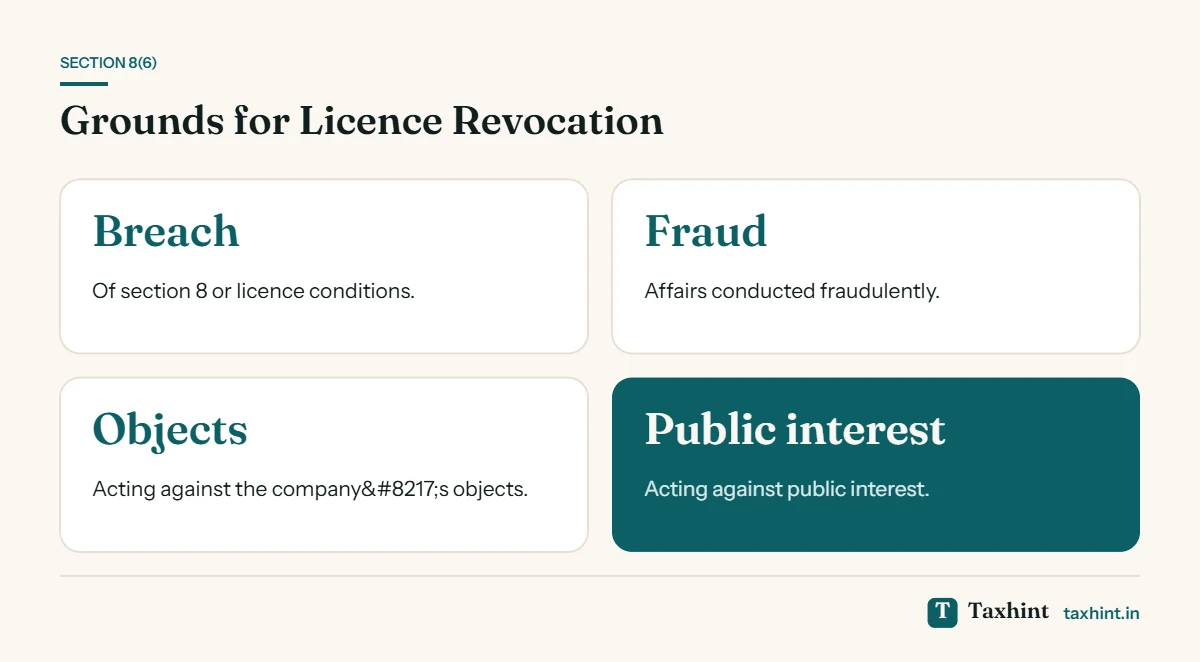
Under section 8(6) of the Companies Act, 2013, the Central Government may revoke a Section 8 licence if the company breaches the section or its licence conditions, or conducts its affairs fraudulently, against its objects or against the public interest. The company must be given a reasonable opportunity of being heard first.
What happens after revocation
Under section 8(7), the government may order the company to be wound up or amalgamated with another Section 8 company with similar objects, again after a hearing. The Registrar is informed and the company can no longer use the privileges of a Section 8 company.
For a microfinance lender, the immediate problem is the RBI exemption: it depends on holding a Section 8 licence. Without it, continuing to lend would need RBI registration.
Practical risks for microfinance companies
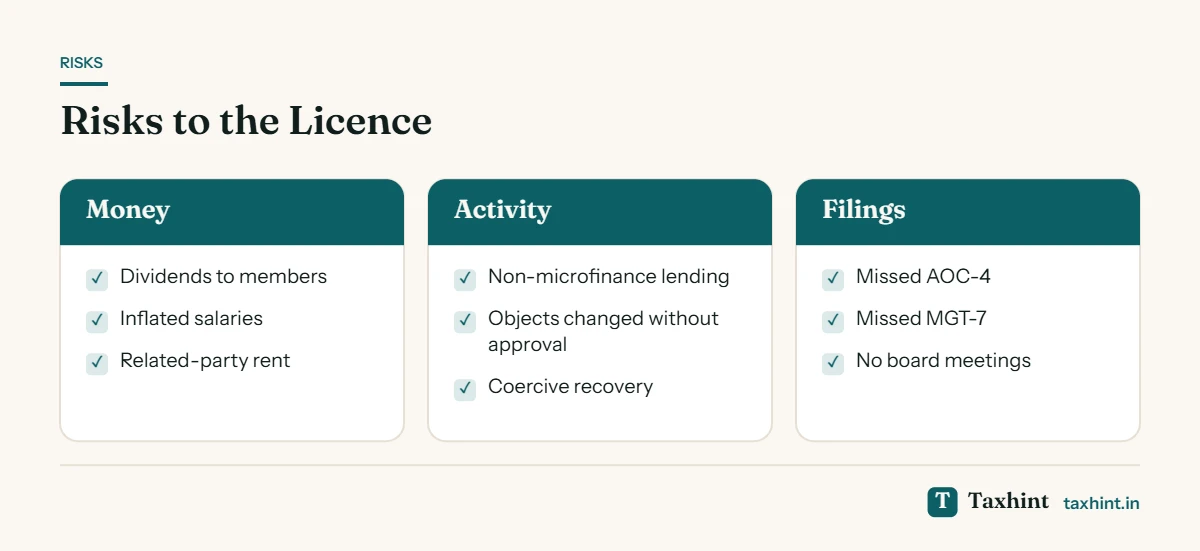
- Profit leaking to members. Paying dividends, inflated salaries or rent to promoters breaks the core Section 8 rule. See our post on salary and dividend rules.
- Drifting from objects. Lending outside microfinance, or for purposes your objects do not cover.
- Changing objects without approval. Altering the MoA objects needs government approval.
- Harsh recovery. Repeated coercion complaints can be seen as acting against the public interest.
- Filing defaults. Missed AOC-4 or MGT-7 also cost the company its board-meeting relaxations.
How to protect the licence
Keep the board’s attention on the exemption at every meeting, apply all income to the objects, keep related-party payments at arm’s length and approved, follow a written fair practices code, and file on time. Our Section 8 compliance service and compliance calendar help with the last part.
A worked example
Suppose a Section 8 lender pays its promoter director a salary that doubles in a year when the surplus doubles, with no board approval and no change in his role. To an inspector, that looks like profit passing to a member. If complaints about harsh recovery arrive the same year, the company has handed the government two reasons to issue a show-cause notice. Fixing pay approval and recovery practice early removes both.
If a show-cause notice arrives
- Read it carefully and note the deadline.
- Collect board minutes, policies, accounts and filings.
- Prepare a written reply addressing each ground, with evidence.
- Ask for a personal hearing.
- Fix the underlying issue at once and show that in the reply.
Take professional help; the reply decides whether Section 8 licence revocation goes further.
FAQs
Can a Section 8 licence be revoked?
Yes. The Central Government can revoke it under section 8(6) for breach of the section or licence conditions, fraud, or acting against objects or public interest, after giving the company a hearing.
What happens to the company after revocation?
The government may order winding up or amalgamation with another Section 8 company with similar objects.
Does revocation affect the RBI exemption?
Yes. The exemption depends on holding a Section 8 licence, so lending would then need RBI registration.
How can a microfinance company avoid revocation?
Apply income only to objects, avoid profit to members, stay within objects, follow fair recovery practices and file on time.
Planning a microfinance company or already running one? Our CAs and CSs handle registration, RBI work and yearly compliance. Get Free Consultation or WhatsApp +91 93117 95484.