November 23, 2026 · Guides
Section 8 vs Trust vs Society for Microfinance: Which Fits?
Section 8 vs trust vs society for microfinance is a question many NGOs face when their lending grows. All three are not-for-profit forms, but they are not equal for running a loan book.
Here is how they compare for lending specifically.
In our experience, the Section 8 vs trust vs society for microfinance question is usually settled by two things: the RBI exemption and what banks will lend to.
In this guide
- The RBI angle
- Governance and transparency
- Funding and borrowing
- Side by side
- Moving a programme into Section 8
- A worked example
- Tax registrations
- FAQs
The RBI angle
RBI’s exemption for not-for-profit microfinance lenders is written for companies licensed under Section 8 that lend only microfinance loans, take no public deposits and keep assets below ₹100 crore. Trusts and societies are not companies under the Companies Act, so they sit outside that specific exemption, and state money-lenders laws may treat them differently. See state microfinance laws.
Governance and transparency
A Section 8 company files audited accounts and annual returns publicly with the MCA, has a board with legal duties, and is watched by the Registrar. Trusts and societies are governed by state laws that vary widely in reporting. Banks and funders lending to a microfinance programme generally find a Section 8 company easier to assess.
Funding and borrowing
Lenders and impact investors usually prefer to lend to a company with a clear board and MCA filings. A Section 8 company cannot raise equity that earns dividends, but it can borrow and receive grants. Trusts and societies can also receive grants, but borrowing for on-lending is often harder.
Side by side
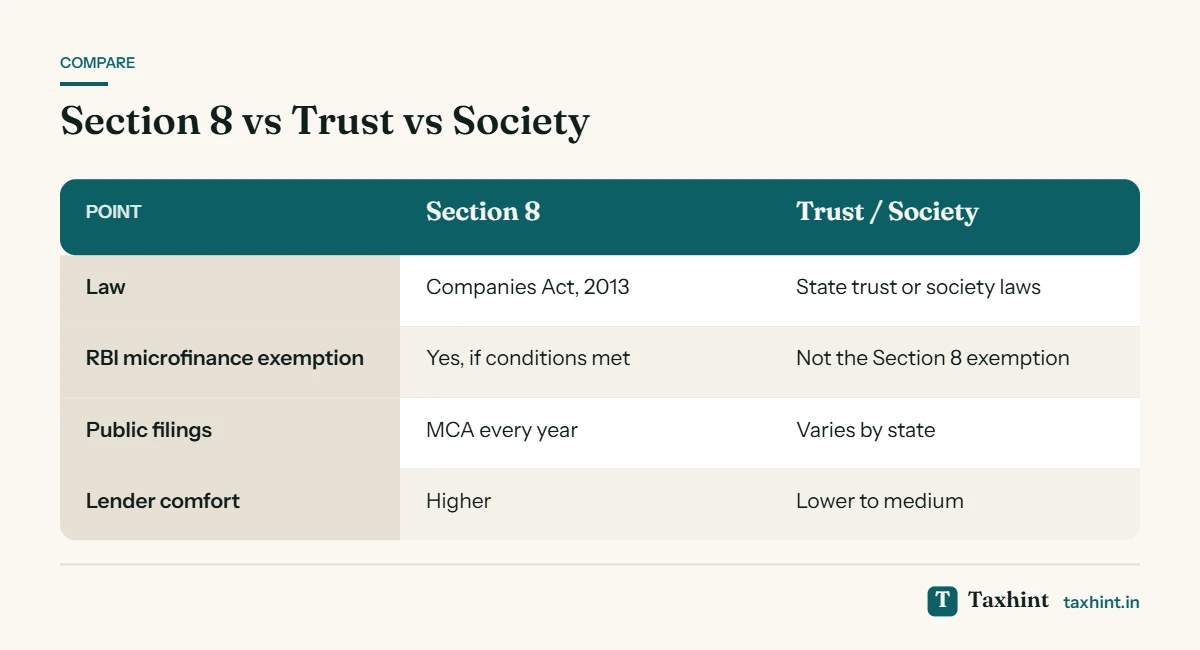
| Point | Section 8 company | Trust | Society |
|---|---|---|---|
| Law | Companies Act, 2013 | State trust law / Indian Trusts Act | Societies Registration Act / state law |
| RBI microfinance exemption | Yes, if conditions met | Not the Section 8 exemption | Not the Section 8 exemption |
| Public filings | MCA filings every year | Varies by state | Varies by state |
| Lender comfort | Higher | Lower | Medium |
Moving a programme into Section 8
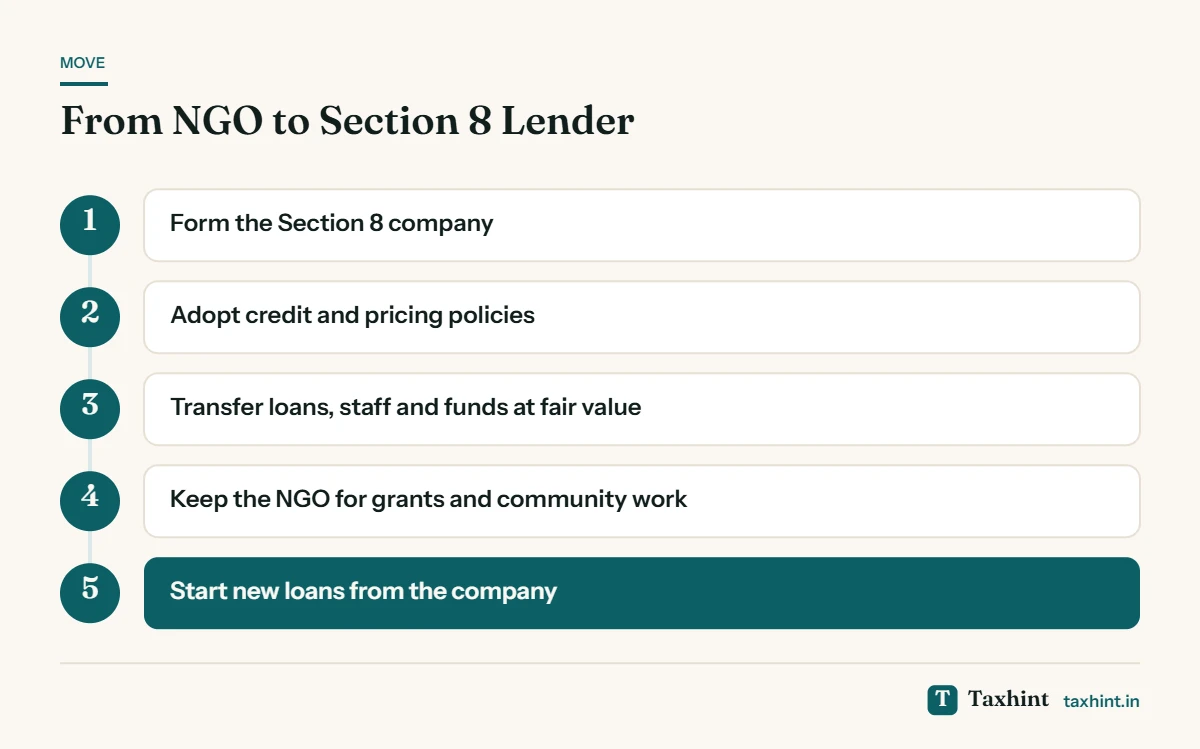
Many NGOs keep their trust or society for grants and community work, and set up a Section 8 company for lending. The loan book, staff and funds move under a planned transfer at fair value. See Section 8 microfinance company registration and our comparison of microfinance company vs credit co-operative.
A worked example
A trust in Rajasthan has run small loans for women’s groups for years from grants. A bank now offers a term loan for on-lending, but asks for a company with MCA filings and a board. The trustees form a Section 8 company, adopt credit and pricing policies, and move new lending into it while the trust keeps its training and health work. That is how most Section 8 vs trust vs society for microfinance decisions play out in practice.
Tax registrations
All three forms can seek 12A and 80G registration under the Income-tax Act, so tax alone rarely decides the choice. What changes is the lending framework and lender comfort, which favour the Section 8 company.
FAQs
Which is best for microfinance: Section 8, trust or society?
For a lending programme, a Section 8 company usually fits best because of the RBI exemption written for it, its governance and lender comfort.
Does the RBI exemption cover trusts and societies?
The exemption for not-for-profit microfinance lenders is written for Section 8 companies meeting its conditions.
Can a trust run microfinance lending?
Many have, but state laws and funding make it harder. Moving lending into a Section 8 company is common.
Can an NGO keep its trust and also form a Section 8 company?
Yes. Many keep the trust or society for grants and use a Section 8 company for lending.
Planning a microfinance company or already running one? Our CAs and CSs handle registration, RBI work and yearly compliance. Get Free Consultation or WhatsApp +91 93117 95484.