NBFC-Factor Registration (Factoring Licence)
Factoring means buying a business’s trade receivables and paying it upfront. A company that wants to do this as its main business needs an RBI Certificate of Registration as an NBFC-Factor under the Factoring Regulation Act, 2011. We set up the company, the policies and the RBI filing.
What an NBFC-Factor is
An NBFC-Factor is an NBFC whose principal business is factoring. RBI checks two numbers: at least 50% of total assets must be factoring assets, and at least 50% of gross income must come from factoring.
For MSME receivables
Factors buy invoices from suppliers, often MSMEs, and collect from the buyer later. Cash flow for the seller, fee income for the factor.
Two ways to factor
A company can register as an NBFC-Factor, or an existing NBFC-ICC with total assets of ₹1,000 crore or more can apply for a CoR to factor under the Act.
Registered assignments
Factoring transactions are registered with the Central Registry (CERSAI) as the Act requires.
Key RBI conditions
| Condition | Requirement |
|---|---|
| Principal business | At least 50% of total assets in factoring and at least 50% of gross income from factoring |
| Net owned fund | ₹10 crore regulatory minimum under scale-based regulation |
| Deposits | Non-deposit taking |
| NBFC-ICC route | Total assets of ₹1,000 crore or more, NOF and compliance record |
Sources: Registration of Factors (Reserve Bank) Regulations, 2022 and RBI’s scale-based regulation framework.
Documents required
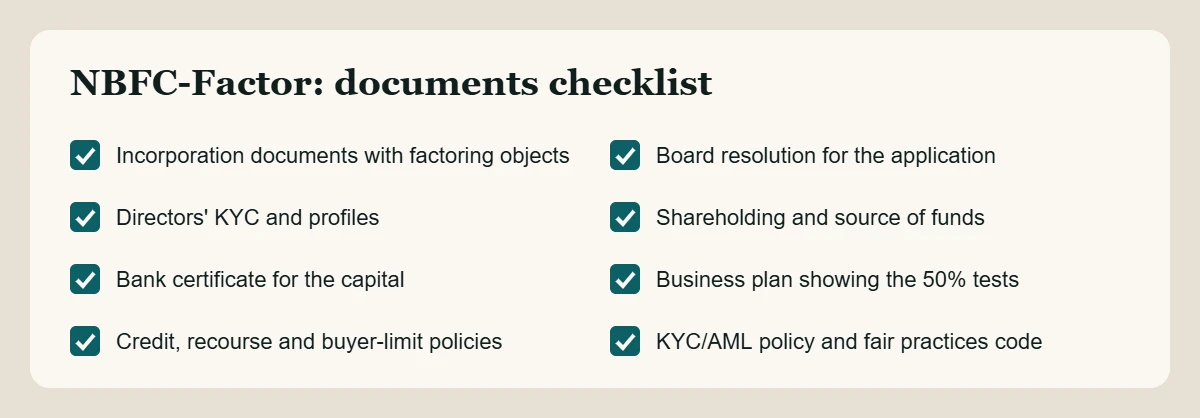
- Incorporation documents with factoring objects
- Board resolution for the application
- Directors’ KYC and profiles
- Shareholding and source of funds
- Bank certificate for the capital
- Business plan showing the 50% tests
- Credit, recourse and buyer-limit policies
- KYC/AML policy and fair practices code
How registration works
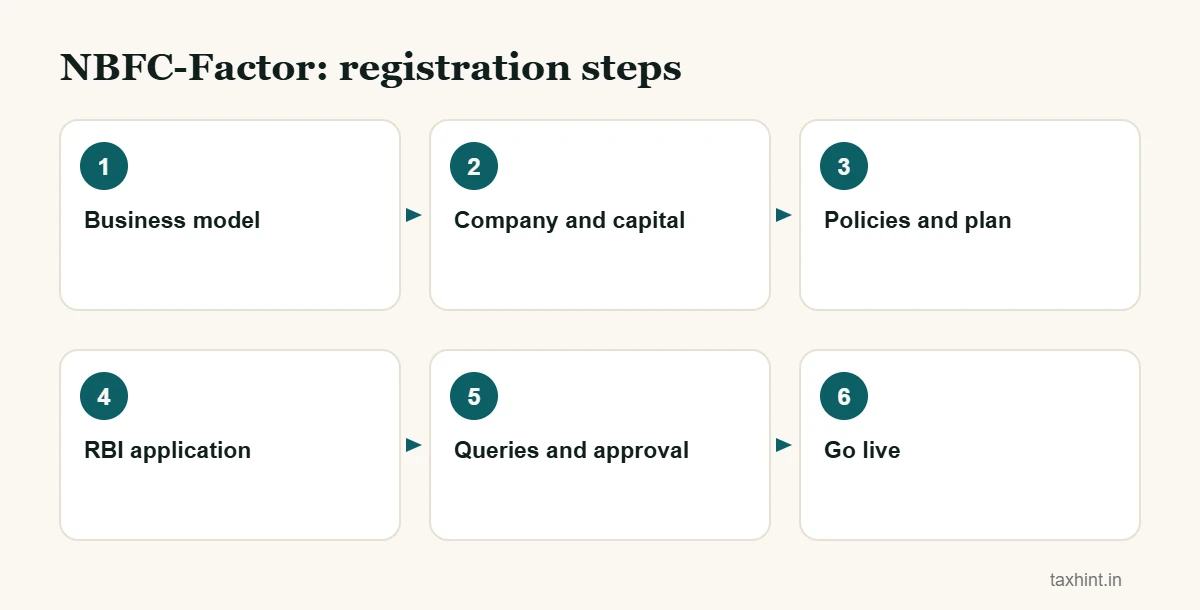
Business model
Decide recourse or non-recourse, the buyer segments and whether you will use TReDS platforms.
Company and capital
Incorporate with factoring objects and bring in the net owned fund.
Policies and plan
Draft buyer limits, credit appraisal and collection policies plus a plan that meets the 50% tests.
RBI application
File the CoR application on the PRAVAAH portal.
Queries and approval
Answer RBI queries; on approval you receive the CoR as NBFC-Factor.
Go live
Register on CERSAI, set up software and start buying receivables.
Need software too?
Invoice-wise limits, ageing and buyer collections need a proper system. See our loan management software.
Frequently asked questions
What is the principal business test for a factor?
At least 50% of total assets must be in the factoring business and at least 50% of gross income must come from factoring.
What is the minimum NOF?
The regulatory minimum for an NBFC-Factor under scale-based regulation is ₹10 crore.
Can a normal NBFC do factoring?
An NBFC-ICC with total assets of ₹1,000 crore or more can apply to RBI for a CoR to factor. Smaller NBFCs register or convert to NBFC-Factor.
Is factoring the same as bill discounting?
They are close, but under factoring the factor takes over the receivable and its collection. The legal form decides which rules apply.
Is the first consultation free?
Yes. We check your plan against the factoring tests before you commit capital.
Ready to begin?
Planning a factoring business? Share your target buyers and capital plan. A CA or CS will check the 50% tests against your model first. Call +91 93117 95484, email [email protected], or fill in the form.