November 26, 2026 · Guides
Co-operative Society Registration Cost: What to Budget For
Registering a co-operative society usually costs far less than a company-based lender, but it is not free, and the share capital you collect is only the start. The Registrar’s fee, documents, bye-law work and the first year of audit and meetings all need money.
Here are the cost heads, so you can plan before the promoters’ meeting. For the service, see co-operative society registration, and for the steps, how to register a co-operative society.
In this guide
- Cost heads at a glance
- 1. Share capital from members
- 2. Registration fee and stamp
- 3. Documents and drafting
- 4. First-year running costs
- 5. How it compares with other routes
- Where to save and where not to
- A planning example
- FAQs
Cost heads at a glance
Use this list to build your budget. Amounts depend heavily on your state and type of society.
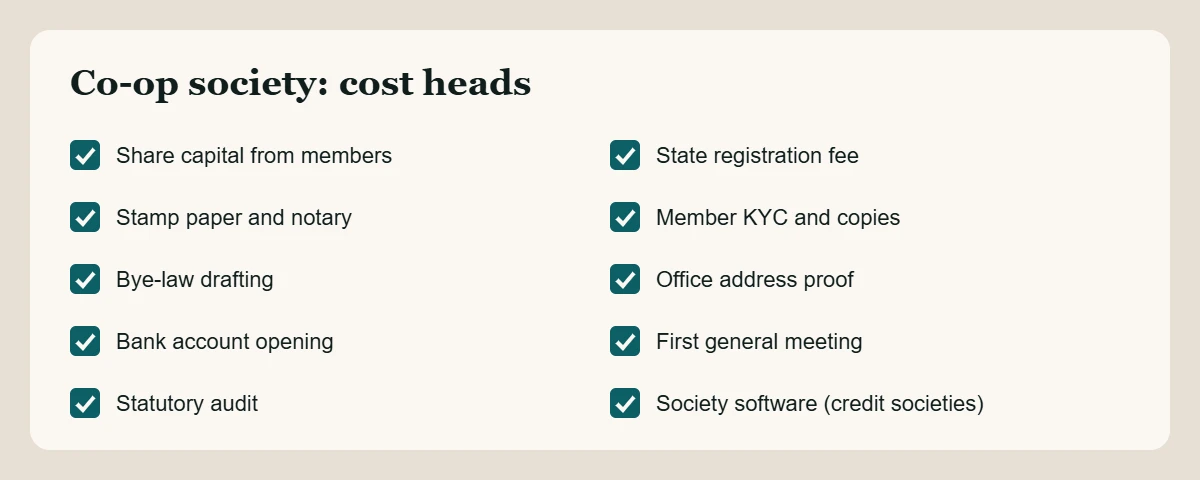
1. Share capital from members
Each promoter buys shares in the society. The minimum share capital and share value are set by the state rules and your bye-laws. This money belongs to the society and becomes its own funds. For a credit society, it is the base on which deposits and loans are built.
2. Registration fee and stamp
States charge a registration fee, often linked to the type of society or its share capital, and may ask for stamp paper for affidavits or agreements. We confirm the current fee for your state at the time of filing, because states revise these from time to time.
3. Documents and drafting
Member KYC copies, notarised affidavits where asked, the office address proof and NOC, and drafting the bye-laws. Bye-laws based on the state model need less work; a society with unusual objects needs more. Our fee depends on the state and the type of society, so we quote after a free consultation.
4. First-year running costs
After registration the society needs a bank account, registers, a general meeting, a statutory audit and returns to the Registrar. Credit and thrift societies should add software from day one. See co-operative society audit and credit and thrift society software.
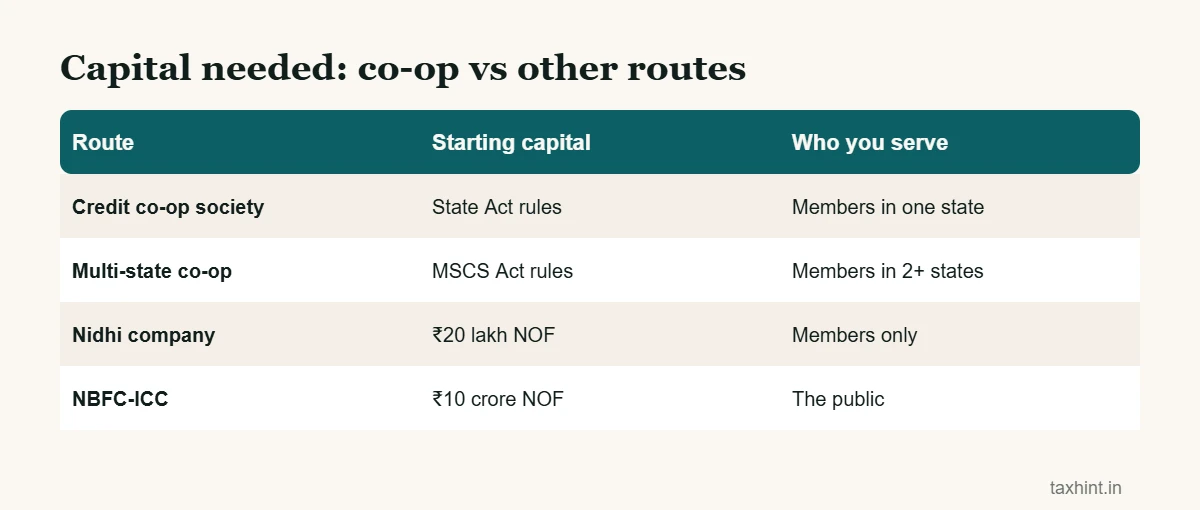
5. How it compares with other routes
A co-op is often the lowest-capital way to run member savings and loans. The trade-off is that you work only with members and under state co-op law.
Where to save and where not to
Save by using the state’s model bye-laws, keeping the first area of operation small, and collecting all member documents in one go. Do not save on audit, member records or proper accounts. A society that gets a poor audit class or falls behind on returns faces questions from the Registrar and loses member trust. Our society annual compliance plan keeps the yearly work on track.
If your plan grows beyond one state later, the society can move to multi-state status; see multi-state co-operative society registration.
A simple planning example
A group of 25 small traders plans a credit society in their town. They agree each will buy a fixed number of shares, which gives the society its first own funds. On top of that they budget for the state fee, stamp and notary charges, bye-law drafting, and a modest amount for the first audit and general meeting. They also set aside money for software so the first deposits and loans are recorded properly from day one.
The biggest surprise for most groups is not the registration itself but the running cost in year one. Audit, returns and meetings are yearly duties under the state Act, and planning for them upfront avoids a scramble at the end of the financial year.
Frequently asked questions
How much does it cost to register a co-operative society?
It depends on the state, the type of society and its share capital. The main heads are share capital, the state fee, documents and drafting.
Is share capital an expense?
No. It belongs to the society and forms part of its own funds.
Are registration fees the same in every state?
No. Each state sets its own fee and revises it from time to time.
What do you charge?
It depends on the state and society type. We quote after a free consultation.
Is a co-op cheaper than a Nidhi company?
Usually the starting capital is lower, but the rules differ. Compare both on our fintech registration services page.
Next step: Want a cost estimate for your society? Tell us the state and type, and we will list each head. Call +91 93117 95484, email [email protected], or use the form on our co-operative society registration page.