November 26, 2026 · Guides
Documents Required for Co-operative Society Registration
A co-operative society file is mostly paperwork from the promoters: who they are, what they agreed, and the money they put in. The Registrar checks each item against the state’s rules, and a single missing signature can send the file back.
Here is the set we prepare for co-operative society registration, with notes on the items that cause trouble. If you are just starting, read how to register a co-operative society first.
In this guide
- The checklist
- Application form
- Bye-laws
- Member list and KYC
- Share money and bank proof
- Meeting resolution and address proof
- Where the documents fit in the process
- After registration
- Mistakes that send files back
- Small things that save time
- FAQs
The checklist
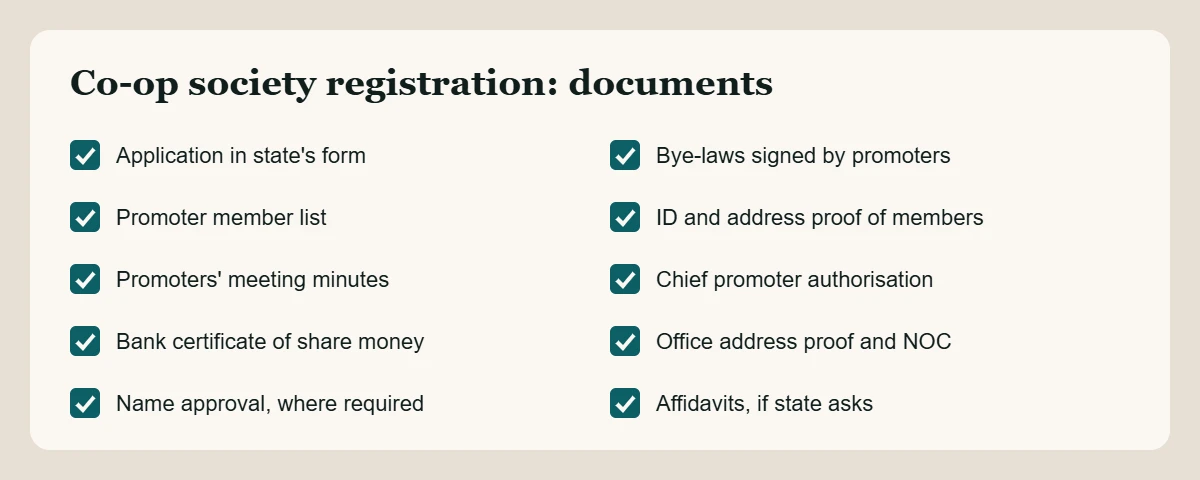
Most states ask for these. Your state may add a form or two.
Application form
Each state has its own prescribed form, often online now. It carries the society’s proposed name, address, area of operation, objects, and the chief promoter’s details. Fill the area of operation carefully: it decides who can become a member later.
Bye-laws
Proposed bye-laws, usually based on the state’s model bye-laws, signed by every promoter on each page or at the end, as the state requires. They must match the objects in the application. Our guide on bye-laws covers the clauses that matter.
Member list and KYC
A list of promoter members with name, father’s or spouse’s name, address, occupation, shares taken and signature, plus ID and address proof for each. Some states want members from separate families or from within the area of operation. Duplicate addresses and missing signatures are the usual problems.
Share money and bank proof
Promoters pay their share money into a bank account opened in the proposed society’s name or the chief promoter’s name, as your state allows. A bank certificate showing the amount goes with the file.
Meeting resolution and address proof
Minutes of the promoters’ meeting that approved the name, bye-laws and chief promoter, and proof of the office address with an owner’s NOC if the place is rented or borrowed.
Where the documents fit in the process
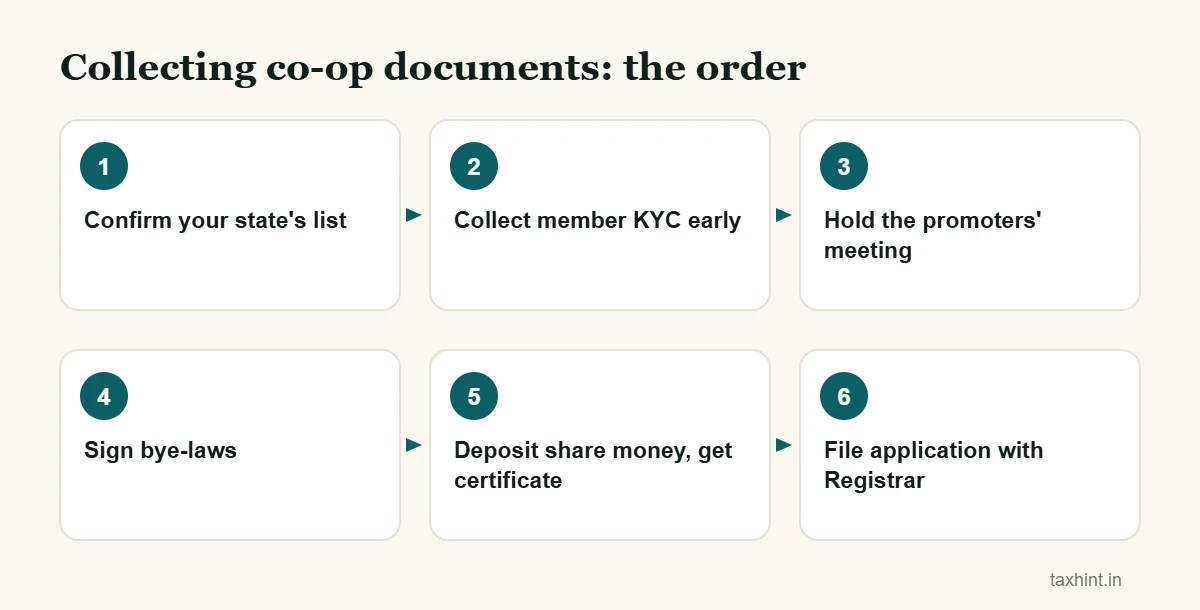
Documents are collected over the steps below. Starting early on member KYC saves the most time.
After registration
Keep copies of everything. The same member details become your share register, and the bye-laws govern every meeting and audit. Societies that take deposits should set up records properly from the start; see credit and thrift society software. Yearly duties are covered under society annual compliance.
Mistakes that send files back
From the files we have handled, these are the reasons Registrars most often return a co-operative society application:
- Members outside the area of operation. If the bye-laws say the society works in one block or district, members living elsewhere can be rejected.
- Two members from one family where the state requires separate families.
- Signatures that do not match the ID proof, or a promoter who signed the member list but not the bye-laws.
- Objects that go beyond co-operative work, such as a credit society that also wants to run a shop without saying so.
- An address proof that is out of date or a rented office without the owner’s consent.
Small things that save time
Make one master sheet of members with every detail the form asks for, and fill all documents from that one sheet. It keeps spellings and addresses the same everywhere. Collect two sets of signatures at the promoters’ meeting, so you are not chasing people later. Keep the bank certificate dated close to the filing date.
If your society will run savings and loans, plan the share structure early. The share capital you collect now becomes part of the society’s own funds, and the bye-laws should say clearly how new members buy shares later. Our guide to starting a credit co-operative society covers this.
Frequently asked questions
Do all states ask for the same documents?
No. The core set is similar, but each state’s rules add their own forms and conditions.
Who signs the bye-laws?
The promoter members, in the way your state’s rules require.
Can the office be in a rented place?
Yes, with a rent agreement or the owner’s NOC, as the state asks.
Can the application be filed online?
Many states now take applications online. We file in whatever way your state allows.
Can you check my documents?
Yes. Share them and we will mark what is missing, free for the first review.
Next step: Want us to check your co-op documents? We will match them against your state’s list. Call +91 93117 95484, email [email protected], or use the form on our co-operative society registration page.