November 24, 2026 · Guides
Education Loan Co-Borrower: Who Can Be One and Why It Matters
In most education loans the student has no income, so a parent or guardian joins as co-borrower. The co-borrower’s income and credit history carry the application, and the co-borrower is equally liable for repayment.
Scheme rules and lender policies differ. Please verify the details with your CA or the scheme provider.
Here is how to handle the co-borrower side properly.
In this guide
Role of the co-borrower
Equal responsibility.
- Signs the agreement along with the student.
- Income and credit history assessed.
- Liable for the full loan if the student does not pay.
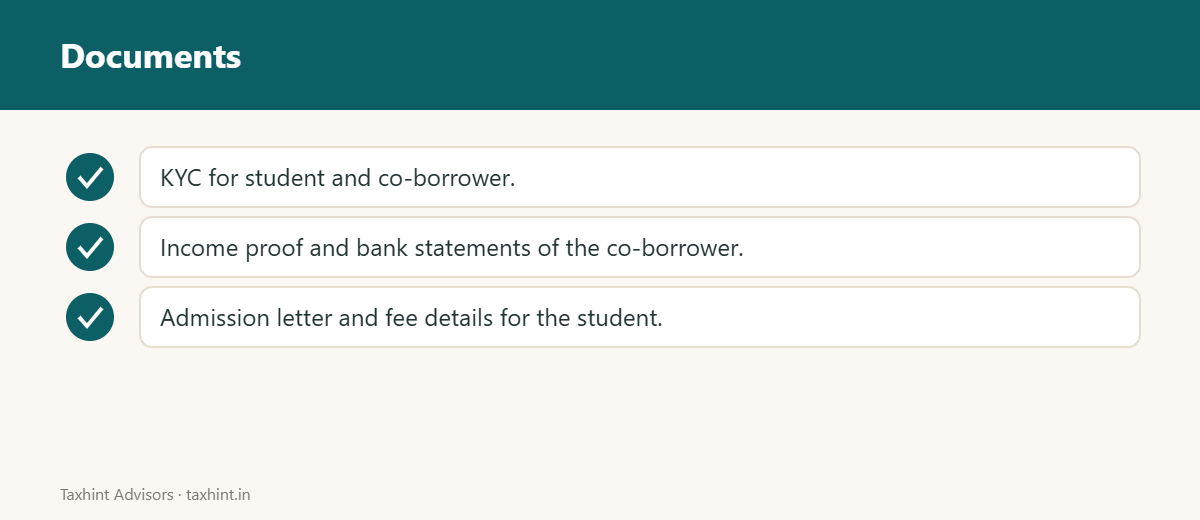
Documents
Collect for both.
- KYC for student and co-borrower.
- Income proof and bank statements of the co-borrower.
- Admission letter and fee details for the student.
Records and follow-up
Keep both in the file.
- Both borrowers linked to the same loan.
- Contact details for both and for a reference.
- Reminders go to the co-borrower too.
- Study progress or result updates as per policy.
During the moratorium
Do not lose touch.
- Track course end date and moratorium end date.
- Inform both borrowers before repayment starts. See moratorium handling.
Practice and rules differ by lender, entity type and state, so please verify with your CA or CS before you finalise your policy.
| Party | Responsibility |
|---|---|
| Student | Study and repay after course |
| Co-borrower | Equal liability and income support |
Why a co-borrower is usually needed
Students often have no income, so the lender looks at a co-borrower, usually a parent or guardian, to share responsibility for repayment. The co-borrower is legally linked to the loan, so the role must be explained clearly.
Illustrative example: a lender explains to the parent that they are responsible for repayment if the student does not pay, and records that the parent understood.
Mistakes to avoid
- Not explaining the legal responsibility of the co-borrower.
- Missing KYC or income proof of the co-borrower.
- Not recording the relationship.
- Contacting only the student for dues.
Checklist
- Co-borrower identity and address verified.
- Income proof checked as per policy.
- Relationship recorded with a proof.
- Co-borrower signs the agreement.
- Both are listed in the system for reminders.
Points to confirm
- Your policy on who may be a co-borrower.
- Legal advice on the agreement format.
- Please verify with your CA, CS or lawyer before you rely on it.
Talking to families
Explain in simple words how the moratorium and repayment work and what happens if payments are missed. Give the family a schedule and a contact person, and invite questions.
A family that understands the terms is more likely to repay on time.
- Simple explanation
- Schedule in hand
- Contact person
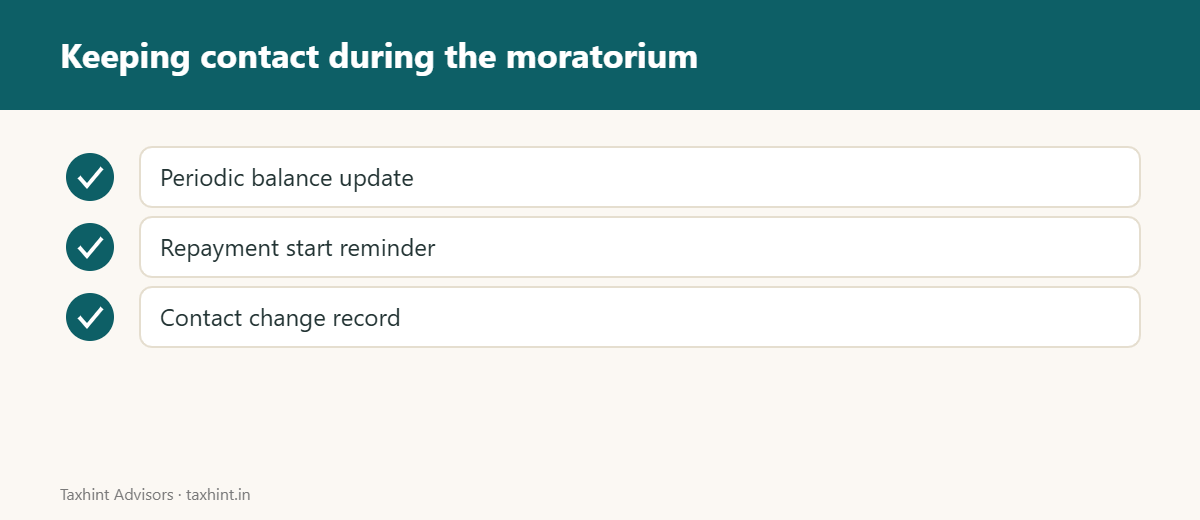
Keeping contact during the moratorium
During the study period, send the family a short update on the outstanding amount and the date from which repayment starts. Review this with your team once a quarter and update the checklist, because real cases always teach something the first draft missed.
- Periodic balance update
- Repayment start reminder
- Contact change record
Changes during the loan
If the co-borrower changes address, income or contact, or in rare cases cannot continue, the file must be updated. Ask the family to inform you. Review this with your team once a quarter and update your checklist, because real cases teach more than the first draft.
Any change in the parties needs fresh documents and approval as per your policy.
- Address and contact updates
- Fresh documents when needed
- Approval recorded
FAQs
Why is a co-borrower needed?
The student usually has no income at the time of the loan.
Is the co-borrower fully liable?
Yes, as per the agreement. Please verify with a lawyer.
Can a sibling or relative be a co-borrower?
Depends on lender and scheme rules.
Who gets the reminders?
Both borrowers.
Want students and co-borrowers linked in one loan record? Book a demo of Taxhint loan software. Talk to Taxhint on +91 93117 95484 or [email protected], or visit taxhint.in.