November 24, 2026 · Guides
Gold Loan Scheme Design: Tenure Slabs and Interest Options

A gold loan scheme is a promise to the customer. If it is confusing, you will have disputes at release time. If it is too complicated, staff will make mistakes.
A few clear schemes beat many clever ones. Here is how to design them.
In this guide
Start with the customer need
Most borrowers want quick cash for a short period. Others want a longer period with small monthly payments.
- A short scheme of a few months for urgent needs.
- A medium scheme with interest paid monthly.
- A longer scheme with interest at closure, if your rules allow.
- Keep to three schemes at most in the beginning.
Define the slabs
Slabs vary rate or loan to value by amount or tenure.
- Loan amount slabs, for example small and large loans.
- Tenure slabs, where longer tenure may carry a different rate.
- A maximum loan to value, within the limit that applies to you.
- Rules for what happens on renewal.
Limits and rate rules differ by entity, so please verify them with your CA or CS.
Charges and how to show them
Hidden charges cause the most complaints.
- List every charge: processing, valuation, late and release charges.
- Print the scheme terms on the receipt.
- Explain how interest is worked out with an example. See interest calculation methods.
- Keep a changelog when you change a scheme.
Put it in software once
Set each scheme in the software and let staff choose it from a list.
- Prevents staff from typing rates by hand.
- Makes reports by scheme possible.
- Lets you retire a scheme without touching old loans.
Test the numbers with the gold loan interest calculator.
A sample scheme sheet
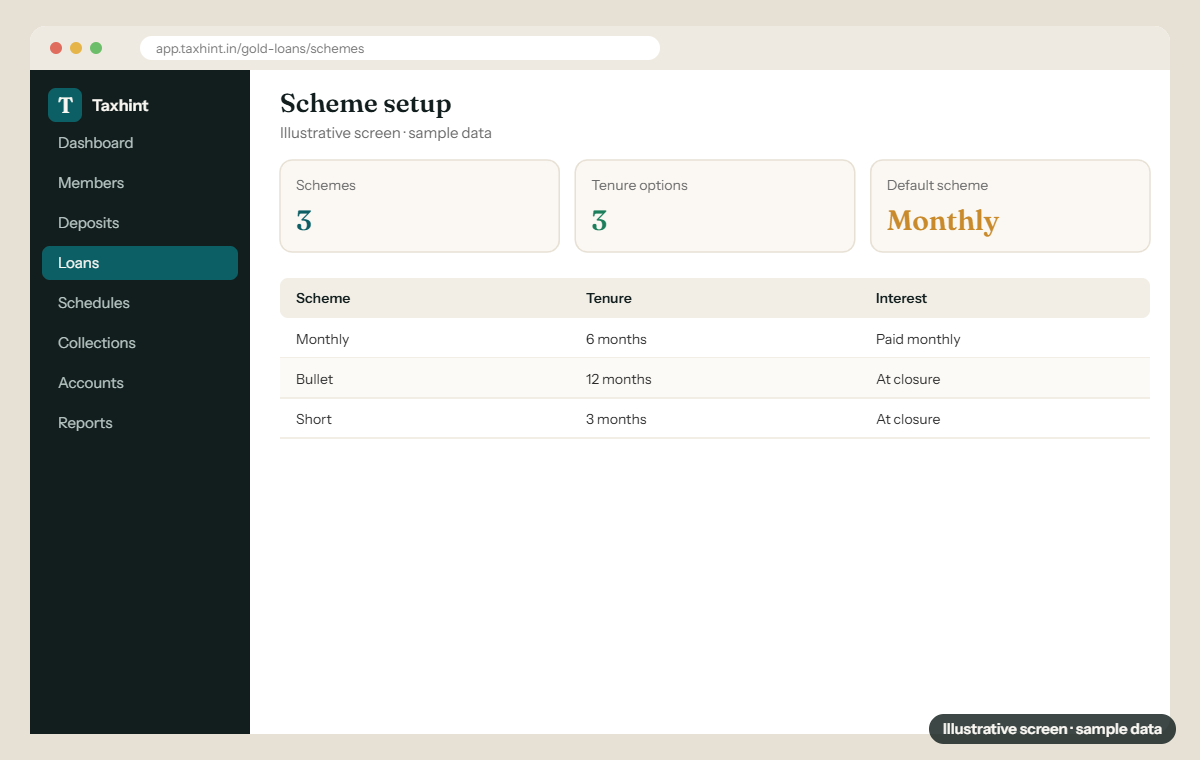
Here is how a small lender might lay out three schemes on one page. The numbers are placeholders only. Set yours according to your policy and the rules that apply to you.
- Quick: short tenure, interest and principal paid at closure, one renewal allowed.
- Monthly: medium tenure, interest paid every month, principal at the end.
- Long: longer tenure with a slab where the rate steps up after a set period.
Print the sheet and keep it at the counter. Staff then quote the same terms to every customer, and the customer can see the terms in writing.
Reviewing a scheme after three months
Look at how many loans each scheme attracted, how many went overdue and how many renewed. A scheme with high overdue is either priced wrongly or sold to the wrong customers. A scheme nobody takes can be removed. Never change old loans when you change a scheme; apply the new terms to new loans only and keep a dated record of the change.
How to explain a scheme to a customer
Use three sentences. First, what the customer receives: the loan amount against the gold. Second, what the customer pays: interest on the scheme, and when. Third, what happens at the end: closure, renewal or overdue. Hand over the printed terms and ask the customer to read the due date aloud before signing. This small habit removes most later disputes.
| Question | Good answer at the counter |
|---|---|
| How much will I pay? | Interest as per this scheme, shown on the receipt |
| When is the due date? | Date printed on the receipt |
| Can I renew? | Yes, as per scheme terms and after paying due interest |
| What if I am late? | Charges as stated in the terms; please call us first |
Staff should be able to answer these four questions without looking anything up.
Worked example: comparing two schemes
Take two illustrative schemes on the same ornament value. Scheme A gives a short tenure with a higher monthly rate and fast renewal. Scheme B gives a longer tenure with a lower rate and a step up if the loan crosses a set number of months. For the borrower, A is simple. For you, B reduces the number of renewals but needs closer review of overdue accounts.
Test each scheme in your software with five sample loans of different sizes. If the interest statement is hard to explain to a customer, the scheme is too complicated.
Design mistakes to avoid
- Too many slabs that staff cannot explain at the counter.
- Charges hidden in small print instead of the sanction slip.
- No rule on what happens after the maturity date.
- Rate changes applied to old loans without notice.
Scheme checklist
- Maximum loan to value stated clearly.
- Tenure options kept to two or three.
- Interest method written down: simple, monthly or slab.
- Renewal and part release terms stated.
- Overdue and auction notice timing stated.
FAQs
How many schemes should I offer?
Start with two or three. Add more when you have data.
Should interest be monthly or at closure?
Offer what customers ask for, within your rules. Many offer both.
Can I change a scheme later?
Yes for new loans. Existing loans keep their original terms.
Where do I show scheme terms?
On the receipt and at the counter.
Want schemes set once and used correctly? Book a demo of Taxhint gold loan software. Talk to Taxhint on +91 93117 95484 or [email protected], or visit taxhint.in.