November 24, 2026 · Guides
Gold Loan Interest Calculation Methods Explained
Two lenders can quote the same rate and charge different amounts, because they work interest out differently. For the customer this is confusing. For you, it is the main source of disputes at release.
Here are the common methods with a worked example so you can check yours.
In this guide
Simple interest on the loan
Interest is charged on the original amount for the days held.
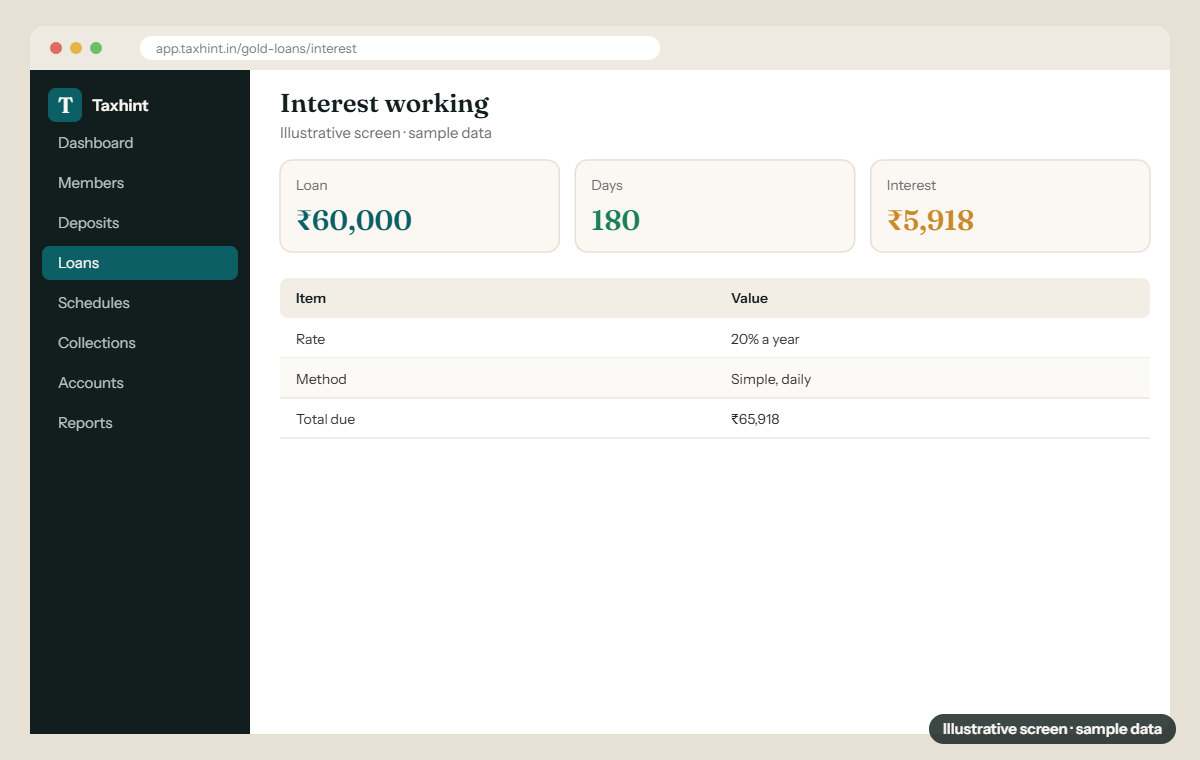
- Interest = loan × rate × days ÷ 365.
- Example: ₹60,000 at 20% for 180 days is about ₹5,918.
- Easy to explain at the counter.
Monthly and daily methods
Monthly interest charges per month or part of a month. Daily charges per day.
- Part months can round up. State the rule on the receipt.
- Daily is fairer for early closure.
- Pick one and use it for every loan of that scheme.
Slab or step-up interest
Some schemes raise the rate as the loan ages.
- For example a lower rate for the first few months and higher after.
- The software must apply each slab to the right days.
- Show the slab table on the receipt.
Rate caps and rules depend on your entity, so please verify with your CA.
Check the working
Always test before you trust.
- Work three sample loans by hand.
- Compare with the gold loan interest calculator and your software.
- Test part payment and renewal.
- Keep the test sheet for audit.
See also the scheme design guide.
Worked example with three methods
Take a loan of ₹60,000 at 20% a year held for 180 days. The numbers below are illustrative.
- Simple daily: 60,000 × 20% × 180 ÷ 365 is about ₹5,918.
- Monthly, part month counted as a full month: 6 months at 20% a year is ₹6,000.
- Monthly, 30-day month: 180 ÷ 30 = 6 months, again ₹6,000.
The difference looks small here, but across hundreds of loans and shorter, odd periods, the choice of method changes income and customer satisfaction.
Test your system with edge cases
Try these cases and keep the results as a test sheet: a loan closed on the due date, a loan closed one day late, a loan renewed after four months, a part payment in the third month and a loan with a rate slab change. If your software and your hand working differ, find out why before you go live.
Which method for which customer
| Method | Best for | Watch out |
|---|---|---|
| Simple daily | Short loans and early closures | Needs daily count |
| Monthly, part month full | Easy counter explanation | Can overcharge short periods |
| Slab or step-up | Longer loans | Complex to explain |
Whatever you pick, print one worked example on your scheme sheet so that staff and customers see the same numbers.
Worked example: same loan, three methods
Take an illustrative loan of 50,000 at a quoted 1.5 percent a month for 6 months. With simple monthly interest the cost is 50,000 x 1.5 percent x 6 = 4,500. With a method that charges a higher rate after the third month, the same loan costs more. With daily interest the cost depends on the exact day of repayment.
The point is not which method is best. It is that the customer must understand the method before signing, and your software must follow the same method as the sanction slip.
Common calculation errors
- Counting a part month as a full month without a written rule.
- Applying a new rate to an existing loan.
- Charging interest after release because the receipt date was entered late.
- Rounding differently in the system and on paper.
Test before you rely on it
- Five sample loans checked by hand.
- A loan closed on the first day, the last day and the day after maturity.
- A part release in the middle of the term.
- A renewal with unpaid interest.
- Compare with the gold loan interest calculator.
FAQs
Which method is best?
Simple daily interest is easiest to explain and fair on early closure.
How is a part month treated?
As per your rule. State it on the receipt.
Why does my software differ from my hand working?
Usually a rounding rule or day count. Compare line by line.
Is there a maximum rate?
Limits depend on your entity. Please verify.
Want gold interest worked out the same way every time? Book a demo of Taxhint software. Talk to Taxhint on +91 93117 95484 or [email protected], or visit taxhint.in.