November 24, 2026 · Guides
Microfinance Impact Measurement: Metrics That Matter
Funders ask what changed for borrowers, not only how many loans you gave. Microfinance impact measurement is the work of answering that honestly, with limited budget and limited data.
This guide separates outputs from outcomes and proposes a small, practical design.
In this guide
- Outputs, outcomes and impact
- Start with a baseline
- Simple indicators
- A worked survey design
- Ethics and limits
- Related reading
- Where this comes from
- Poverty and wellbeing tools
- Using the findings
- A realistic budget
- FAQs
Outputs, outcomes and impact
| Level | Question | Example |
|---|---|---|
| Output | What did we deliver? | Loans disbursed, trainings held |
| Outcome | What changed for borrowers? | Income stability, savings, assets |
| Impact | What changed because of us? | Needs a comparison group |
Start with a baseline
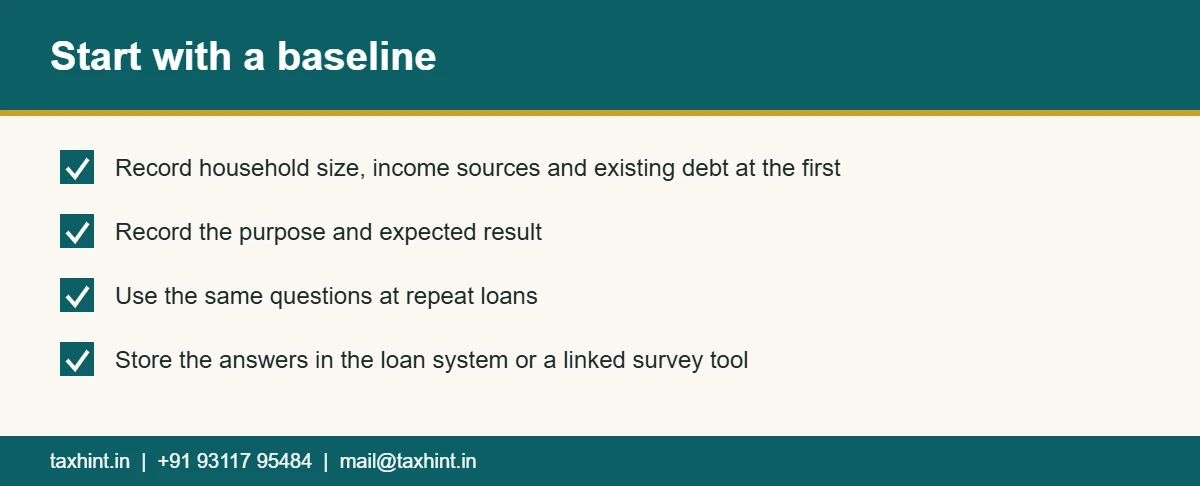
- Record household size, income sources and existing debt at the first loan.
- Record the purpose and expected result.
- Use the same questions at repeat loans.
- Store the answers in the loan system or a linked survey tool.
Simple indicators
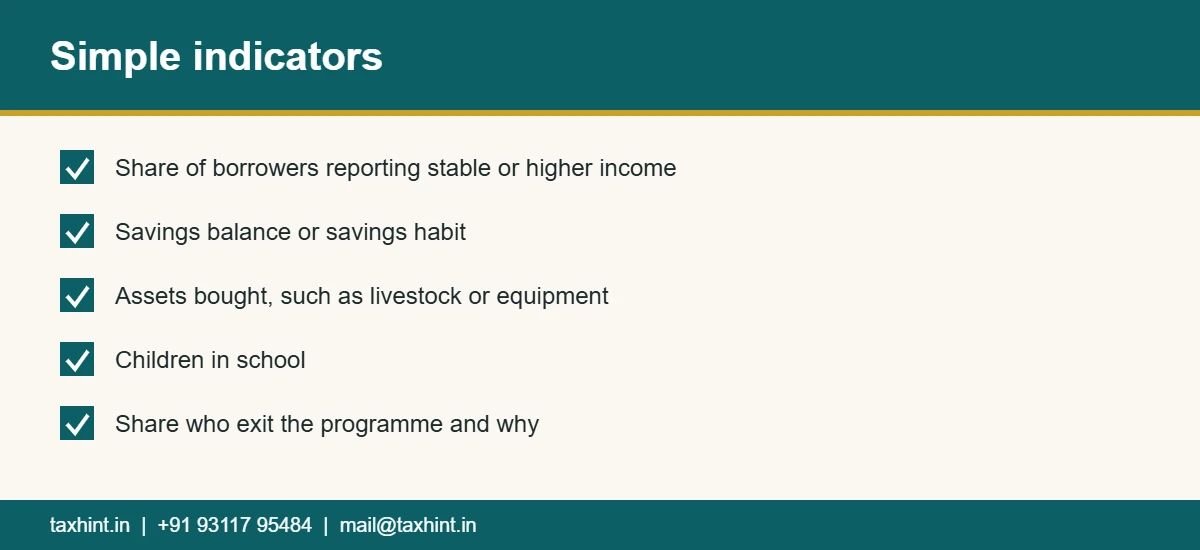
- Share of borrowers reporting stable or higher income.
- Savings balance or savings habit.
- Assets bought, such as livestock or equipment.
- Children in school.
- Share who exit the programme and why.
A worked survey design
This is an illustrative design, not a result. Each year, interview a random sample of 300 borrowers drawn from different branches, using a short questionnaire in their language. Ask the same questions as at baseline. Report the share with higher income, with a note on how the sample was chosen and what the survey cannot show, such as outside factors like rainfall or prices. Do not claim that the loan alone caused the change.
Ethics and limits
- Get consent and protect personal data; see borrower data.
- Do not pressure borrowers to give favourable answers.
- Disclose sample size and method.
- Use independent reviewers where possible.
Related reading
See social performance reporting and CSR funding.
Where this comes from
Source: SIDBI – micro lending development and capacity building. Figures and policies change, so check the latest version before relying on them.
Poverty and wellbeing tools
Some lenders use short poverty scorecards or wellbeing questionnaires to see whether borrowers are moving up. Choose a tool that funders know, keep it short and train interviewers. Do not mix tools across years without noting the change. A modest, consistent tool beats an elaborate one used once.
Using the findings
- Share a one-page summary with staff and borrowers.
- Adjust products where outcomes are weak, for example loan size or repayment frequency.
- Report both positive and negative findings to the board.
- Archive raw data safely with consent records.
A realistic budget
A small survey needs interviewers, travel, a short training, data entry and analysis time. Plan for these costs in advance and, if you seek CSR or grants, include the measurement cost in the project budget. Cutting measurement to save money leaves you unable to show results at renewal time.
FAQs
Do we need a control group?
A comparison group gives stronger evidence but costs more. Many lenders start with a baseline and follow-up.
How big should the sample be?
It depends on the population and the accuracy needed. A statistician can advise.
Can the loan officer do the survey?
Independence is better. Use separate staff or an outside agency.
How often?
Annually for a sample is common.
Can impact numbers be used in marketing?
Only if the method is sound and the claim is modest. Overclaiming harms trust.
Can grants fund impact measurement?
Many donors allow a share of the budget for monitoring and evaluation. Ask in advance.
Planning a microfinance company or already running one? Our CAs and CSs handle registration, RBI work and yearly compliance. Get Free Consultation or WhatsApp +91 93117 95484.