November 24, 2026 · Guides
Social Performance Reporting for Microfinance Institutions
Microfinance exists to serve people who lack access to credit. Social performance reporting shows whether you are doing that well, not just whether you are profitable. Funders, rating agencies and regulators increasingly ask for it.
This guide proposes a small set of indicators and a simple reporting rhythm.
In this guide
- Four areas to cover
- Reference frameworks
- A reporting rhythm
- A worked illustration
- Common gaps
- Related reading
- Where this comes from
- Where the data comes from
- What the board should ask
- Writing the report
- FAQs
Four areas to cover
| Area | Example indicators |
|---|---|
| Outreach | Number of borrowers, share of women, share in rural or underserved areas |
| Client protection | Complaints received and resolved, time to resolve, key fact statement given |
| Responsible pricing | Average cost to the borrower, spread across products |
| Outcomes | Savings, enterprises started, repeat borrowers, exits |
Reference frameworks
Industry standards for social performance management, such as the Universal Standards for Social and Environmental Performance Management and the client protection standards, give a ready checklist. Use the one your funders recognise rather than inventing your own. Our impact measurement guide goes deeper into outcomes.
A reporting rhythm
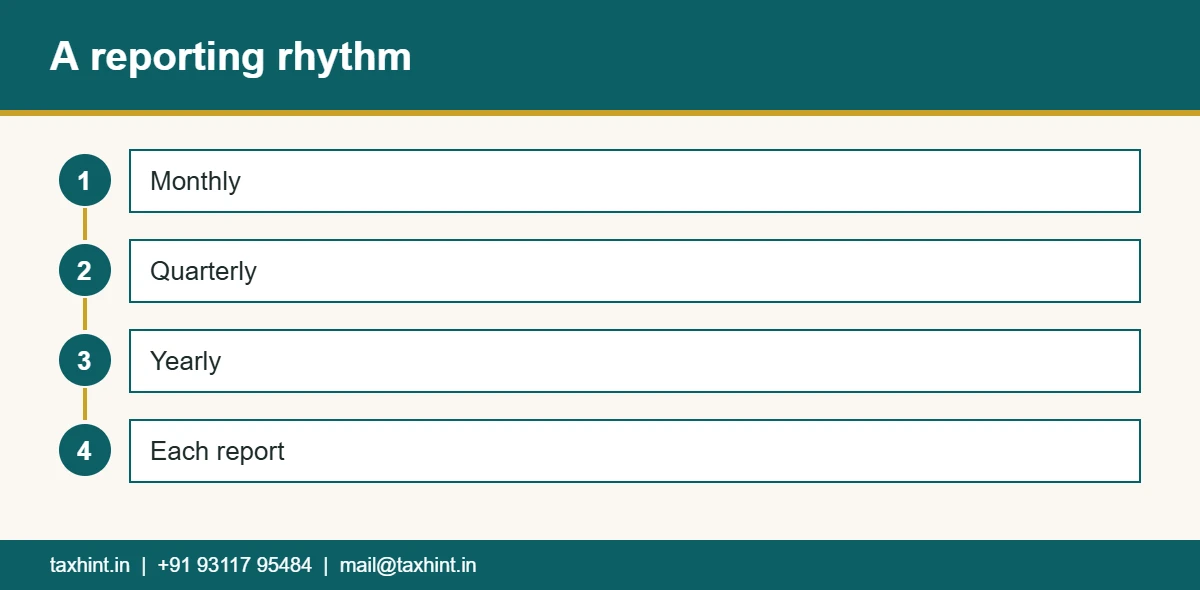
- Monthly: complaints, outreach and portfolio quality to management.
- Quarterly: summary to the board with trends.
- Yearly: a short public social performance report.
- Each report: say how data was collected and what it does not show.
A worked illustration
This is illustrative, not a client case. A lender reports 12,000 borrowers, 94 percent women, 300 complaints and an average resolution time of five days. Beside these it records that 40 percent of complaints concerned insurance claims. The board then orders a review of the claims process. The numbers led to a concrete action, which is the test of a useful social report.
Common gaps
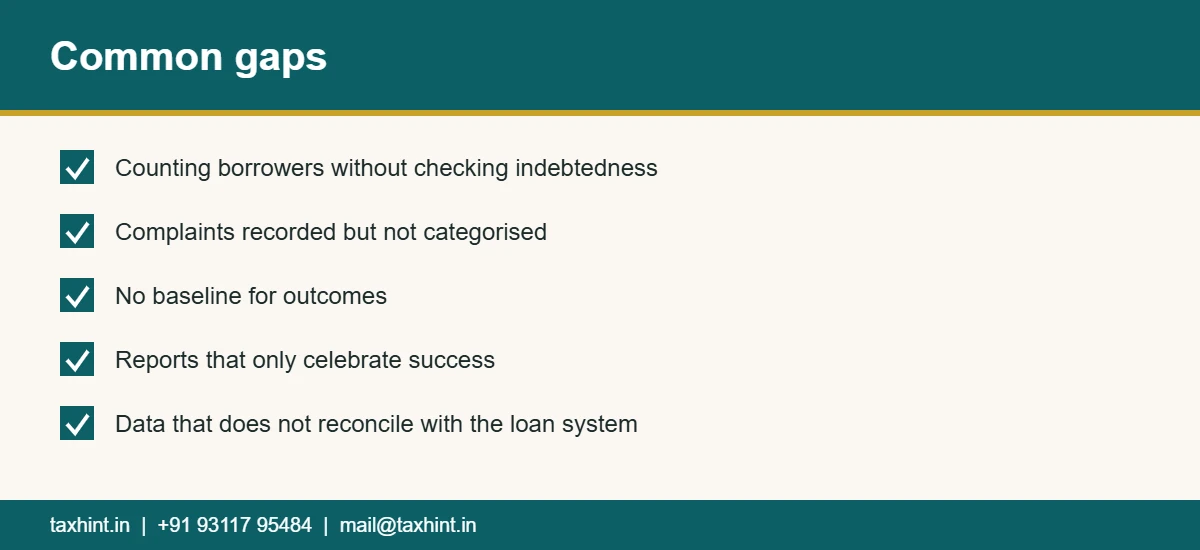
- Counting borrowers without checking indebtedness.
- Complaints recorded but not categorised.
- No baseline for outcomes.
- Reports that only celebrate success.
- Data that does not reconcile with the loan system.
Related reading
See grievance cell, financial literacy and grading and rating.
Where this comes from
Source: SIDBI – microfinance initiatives and client protection work. Figures and policies change, so check the latest version before relying on them.
Where the data comes from
- Loan system: borrowers, regions, products and repeat loans.
- Grievance register: complaints and resolution time; see our grievance register format.
- Utilisation checks and surveys for outcomes.
- Training records for financial literacy sessions.
What the board should ask
- Which complaint category is growing, and why?
- Are we reaching the households we say we serve?
- Is the average cost to the borrower within our pricing policy?
- Which indicator is weakest, and who owns it?
Writing the report
- Start with a one-page summary of key numbers.
- Add short stories only if they reflect typical cases.
- State limitations plainly.
- Explain what you will do differently next year.
FAQs
Is social reporting required by RBI?
RBI sets client protection and fair practice rules. Wider social reporting is often asked for by funders and raters.
How many indicators are enough?
A small, reliable set beats a long list. Start with ten.
Should we publish the report?
Publishing builds trust, but check with your board and funders.
Who owns the numbers?
A named officer in management, with internal audit sampling the data.
Can software produce this report?
Yes, if the loan system captures gender, location and complaint data in structured fields.
How long should the report be?
Two to six pages is enough for most lenders. Use clear tables.
Planning a microfinance company or already running one? Our CAs and CSs handle registration, RBI work and yearly compliance. Get Free Consultation or WhatsApp +91 93117 95484.