November 24, 2026 · Guides
Microfinance Write-Off Policy: Governance, Approval and Recovery
A microfinance write-off policy answers a hard question honestly: when is a loan unlikely to be recovered, and who decides? Without a policy, write-offs become a branch habit or a way of hiding bad news.
This guide sets out what the policy should say and how to run the process with proper approvals and records.
In this guide
- What a write-off is and is not
- Contents of the policy
- Process
- Link to provisioning
- Controls to prevent abuse
- Related reading
- Where this comes from
- A worked illustration
- Mistakes to avoid
- FAQs
What a write-off is and is not
A write-off removes a loan from the active books because recovery is unlikely. It is an accounting decision. It does not forgive the borrower or end the right to recover. Recovery after write-off continues under the fair practice code and is reported as recovery income.
Contents of the policy
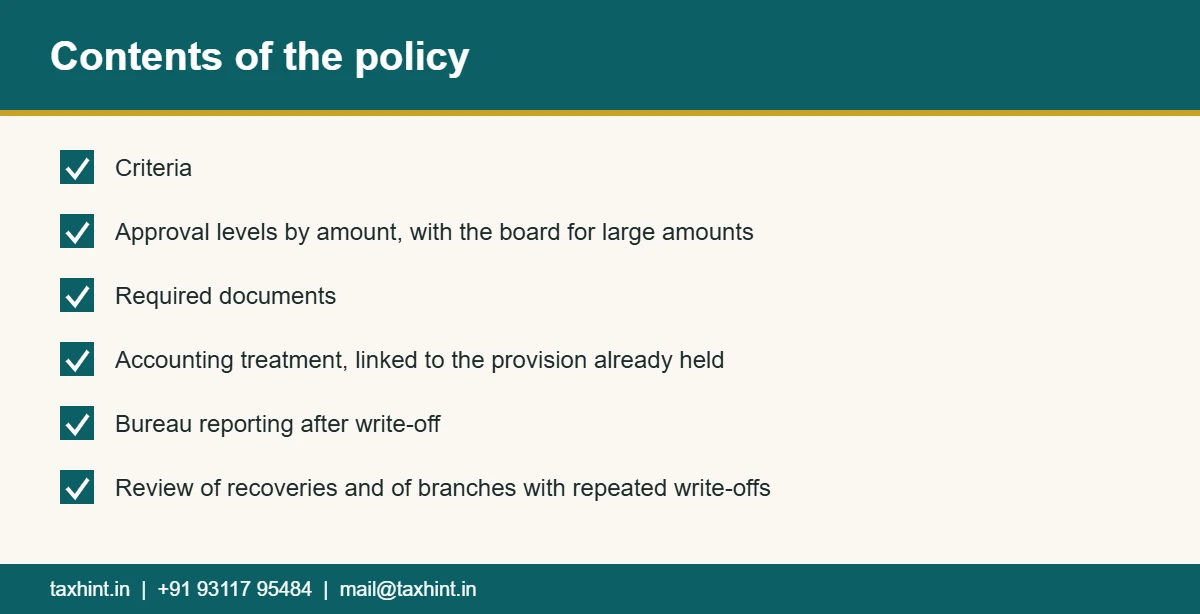
- Criteria: age of overdue, recovery attempts made, borrower circumstances.
- Approval levels by amount, with the board for large amounts.
- Required documents: recovery history, field visit notes, legal status.
- Accounting treatment, linked to the provision already held.
- Bureau reporting after write-off.
- Review of recoveries and of branches with repeated write-offs.
Process
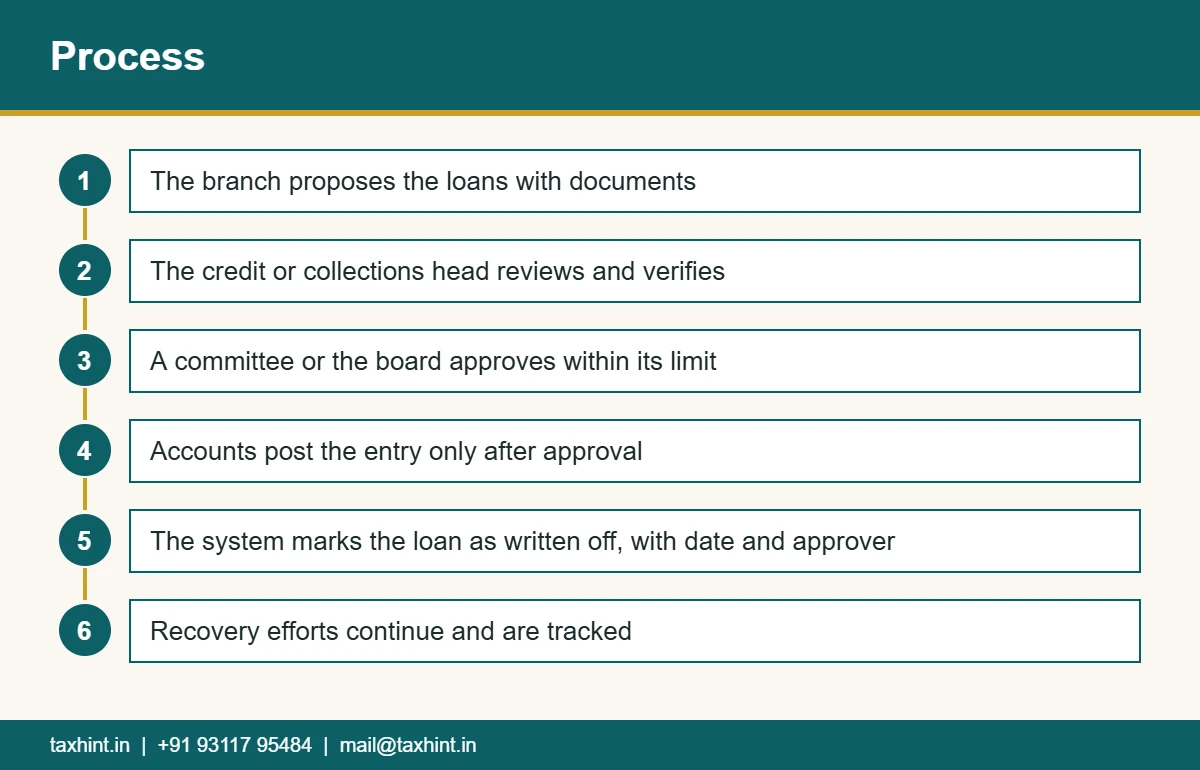
- The branch proposes the loans with documents.
- The credit or collections head reviews and verifies.
- A committee or the board approves within its limit.
- Accounts post the entry only after approval.
- The system marks the loan as written off, with date and approver.
- Recovery efforts continue and are tracked.
Link to provisioning
Write-offs should follow provisioning, not surprise it. Under the RBI provisioning framework, the loans classified as non-performing carry provisions that rise with age. The Directions set the norms; see our provisioning guide.
Controls to prevent abuse
- No branch can write off a loan on its own.
- A random sample of written-off loans is revisited by internal audit.
- Recoveries after write-off are posted to a separate account.
- The audit committee sees a quarterly summary.
Related reading
Read fair practices and recovery and the overdue ladder.
Where this comes from
Source: RBI (NBFC – IRACP) Directions, 2025. RBI updates these Directions from time to time, so confirm the current text before acting.
A worked illustration
This is illustrative, not a client case. A branch proposes writing off 12 loans totalling ₹4.8 lakh. Each file shows the overdue age, three recorded visits, a reason for non-payment and a note on whether any guarantor or group member can help. The credit head verifies a sample, the committee approves, and accounts post the entry against provisions already held. Over the next year ₹60,000 is recovered, and it is booked as recovery income in a separate account, with a quarterly note to the audit committee.
Mistakes to avoid
- Writing off to clean the PAR report before an audit.
- Letting a branch write off without head-office approval.
- Forgetting to update the bureau status.
- Stopping recovery efforts after write-off.
FAQs
Does a write-off mean the borrower is free from the loan?
No. It is an accounting step. Lawful recovery can continue.
Who should approve write-offs?
A committee or the board, depending on the amount, as the policy sets.
How do write-offs affect the bureau record?
They must be reported accurately. Follow the bureau’s rules for status and updates.
Can recoveries after write-off be counted as income?
Yes, they are generally recognised when received, under your accounting policy and auditor’s advice.
How is a write-off different from a waiver?
A write-off is an accounting step. A waiver is a decision to forgo the dues, which needs separate authority.
Should we tell the borrower?
Follow your policy and fair practice code. Recovery after write-off must still be lawful and respectful.
Running loans on spreadsheets? Book a free demo of our microfinance software, starting ₹15,000, or WhatsApp +91 93117 95484.