November 24, 2026 · Guides
The Overdue Management Ladder for Microfinance Lenders

Good overdue management starts the day after a missed payment, not weeks later. A clear ladder tells every officer what to do, when and who to inform.
This guide sets out a ladder you can adapt, with fair-practice limits at each step.
In this guide
- The ladder
- Fair practice limits
- A worked illustration
- Use data to prioritise
- Related reading
- Where this comes from
- Sample call scripts
- Restructuring and rescheduling
- Common mistakes
- FAQs
The ladder
| Day | Action | Owner |
|---|---|---|
| 1-3 | Friendly call or visit; understand the reason | Loan officer |
| 4-7 | Second visit; group leader joins; record a promise date | Loan officer |
| 8-15 | Branch manager visits; check for hardship; offer a plan if needed | Branch manager |
| 16-30 | Area manager review; consider restructuring | Area manager |
| 31+ | Credit committee review; formal notice if appropriate; recovery policy applies | Credit head |
| 90+ | Classification and provisioning per RBI rules | Finance and audit |
Fair practice limits
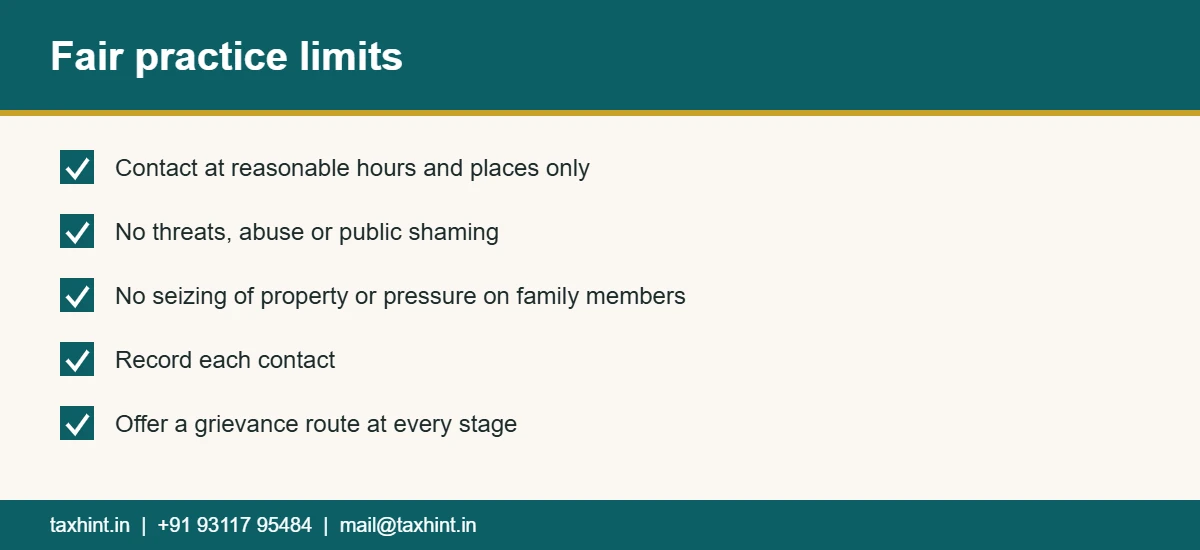
- Contact at reasonable hours and places only.
- No threats, abuse or public shaming.
- No seizing of property or pressure on family members.
- Record each contact.
- Offer a grievance route at every stage.
A worked illustration
This is illustrative, not a client case. A borrower misses an instalment of ₹650 on Saturday. On Monday the officer calls and learns she was sick. On Wednesday the officer visits and she pays part. By day eight the manager meets her; she asks to move the date, and the policy allows a one-time rescheduling if recorded. She pays the rest the following week. Because the first call happened on day two, a missed payment never turned into a long overdue.
Use data to prioritise

- A daily list of loans in each bucket.
- Flags for repeated missed payments.
- A view of roll rates from one bucket to the next.
- Weekly review at branch and area level.
Related reading
See fair practices and recovery, write-off policy and provisioning.
Where this comes from
Source: RBI (NBFC – Microfinance Institution) Directions, 2025. RBI updates these Directions from time to time, so confirm the current text before acting.
Sample call scripts
These are illustrative. Day-two call: “Namaste, this is [name] from [company]. We did not receive your instalment this week. Is everything alright? When will you be able to pay?” Day-eight visit: “I understand things are difficult. Let us look at what is possible. If you need to move the date once, we can note it.” Notice that the officer asks, listens and records. The goal is repayment with dignity, not pressure.
Restructuring and rescheduling
- Allow only under a written policy with approvals.
- Document the reason and the new schedule.
- Check eligibility under the current RBI Directions.
- Track restructured loans separately and report them honestly.
- Do not use restructuring to hide stress in the portfolio.
Common mistakes
- Waiting until the weekly meeting to follow up.
- Different rules in different branches.
- Pressure on group members for another member’s dues.
- No record of contacts.
FAQs
When should restructuring be offered?
When the borrower’s difficulty looks temporary and she can repay under new terms. Follow the Directions on restructuring and your board policy.
Can group members be asked to pay for a defaulter?
Be careful. Group pressure can become coercive. Follow your fair practice code and the law.
What contact times are acceptable?
Follow your fair practice code, which should state reasonable hours.
What is a good first-week recovery rate?
Targets vary. Track your own history and improve gradually.
What if the borrower cannot be found?
Verify with the group leader and neighbours respectfully, record attempts and escalate per policy. Do not disclose her loan to others.
Running loans on spreadsheets? Book a free demo of our microfinance software, starting ₹15,000, or WhatsApp +91 93117 95484.