November 24, 2026 · Guides
Repayment Reminders for Microfinance: WhatsApp and SMS Flows
A timely reminder prevents many late payments, and it is cheaper than a field visit. Microfinance repayment reminders work best when they are polite, short and sent at predictable times.
Here is a simple flow you can set in your software.
In this guide
- A simple reminder schedule
- What a good message contains
- Consent and templates
- Language and format
- Track what works
- What the software should do
- Sample messages
- Timing and frequency rules
- What good looks like
- FAQs
A simple reminder schedule
| When | Message type |
|---|---|
| 2 days before due date | Friendly reminder with amount and date |
| Morning of due date | Short reminder with centre meeting time |
| 1 day after missed | Neutral note that payment was not received |
| Day 7 overdue | Request to call branch; officer follow-up |
What a good message contains
Borrower name, loan account, amount due, date, and a branch contact number. Avoid threats or public shaming. The RBI fair practices expectations apply to tone too; see our fair practices and recovery guide.
Consent and templates
Take the borrower’s consent to receive messages at enrolment and record it. Business WhatsApp messages need pre-approved templates, and commercial SMS in India needs sender and template registration on the telecom DLT platform. Your vendor or messaging provider should handle this; ask who does.
Language and format
Send in the borrower’s language, in simple words. Many borrowers prefer voice calls, so keep an IVR or call option for those who cannot read.
Track what works
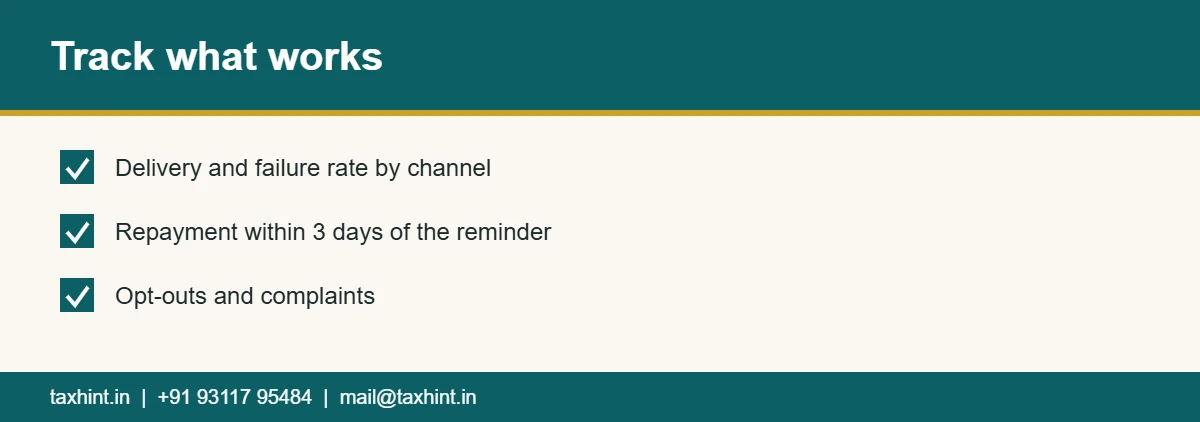
- Delivery and failure rate by channel.
- Repayment within 3 days of the reminder.
- Opt-outs and complaints.
What the software should do
Trigger messages from due dates, stop them once payment posts, log every message against the loan, and let you pause reminders for a borrower in dispute. See our microfinance software for these features.
Sample messages
These are illustrative templates, not approved ones. A due-date reminder might read: “Dear Sunita ji, your loan instalment of ₹650 is due on Saturday at the centre meeting. Thank you. Helpline: [branch number].” A missed-payment note might read: “We did not receive your instalment of ₹650 due on Saturday. Please pay at the branch or call [number] if you face any difficulty.” Notice what is missing: no threat, no mention of neighbours, no deadline that sounds like a penalty. Keep each message under two short sentences.
Timing and frequency rules
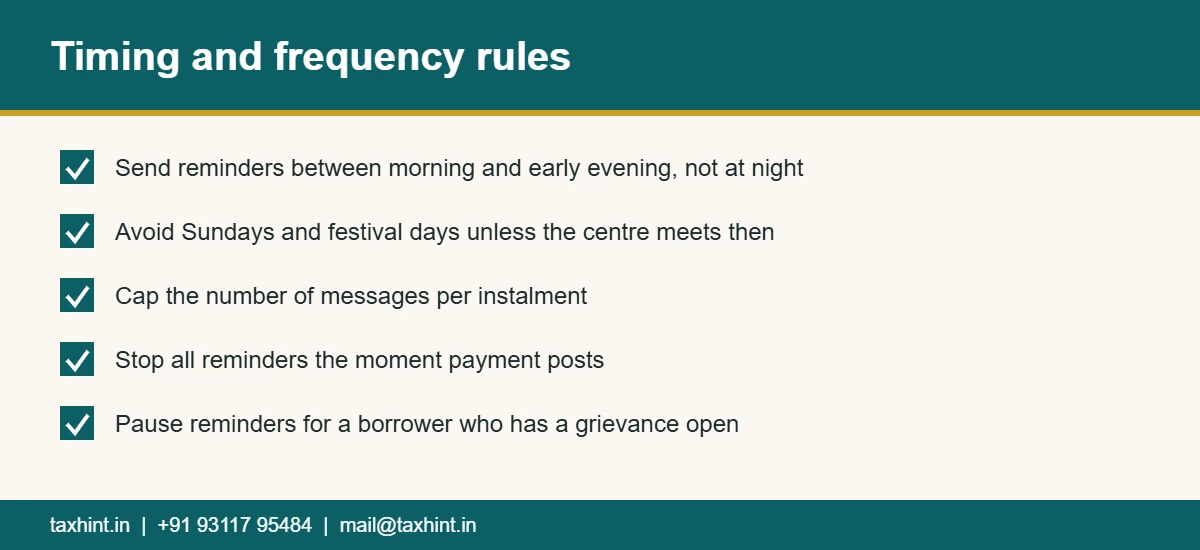
- Send reminders between morning and early evening, not at night.
- Avoid Sundays and festival days unless the centre meets then.
- Cap the number of messages per instalment.
- Stop all reminders the moment payment posts.
- Pause reminders for a borrower who has a grievance open.
What good looks like
Track three numbers every month: delivery rate, share of reminded borrowers who paid within three days, and opt-outs or complaints. If opt-outs rise, your tone or frequency is wrong. If delivery is low, check numbers at enrolment, because wrong numbers are the usual reason.
FAQs
Do we need borrower consent for WhatsApp?
Yes. Record consent at enrolment and use approved message templates.
Is SMS enough?
SMS works for most borrowers; WhatsApp suits those with smartphones. Many lenders use both.
How many reminders are too many?
Two before and one or two after the due date is usually enough. More feels like harassment.
Can reminders replace field visits?
They reduce visits but do not replace centre meetings or grievance handling.
Should reminders go out in English?
Use the borrower’s language and simple words. Many borrowers read only their local language.
What if the borrower asks us to stop?
Honour it at once, record it and switch to a call or branch visit if the loan needs follow-up.
Running loans on spreadsheets? Book a free demo of our microfinance software, starting ₹15,000, or WhatsApp +91 93117 95484.