November 26, 2026 · Guides
NBFC Eligibility Criteria: Who Can Get an RBI Licence
Before spending on filings, it is worth checking whether your company can get an NBFC licence at all. RBI looks at five things: the company itself, the money, the people, the business and the record. Miss one and the application stalls, however good the rest is.
Here is each test in plain words, with what to check on your side. For the full service, see NBFC registration, and for the overall plan read how to start an NBFC.
In this guide
- The five tests at a glance
- 1. The applicant must be a company
- 2. Net owned fund
- 3. Fit and proper directors and owners
- 4. The business must be financial
- 5. A clean compliance record
- If you do not meet the tests
- Three common cases
- What to do next
- FAQs
The five tests at a glance
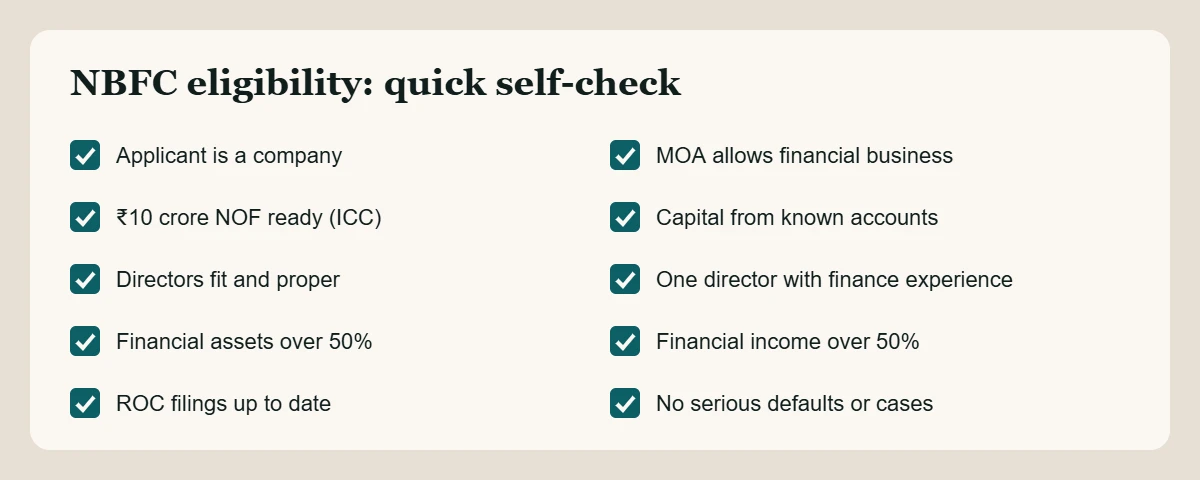
Use this as a quick self-check before you call anyone.
1. The applicant must be a company
Only a company registered under the Companies Act can apply. A partnership, LLP, proprietorship, trust or society cannot. The company’s objects in its MOA must allow financial business. If you are using an existing company, an object change may be needed first.
2. Net owned fund
Under RBI’s scale-based regulation, the regulatory minimum net owned fund for an NBFC-ICC, NBFC-MFI or NBFC-Factor is ₹10 crore. NBFC-P2P and Account Aggregators need ₹2 crore, and specialised categories such as infrastructure finance need far more. NOF is not paid-up capital: intangible assets and some group investments are deducted. Our net owned fund guide explains the working.
3. Fit and proper directors and owners
RBI checks the background of directors and major shareholders: integrity, credit history, past defaults, regulatory actions and experience. A board with real finance experience is a strong point. A director with a wilful default or a serious pending case can sink the file. If you are unsure about someone, raise it with us before filing, not after.
4. The business must be financial
RBI uses the principal business test: financial assets above 50 per cent of total assets, and income from them above 50 per cent of gross income. Your business plan should show this clearly. A company that also trades goods or runs another business needs a plan that explains how the lending part will dominate.
5. A clean compliance record
For an existing company, RBI looks at its ROC filings, tax record and any past defaults. Pending annual returns or a history of late filings should be fixed before you apply.
If you do not meet the tests
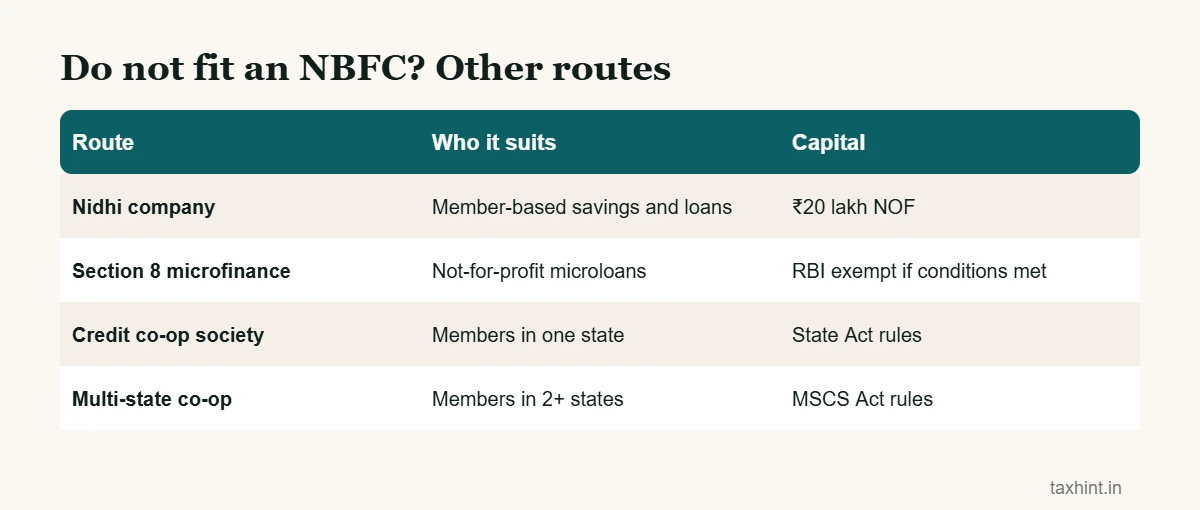
If the capital or structure does not fit, compare the other routes. Each one comes with its own limits on who you can serve.
Three cases we see often
A family business with a long trading history. The company has stock, debtors and a factory on its books. Turning it into an NBFC means the lending assets must overtake everything else, which can take years. A new company owned by the same family is usually the cleaner route.
A promoter with ₹4 to 5 crore. That is below the ₹10 crore regulatory minimum for an NBFC-ICC. Rather than waiting, many such promoters start with a Nidhi company or a credit co-operative society, build a track record with members, and revisit an NBFC later.
A director with an old default. One director had a settled loan with a bank years ago. RBI may still ask about it. The best approach is to disclose it upfront with the settlement letter, rather than let RBI find it in a credit report.
What to do next
If you pass all five tests, the next step is the document set and the application. Our guides on the NBFC registration process and documents required cover both. If you are close but not quite there, talk to us first: fixing an object clause or a capital trail before filing is far easier than after.
Frequently asked questions
Can an LLP or partnership become an NBFC?
No. Only a company registered under the Companies Act can apply for an NBFC Certificate of Registration.
What is the minimum net owned fund?
For NBFC-ICC, NBFC-MFI and NBFC-Factor it is ₹10 crore under scale-based regulation; NBFC-P2P and Account Aggregators need ₹2 crore.
Do directors need a finance background?
RBI looks for fit and proper people. Finance experience on the board is a strong point, though not every director needs it.
What is the principal business test?
Financial assets must be more than half of total assets, and income from them more than half of gross income.
Can you check my eligibility?
Yes. Share your company details and plan; the first consultation is free.
Next step: Not sure you qualify? We will check your company against each test before you file. Call +91 93117 95484, email [email protected], or use the form on our NBFC registration page.