November 26, 2026 · Guides
How to Start an NBFC Company in India: A Step-by-Step Guide
Most people who ask us how to start an NBFC already have the lending idea. They know who they want to lend to and roughly how much money they can put in. What they are less sure about is the order of things: company first or RBI first, how much capital RBI will look for, and what the file has to show before a Certificate of Registration comes through.
This guide walks through that order, the way we run it for clients. If you want the service page with the full process, it is on our NBFC registration page.
In this guide
- What an NBFC is, in plain words
- Step 1: Pick the right type of NBFC
- Step 2: Arrange the net owned fund
- Step 3: Set up the company and the board
- Step 4: Prepare and file the RBI application
- Documents RBI will ask for
- How long it takes
- After the Certificate of Registration
- FAQs
What an NBFC is, in plain words
A non-banking financial company is a company registered under the Companies Act whose main business is lending, investing or a similar financial activity. Before it carries on that business, Section 45-IA of the RBI Act says it needs a Certificate of Registration (CoR) from the Reserve Bank.
RBI looks at two numbers to decide whether your business counts as “financial”: financial assets should be more than half of total assets, and income from them more than half of gross income. If both are true, you need the CoR.
Step 1: Pick the right type of NBFC
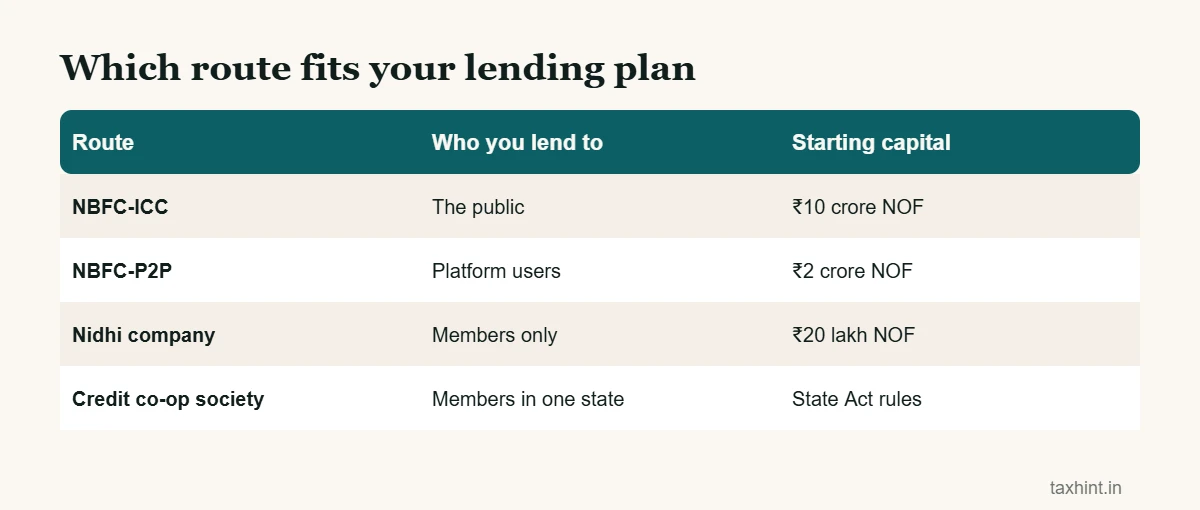
“NBFC” covers several licences. The type decides your capital, your rules and sometimes your regulator. Most new lenders apply as an Investment and Credit Company (NBFC-ICC). Others are narrower:
- Microfinance lending to low-income households: NBFC-MFI
- Gold loans as the main product: a gold loan NBFC, usually registered as an ICC
- Buying trade receivables: NBFC-Factor
- Online lender-borrower platforms: NBFC-P2P
If your plan is small, or you only want to work with members, look at a Nidhi company or a credit co-operative society first. All the options are compared on our NBFC services page.
Step 2: Arrange the net owned fund
Under RBI’s scale-based regulation, the regulatory minimum net owned fund (NOF) for an NBFC-ICC, NBFC-MFI or NBFC-Factor is ₹10 crore. NBFC-P2P and NBFC-Account Aggregators stay at ₹2 crore. Larger categories, such as infrastructure finance companies, need much more.
NOF is not the same as paid-up capital. It is owned funds minus intangible assets and certain investments in group companies. Our guide on net owned fund shows how it is worked out. RBI also asks where the money came from, so keep the bank trail clean from day one.
Step 3: Set up the company and the board
You can incorporate a new company or use an existing one, as long as its objects allow financial business and its record is clean. The board matters more than people expect. RBI checks that directors and key shareholders are “fit and proper”: their background, credit history and experience in finance.
A board with at least one person who has run lending before makes the file stronger. A director with a past default or a pending case can slow everything down.
Step 4: Prepare and file the RBI application
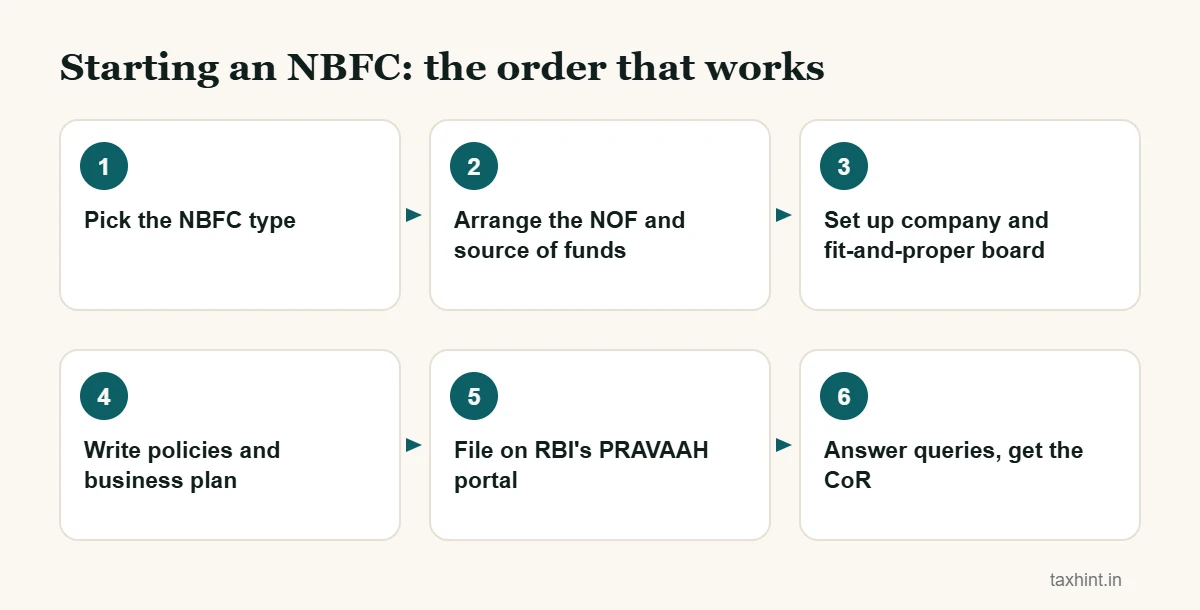
The application goes in online on RBI’s PRAVAAH portal. The steps below are how we usually run it.
Documents RBI will ask for
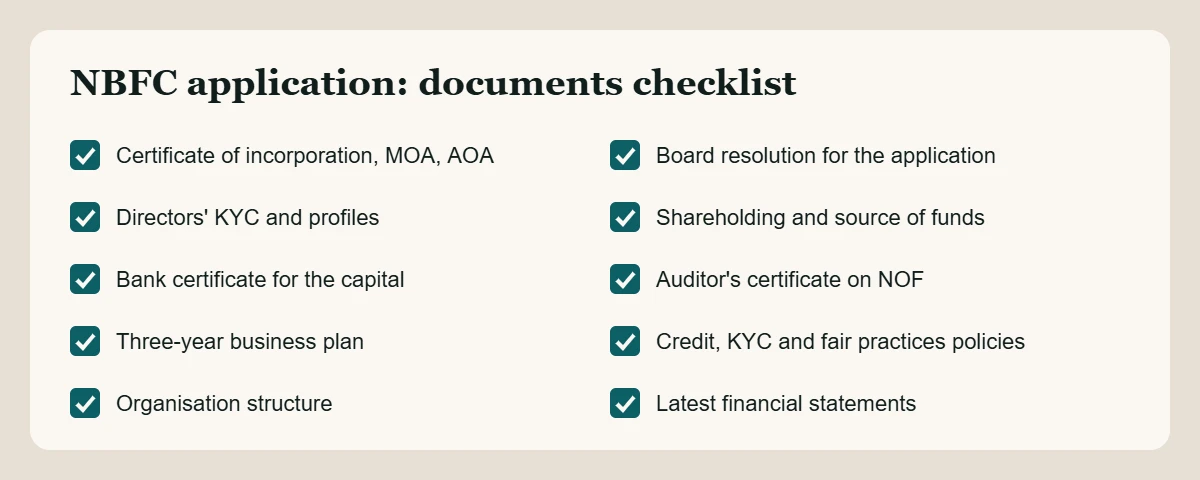
The exact list depends on the category, but most files carry the items in this checklist. Board-approved policies are the part promoters most often underestimate: RBI reads them, so they need to fit your actual business.
How long it takes
There is no fixed number of days. A complete file with a clear business plan and a clean board moves faster. Queries from RBI, a change of director midway or unclear source of funds add weeks. Plan for months, not weeks, and do not commit to borrowers before the CoR is in hand.
If time is the main concern, buying an existing NBFC can sometimes be quicker, but it needs RBI’s prior approval too. See our NBFC takeover service and the rules on change in control.
After the Certificate of Registration
The CoR is the start, not the end. You file returns with RBI, get auditor certificates every year, follow fair practices and KYC rules, and keep ROC filings up to date. Our NBFC compliance team handles this on a yearly plan.
You will also need a system for the loan book from the first disbursement. Our loan management software covers loans, EMIs, collections and RBI-ready reports.
Frequently asked questions
What is the minimum capital to start an NBFC?
For an NBFC-ICC, NBFC-MFI or NBFC-Factor, RBI’s regulatory minimum net owned fund is ₹10 crore under scale-based regulation. NBFC-P2P and Account Aggregators need ₹2 crore.
Can I start lending before RBI registration?
No. Section 45-IA of the RBI Act requires a Certificate of Registration before a company carries on non-banking financial business.
Can an existing company apply for an NBFC licence?
Yes, if its objects allow financial business, it meets the NOF and its directors pass the fit-and-proper review.
Is buying an NBFC faster than a new licence?
Sometimes. A takeover still needs RBI’s prior approval and a public notice, and the company’s past record comes with it.
Do you charge for the first consultation?
No. The first discussion is free. We check your plan, capital and board before you spend on filings.
Next step: Planning an NBFC? Share your lending plan and capital, and a CA or CS will tell you which route fits. Call +91 93117 95484, email [email protected], or use the form on our NBFC registration page.