November 27, 2026 · Guides
Closing a Nidhi Company: Strike Off and Winding Up
Some Nidhis never get going: they miss the NDH-4 window, cannot reach 200 members or lose interest. Others want to exit after years of work. Either way, a Nidhi holds member money, so closing it needs more care than closing an ordinary company.
Here is the safe order of steps.
In this guide
- When closure comes up
- Settle member money first
- Strike off or winding up
- A worked example
- How we help
- Common mistakes
- How long closure takes
- FAQs
When closure comes up
Since the 2022 amendment, a company that is not declared a Nidhi through NDH-4 cannot take deposits or give loans under the Nidhi Rules. Many such companies choose to close rather than stay idle. See NDH-4 rejection reasons.
Settle member money first
Before any closure, every deposit must be repaid with interest due and every loan settled or recovered. Pledged gold must go back to members against repayment. Keep proof of each payment.

Strike off or winding up
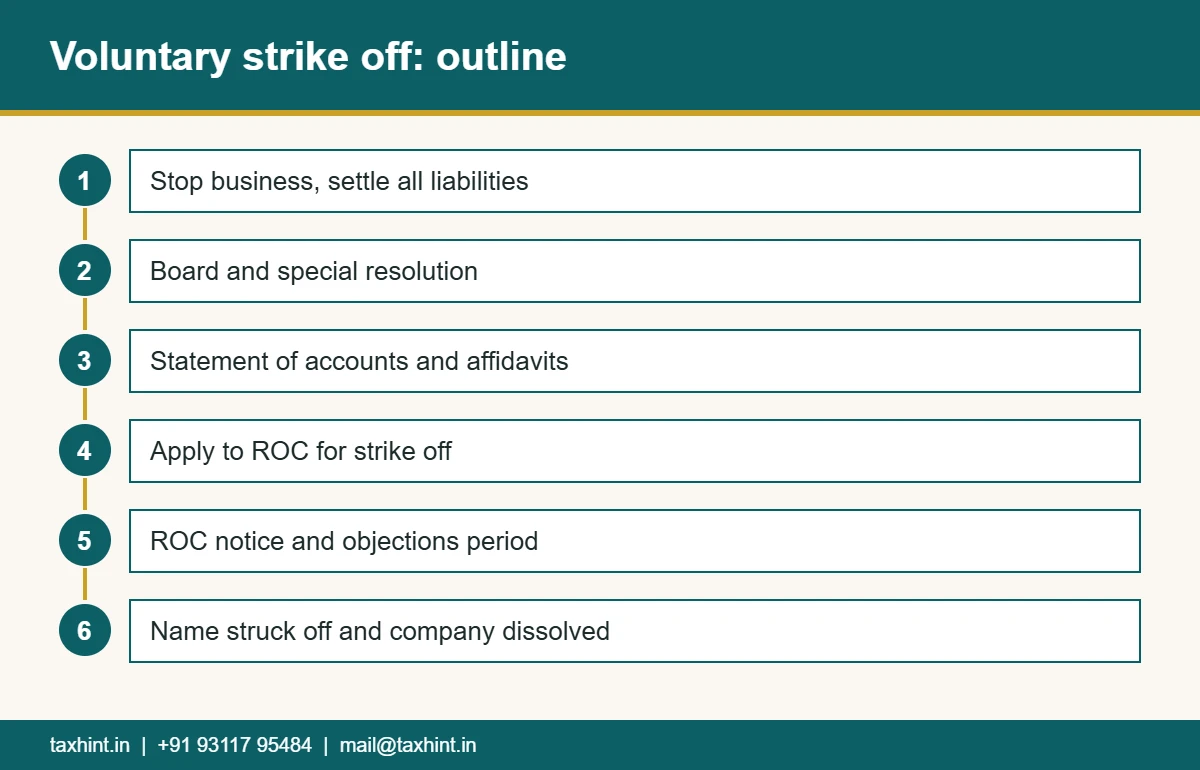
A company with no liabilities and no business can apply to the Registrar to strike off its name under section 248 of the Companies Act. If liabilities cannot be cleared, or there are disputes, the company may need a winding up route instead. Choose with your CS after the member money is settled.
A worked example
A company incorporated as a Nidhi collected share money from 90 members and opened a few savings accounts, then failed to reach 200 members within 120 days. Its board stops new accounts, repays all savings balances with interest, closes the bank account and files pending ROC returns. Only then does it apply for strike off. Because no member money is left, the application can move without objections.
How we help
We plan the settlement, prepare the papers and file the strike off. See Nidhi company compliance. Considering a different structure instead? Read Nidhi vs credit society.
Common mistakes
Applying for strike off with deposits outstanding. Member money must be settled first.
Leaving ROC returns pending. Old defaults come up at the strike off stage.
No written record of repayments. Keep receipts and bank proofs for every member payment.
Silent closure. Members should hear from the company in writing.
How long closure takes
Settling member money is usually the longest part. Fixed deposits may need to run to maturity unless members agree to close early under the deposit rules, and gold loans need borrowers to repay and collect their jewellery. Once nothing is owed, preparing the strike off papers takes a few weeks, and the Registrar then gives public notice and waits for objections before striking off the name. Plan for months, not days, and keep members informed at each stage.
Frequently asked questions
Can a Nidhi be closed by strike off?
Yes, if it has no liabilities and no business, by applying under section 248 of the Companies Act.
What must be done before strike off?
Repay all deposits, settle loans, return pledges, close accounts and clear ROC filings.
What if liabilities cannot be cleared?
A winding up route may be needed instead of strike off.
Why do some new Nidhis close?
A company not declared a Nidhi through NDH-4 cannot take deposits or give loans.
Do members need to be informed?
Yes. Members should be told in writing and paid before closure.
Need help? Need to close a Nidhi properly? Get Free Consultation or call +91 93117 95484.