November 27, 2026 · Guides
Share Capital Rules for Multi-State Co-operative Societies
Share capital is how members own a multi-state co-operative society. The MSCS Act, the rules and the society’s bye-laws together decide how much a member can hold, how shares move and how they are paid back.
Credit societies have extra capital norms since 2023. Here is the picture.
In this guide
- Bye-laws set the frame
- Capital norms for credit MSCS
- Shares through a member’s life
- A worked example
- Common mistakes
- How we help
- Tips for boards
- In short
- FAQs
Bye-laws set the frame
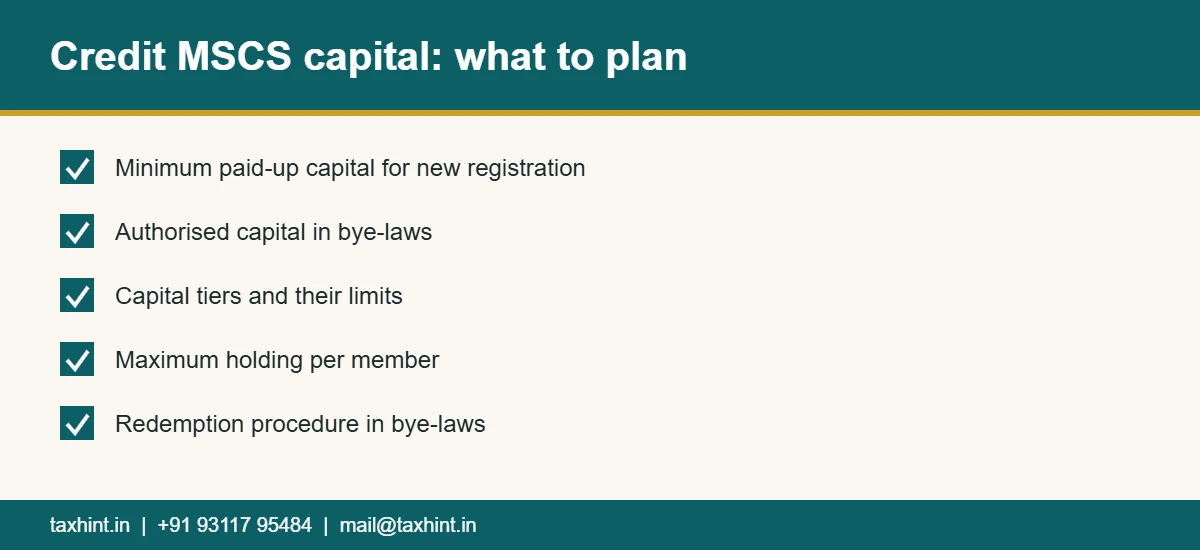
Under the MSCS Rules, the bye-laws cover the manner and limits in which the society raises funds and the maximum share capital any member may hold. They may also set the procedure for redemption of shares. The Act itself has sections on restriction on holding shares (section 33), restriction on transfer (section 34) and redemption (section 35).
Capital norms for credit MSCS
The 2023 amendment rules bring prudential norms for thrift and credit societies. They cover the minimum paid-up and authorised share capital needed to start business on a new registration, tiers of capital with limits for each, and related norms. At registration, the Central Registrar checks that the capital and prudential norms in the bye-laws match the guidelines.
Shares through a member’s life
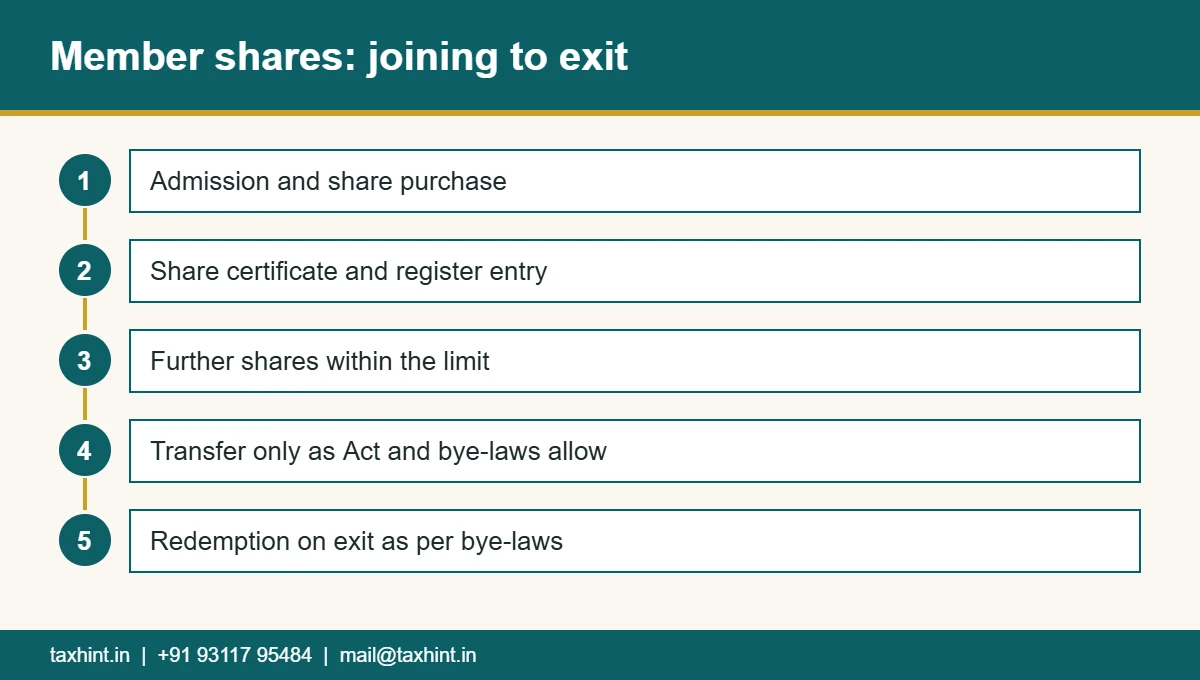
A member buys shares on joining, may add more within the limit, and gets them back on leaving as the bye-laws provide.
A worked example
A credit MSCS with members in UP and Uttarakhand sets the share value and the maximum any one member can hold in its bye-laws. A member who leaves after five years asks for her share money back. The society checks its bye-law procedure for redemption, any dues she owes, and whether the redemption keeps it within its capital norms, then pays her and updates the share register.
If many members leave at once, redemption can push capital below the norm. That is why the bye-laws and the board need a redemption policy, not just a form.
Common mistakes
No member-wise cap. A few members holding most of the capital goes against the co-operative idea and the bye-laws.
Informal transfers. Shares changing hands without board approval and register entries.
Redemptions without a capital check. Paying out share money that leaves the society below its norms.
How we help
We draft capital clauses, redemption policies and handle filings. See multi-state registration, MSCS compliance and what share capital means in a co-operative.
Tips for boards
- Review share capital against the norms every quarter
- Keep the share register and certificates matched
- Approve transfers and redemptions in board minutes
- Plan for redemptions in the budget
In short
- Bye-laws set share value, limits per member and redemption
- Sections 33, 34 and 35 deal with holding, transfer and redemption
- Credit MSCS have minimum capital and tiers under the 2023 rules
- Check capital norms before paying out redemptions
Frequently asked questions
Where are MSCS share limits set?
In the bye-laws, within the MSCS Act and Rules, including the maximum share capital any member may hold.
Which sections deal with shares?
Section 33 (restriction on holding), section 34 (restriction on transfer) and section 35 (redemption) of the MSCS Act.
Do credit MSCS have minimum capital?
Yes. The 2023 rules set minimum paid-up and authorised capital for new registrations and capital tiers.
Can shares be redeemed?
Yes, as the Act and the bye-law procedure allow.
Who checks capital norms at registration?
The Central Registrar checks that the bye-laws match the guidelines.
Need help? Drafting MSCS bye-laws? Get Free Consultation or call +91 93117 95484.