November 24, 2026 · Guides
Recurring Deposit Default and Penalty in a Nidhi: Setting It in Software
Recurring deposits depend on regular instalments. Some members miss a month or two. If you have no clear rule for it, you either lose goodwill by charging unfairly or lose discipline by never charging.
Write the rule, set it in the software and apply it the same way to everyone.
In this guide
Decide the rule
Put numbers in your scheme.
- Grace days after the due date.
- Penalty method, such as an amount per hundred per month.
- Number of missed instalments before closure review.
- Treatment of the interest if the account is closed early.
Penalty, interest and closure rules for deposits are governed by your scheme and the Nidhi Rules, so please verify with your CA or CS.
Tell members at the start
Prevent disputes.
- Print the rule on the application form and the passbook.
- Explain it to the member at account opening.
- Remind members before the due date. See maturity alerts.
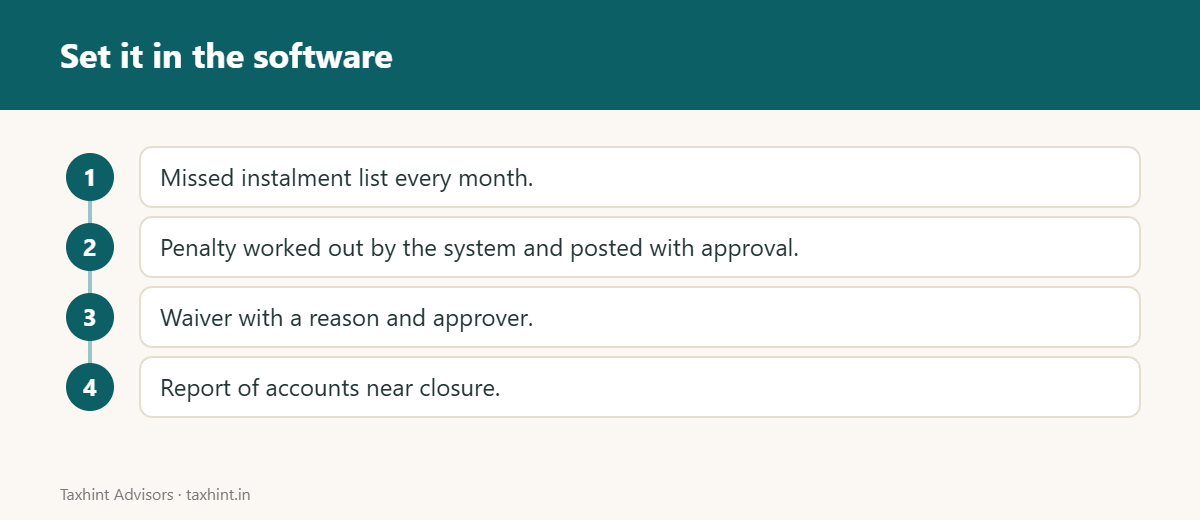
Set it in the software
Avoid manual calculation.
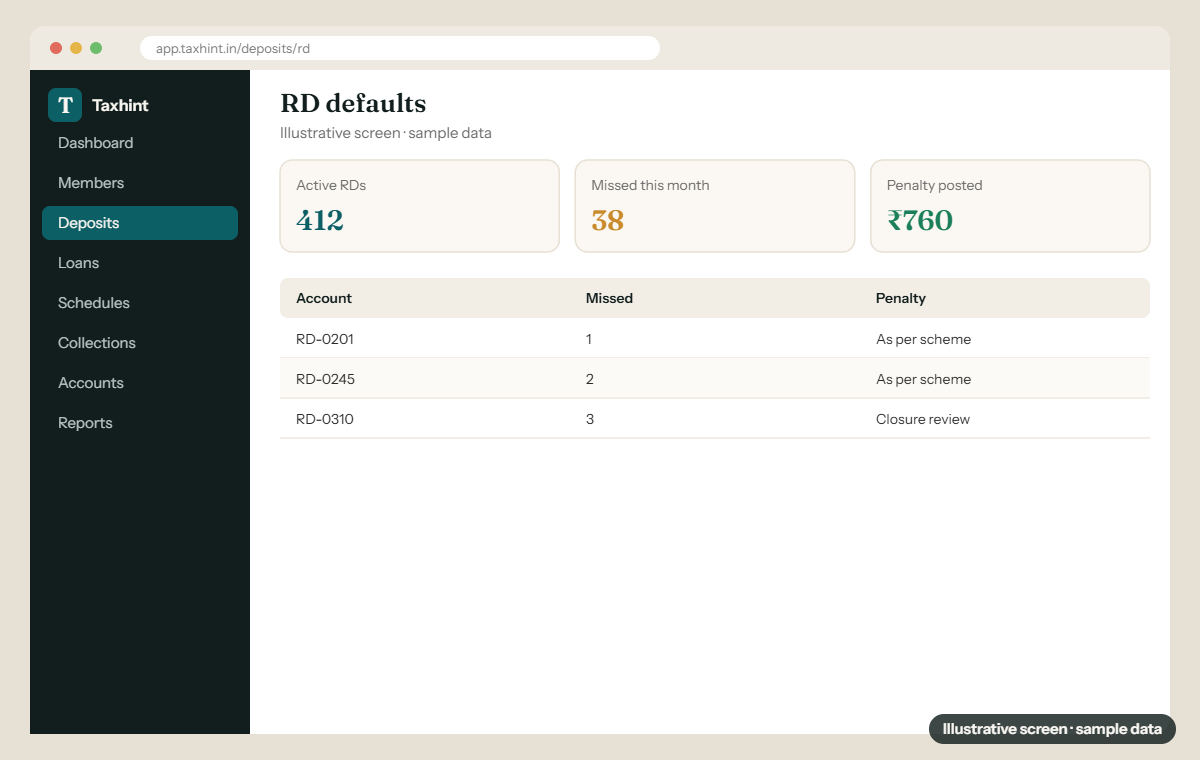
- Missed instalment list every month.
- Penalty worked out by the system and posted with approval.
- Waiver with a reason and approver.
- Report of accounts near closure.
Test maturity with the RD calculator.
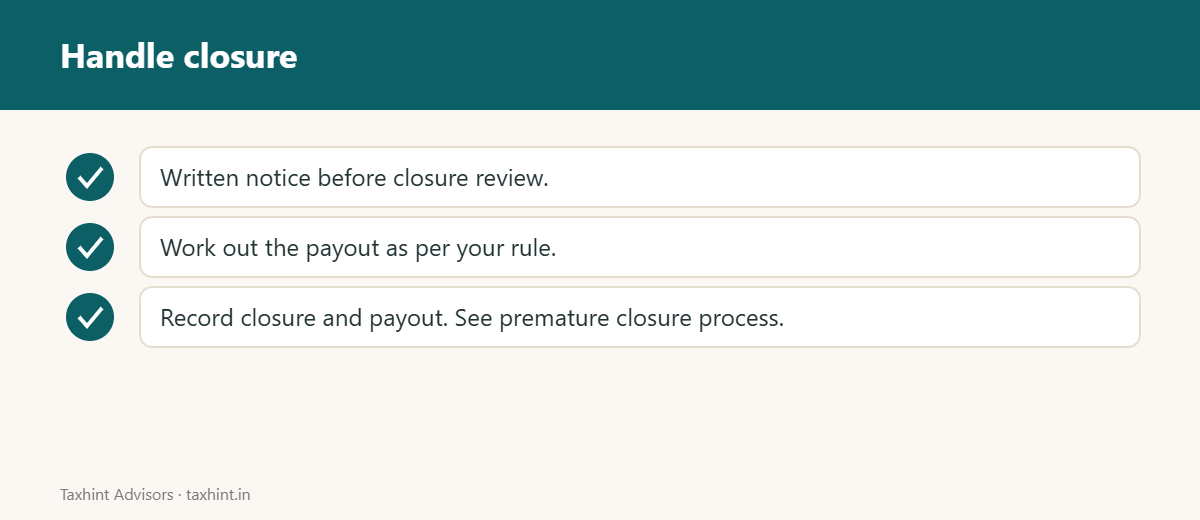
Handle closure
Treat everyone alike.
- Written notice before closure review.
- Work out the payout as per your rule.
- Record closure and payout. See premature closure process.
See Nidhi management software.
A worked example
A member has an RD with a monthly instalment of ₹2,000. She misses the March instalment and pays it 12 days late. Suppose your scheme gives a grace of five days and charges a penalty of a small amount per hundred for each month or part. The system flags the instalment as late, works out the penalty from the due date, and posts it with the payment. The staff member can waive it with a reason if the manager approves. The numbers here are only an illustration, and your scheme and rules decide the real ones.
Reports to review monthly
- RDs with one, two or three missed instalments.
- Penalty posted and penalty waived, with reasons.
- RDs closed early and why.
- Members who restarted an RD after closure.
If many members miss instalments in the same month, look for a reason such as a local event or a collection timing problem, not only member behaviour.
Policy template
| Item | Your rule |
|---|---|
| Grace days | Set in scheme |
| Penalty method | Set in scheme |
| Waiver authority | Manager or director |
| Closure after missed instalments | Set in scheme |
| Payout on closure | Set in scheme |
Complete this template with your CA and print it on the scheme leaflet. Rules for Nidhi deposits are specific, so verify them before you finalise.
Handling a missed instalment fairly
Missed RD instalments are common. The important thing is that the rule is written, shown to the member at opening and applied the same way for everyone. The software should calculate any charge from that rule, not from the cashier memory.
Illustrative example: a member misses one month. The system shows the missed instalment, the charge as per your scheme and the revised maturity. The cashier explains this and gives a printed note.
Mistakes to avoid
- Charges changed without informing members.
- Different cashiers applying different amounts.
- Charge applied but not shown in the passbook.
- No review of repeat defaulters.
Checklist
- Penalty rule written in the scheme document.
- Rule entered in software and tested.
- Member told at account opening.
- Waiver permission limited and logged.
- Please verify scheme terms with your CA or lawyer.
FAQs
Should I charge a penalty for missed RD instalments?
Per your scheme and the rules. Please verify.
How do I handle waivers?
With a recorded reason and an approver.
When should an RD be closed?
As per your rule after notice. Write it in the scheme.
Can software post penalties automatically?
Yes, with a waiver option.
Want RD defaults and penalties handled by rules? Book a demo of Taxhint Nidhi software. Talk to Taxhint on +91 93117 95484 or [email protected], or visit taxhint.in.