November 27, 2026 · Guides
Payment Aggregator Licence from RBI: Who Needs It and What It Takes
A payment aggregator collects payments from customers on behalf of merchants and settles the money to them. Because it handles other people’s money, RBI regulates it under the Payment and Settlement Systems Act, 2007.
In September 2025 RBI brought the rules together in the Master Direction on Regulation of Payment Aggregators. Here is what a non-bank needs to know before applying.
In this guide
- Who needs authorisation
- Net worth requirement
- How the application usually runs
- After authorisation
- A worked example
- How we help
- Payment aggregator or payment gateway
- Common mistakes
- FAQs
Who needs authorisation
Under the Master Direction, a bank does not need authorisation to carry on payment aggregator business. A non-bank entity must seek authorisation from RBI by applying through RBI’s online portal.
A payment gateway that only provides technology, without handling funds, is treated differently from an aggregator. If your business touches merchant money, assume you are in aggregator territory and get advice early.
Net worth requirement
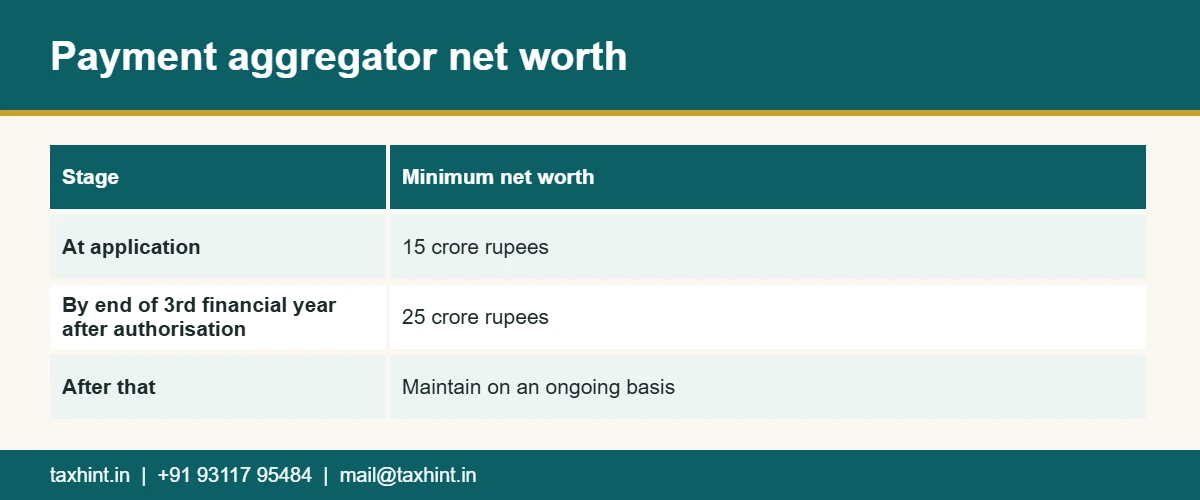
An entity applying for authorisation must have a minimum net worth of 15 crore rupees when it applies, and reach at least 25 crore rupees by the end of the third financial year after authorisation. The minimum must be kept on an ongoing basis. For this purpose, net worth also counts preference shares that are compulsorily convertible into equity.
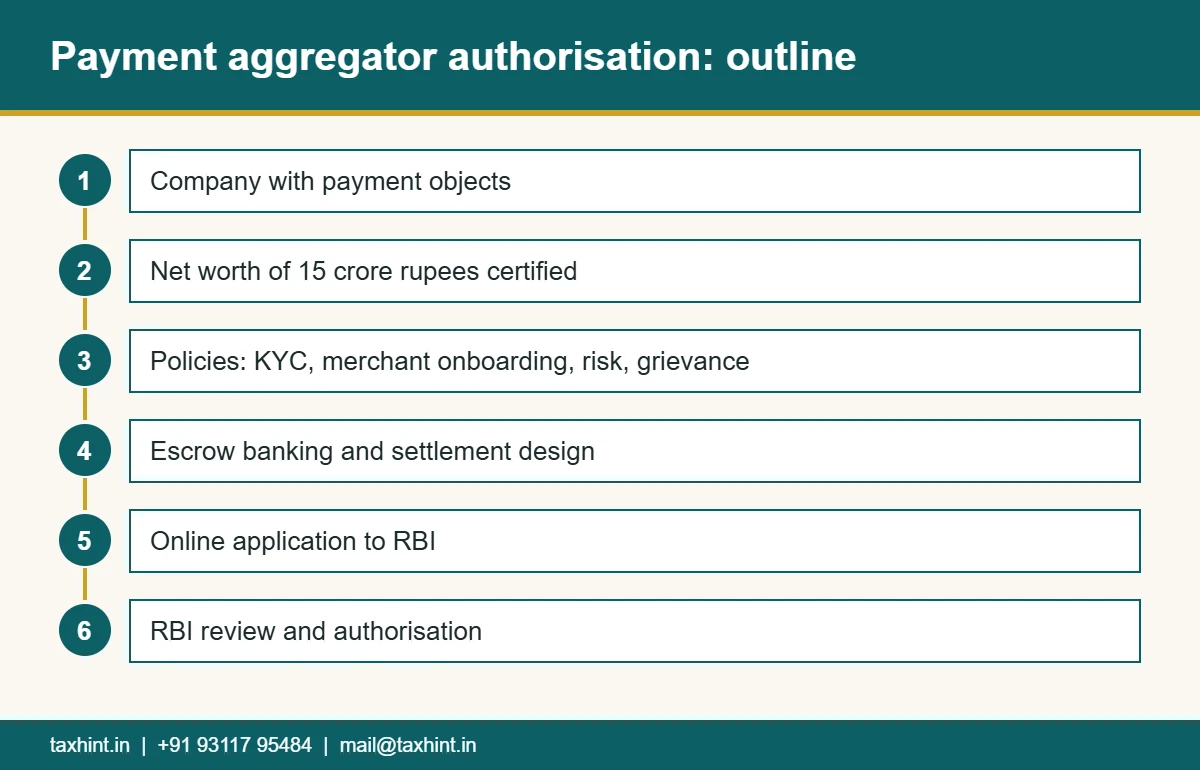
How the application usually runs
Plan the capital, the systems and the policies together. RBI reviews governance, technology and security, not just the money.
After authorisation
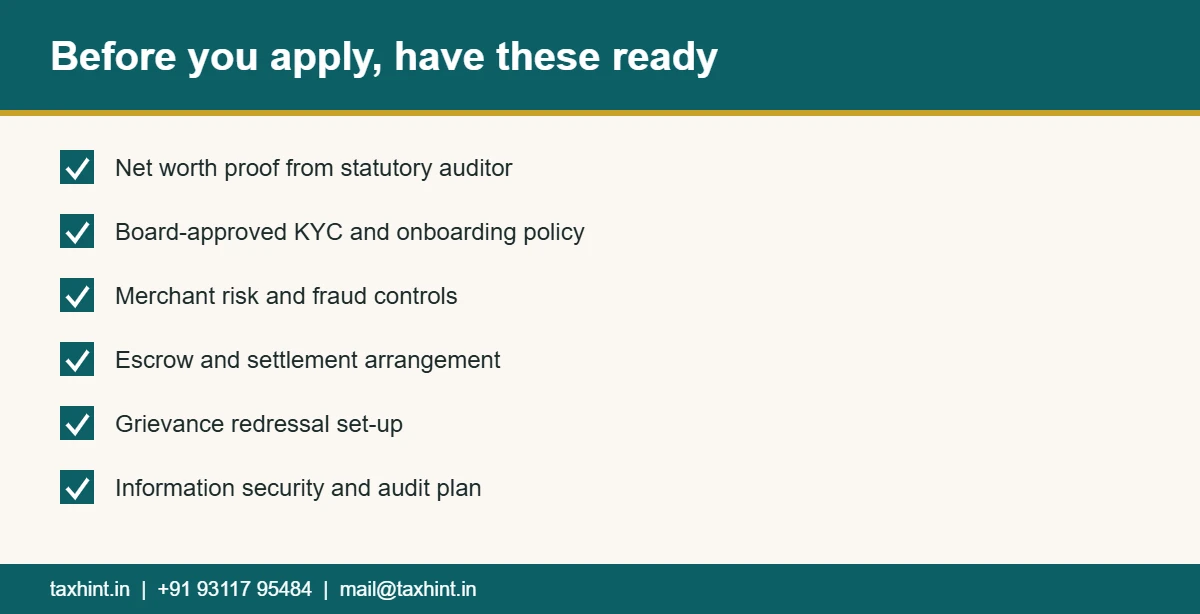
The Master Direction also covers escrow accounts, merchant due diligence, governance and reporting. Expect yearly compliance work and auditor certificates. See payment aggregator compliance.
A worked example
A start-up builds a checkout for small online sellers and wants to collect customer payments and settle them to sellers. That makes it a payment aggregator, so it needs RBI authorisation. It has raised 16 crore rupees, which clears the 15 crore floor at application. Its business plan shows how it will reach 25 crore rupees of net worth by the end of the third year after authorisation, through profits and a planned second round. Without that plan, RBI would have good reason to doubt it can stay compliant.
How we help
We structure the company, coordinate the net worth certificate and prepare the application and policies. See payment aggregator licence. Building a lending business instead? See NBFC registration and NBFC vs bank.
Payment aggregator or payment gateway
People use the two words loosely, but the difference matters for licensing. An aggregator receives money from customers and settles it to merchants, so funds pass through its hands, usually via an escrow account. A gateway provides the technology that routes the payment, without itself holding the money. If your model has any point where merchant funds sit with you, plan for aggregator authorisation.
Common mistakes
Starting operations first. A non-bank needs authorisation before it carries on aggregator business.
Counting loans as net worth. Net worth is computed as RBI specifies; borrowed money is not capital.
No plan for year three. Clearing 15 crore at application is not enough if the path to 25 crore is unclear.
Frequently asked questions
Does a bank need RBI authorisation to be a payment aggregator?
No. Under the Master Direction, banks do not need separate authorisation.
What net worth does a non-bank need?
At least 15 crore rupees when applying and 25 crore rupees by the end of the third financial year after authorisation.
Do convertible preference shares count?
Yes. Compulsorily convertible preference shares are included in net worth for this purpose.
How do you apply?
A non-bank applies for authorisation through RBI’s online portal.
Which law governs payment aggregators?
The Payment and Settlement Systems Act, 2007, with RBI’s Master Direction on Regulation of Payment Aggregators.
Need help? Planning a payment aggregator? Get Free Consultation or call +91 93117 95484.