November 27, 2026 · Guides
NBFC vs Bank: The Real Differences
NBFCs lend and invest, so they look a lot like banks from the outside. RBI itself says their activities are akin to those of banks. But the law treats them very differently.
Here are the differences RBI lists, and what they mean if you are deciding whether to start an NBFC.
In this guide
- The three differences RBI lists
- Registration and capital
- Why choose an NBFC
- NBFC vs other options
- How we help
- Two lenders, two structures
- Questions to ask before you decide
- FAQs
The three differences RBI lists
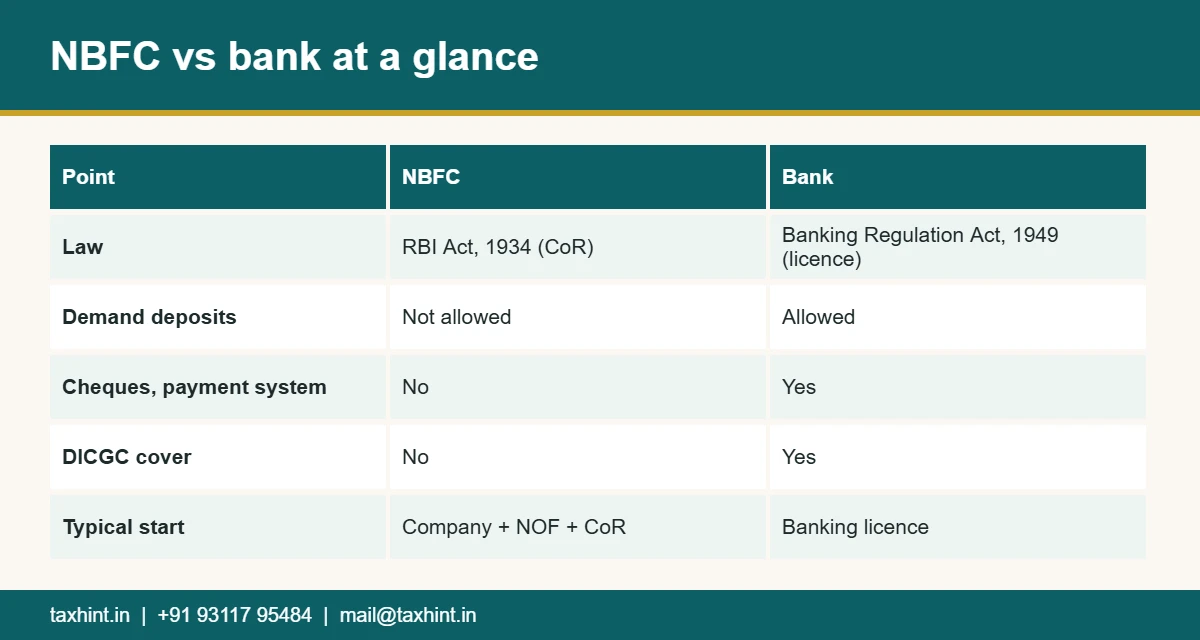
RBI’s FAQ on NBFCs names three:
- NBFCs cannot accept demand deposits.
- NBFCs are not part of the payment and settlement system and cannot issue cheques drawn on themselves.
- DICGC deposit insurance is not available to depositors of deposit-taking NBFCs.
Registration and capital
A company must get a Certificate of Registration under section 45-IA of the RBI Act and hold the minimum net owned fund before it starts NBFC business. For a lending NBFC (ICC) that is 10 crore rupees. RBI’s FAQ lists higher figures for specialised types, for example 300 crore rupees for an infrastructure finance company and 20 crore rupees for a housing finance company.
Applications are made online on RBI’s PRAVAAH portal.
Why choose an NBFC
An NBFC can lend to the public, focus on a niche such as vehicles, gold, MSMEs or microfinance, and move faster than a bank on product design. It cannot offer current or savings accounts or cheque books, so its money comes from capital and borrowings rather than everyday deposits.
NBFC vs other options
If you only want to serve members, a Nidhi company or a credit co-operative society may fit better. Our comparison and entity chooser help you decide.
How we help
We take you from company formation to RBI registration. See NBFC registration, types of NBFC and the NOF calculator.
Two lenders, two structures
A group wants to give two-wheeler loans to the public in three districts. It has capital of more than 10 crore and does not need to take deposits. An NBFC suits it: it can lend to anyone who qualifies, fund growth with bank borrowings and never needs a cheque book.
Another group wants a place where employees of a large factory can save every month and borrow in emergencies. It has nowhere near 10 crore. A credit co-operative society fits much better, because it works only with members and needs far less to start.
Questions to ask before you decide
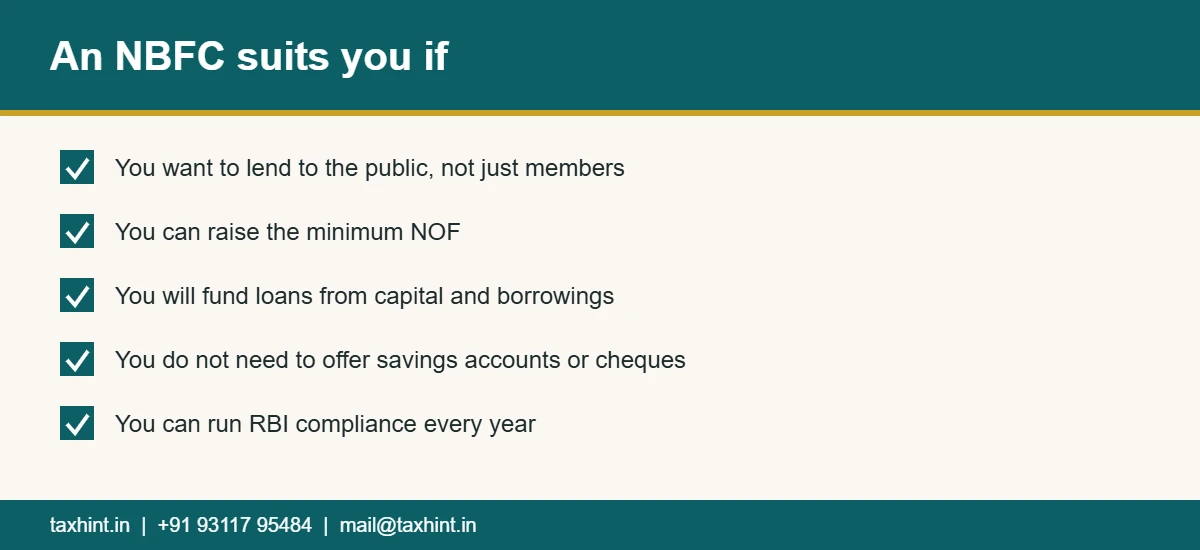
- Will you lend to the public or only to members?
- Can you raise the minimum NOF for your NBFC type?
- Where will the money to lend come from after the first year?
- Do you have people with lending and collection experience?
- Can you run RBI and ROC compliance every year?
If most answers point away from an NBFC, look at the alternatives first.
Frequently asked questions
Can an NBFC accept demand deposits?
No. This is one of the main differences RBI lists.
Can an NBFC issue cheques?
No. NBFCs are not part of the payment and settlement system and cannot issue cheques drawn on themselves.
Are deposits with an NBFC insured?
No. DICGC insurance is not available to depositors of deposit-taking NBFCs.
How much capital does a lending NBFC need?
A minimum net owned fund of 10 crore rupees for an ICC.
Where do you apply for NBFC registration?
On RBI’s PRAVAAH portal.
Need help? Thinking of starting an NBFC? Get Free Consultation or call +91 93117 95484.