November 25, 2026 · Guides
What Is an MIS Deposit? Monthly Income Scheme Explained
MIS stands for monthly income scheme. The depositor puts in a lump sum for a fixed term and receives interest every month. The principal is returned at the end of the term.
It suits people who want a regular income, such as retirees, rather than growth at maturity.
Here is how it works.
In this guide
How it works
Steps.
- Depositor places a lump sum for a fixed term.
- Interest is paid each month at the agreed rate.
- Principal is returned at maturity.
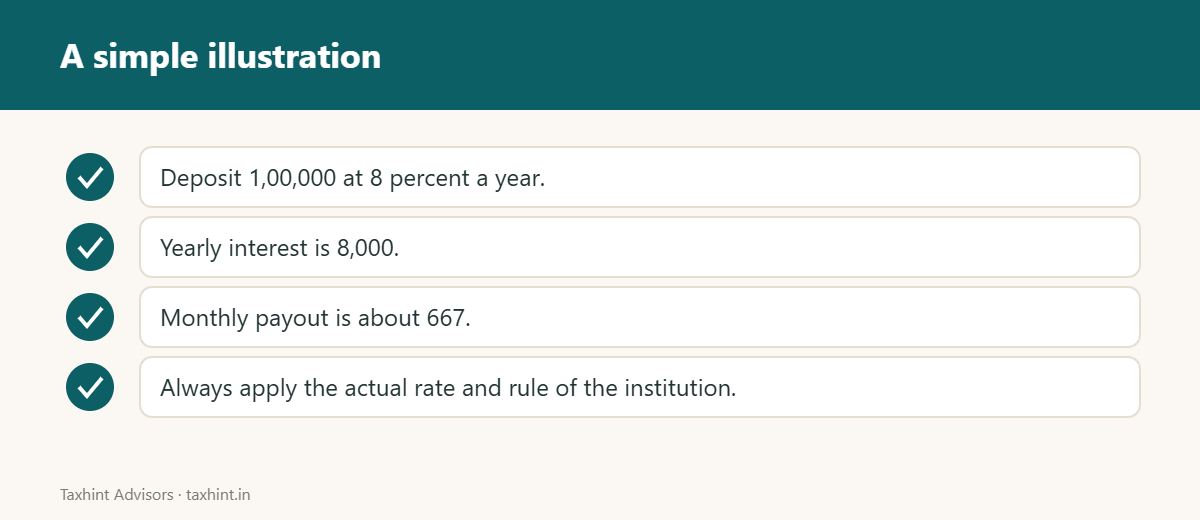
A simple illustration
Numbers for learning only.
- Deposit 1,00,000 at 8 percent a year.
- Yearly interest is 8,000.
- Monthly payout is about 667.
- Always apply the actual rate and rule of the institution.
Compare with FD
Different cash flow.
- Cumulative FD adds interest to the deposit and pays at maturity.
- MIS pays out each month, so the balance does not grow.
- Use the MIS interest calculator to compare.
Payout handling
Operational points.
- Payout by bank transfer on a fixed date.
- TDS and declaration forms where applicable. Please verify.
- Premature closure rules in the scheme. See MIS scheme software.
MIS in software
What lenders need.
- Payout schedule generated at opening.
- Bulk payout files and reconciliation.
- Maturity alerts and renewal follow-up.
See Nidhi software and credit and thrift society software. Rules differ by entity type and change over time, so please verify with your CA or CS.
| Item | Example |
|---|---|
| Deposit | 1,00,000 |
| Rate | 8% a year |
| Monthly payout | About 667 |
A simple example
A member deposits a lump sum and receives interest every month instead of at maturity. At the end of the term the principal is returned. The scheme rules decide the rate, the payout date and what happens on early closure.
Common misunderstandings
- An MIS pays out interest regularly, unlike a cumulative deposit.
- The principal is returned at maturity, not monthly.
- Early closure may carry a different rate or charge as per the scheme.
Why it matters in daily work
MIS deposits need accurate monthly payout tracking and clear records, so that members receive the right amount on the right date.
Quick checklist
- State payout date and mode in the scheme.
- Automate monthly interest entries.
- Test early closure cases.
- Review payout exceptions each month.
Related terms to read next
This term links to other parts of your process. These guides cover them.
- Premature FD closure
- Deposit maturity alerts
- Nidhi FD and RD (Hindi)
Please verify with your CA, CS or lawyer before you rely on it.
Questions people ask
When do I get the interest? On the payout date stated in the scheme, usually every month.
What if I close early? The scheme sets the rate and charges for early closure. Ask before you deposit.
Is the principal paid monthly? No. The principal comes back at maturity.
Practical tip
Prepare a simple monthly payout list showing each member, the amount and the date, and match it with the bank payment file before release. Put it in your written procedure so that every new staff member follows it from the first day.
- Payout list
- Bank file match
- Exceptions noted
FAQs
Is MIS interest paid monthly?
Yes, by definition.
Does the principal grow?
No, it is repaid at maturity.
Who offers MIS?
Banks, post office and some societies or Nidhis within their rules. Please verify.
Is MIS taxable?
Interest is generally taxable. Please check with your CA.
Want MIS payouts scheduled automatically? Book a demo of Taxhint software. Talk to Taxhint on +91 93117 95484 or [email protected], or visit taxhint.in.