November 25, 2026 · Guides
What Is a Recurring Deposit? How RD Works With an Example
A recurring deposit, or RD, is a savings product where a depositor pays a fixed amount every month for a chosen period and receives the total plus interest at maturity.
It suits people who cannot invest a lump sum but can save regularly. Banks, cooperative societies and Nidhi companies offer RDs, each within their own rules.
Here is how it works.
In this guide
How it works
Steps.
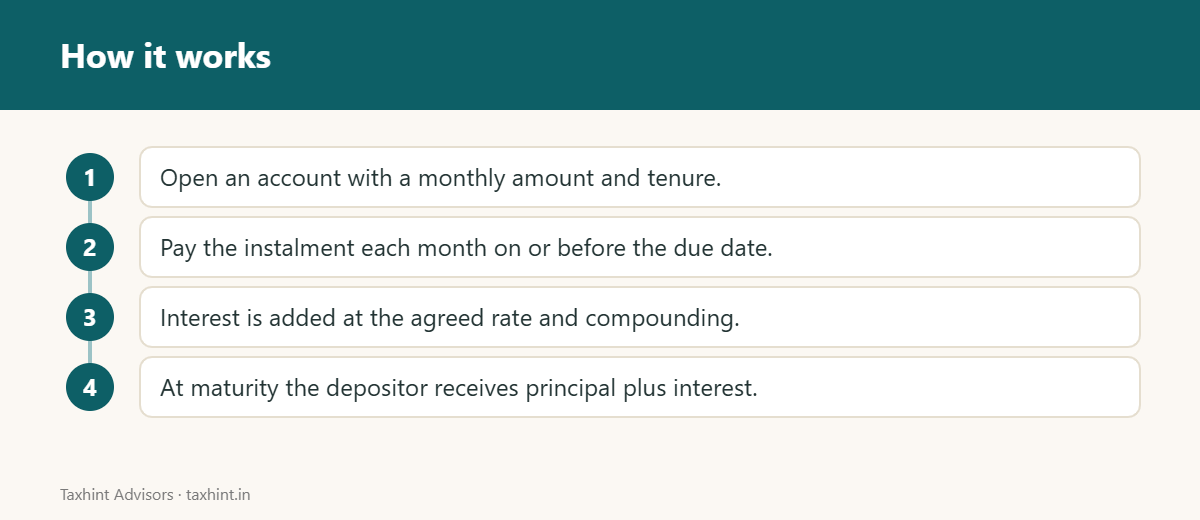
- Open an account with a monthly amount and tenure.
- Pay the instalment each month on or before the due date.
- Interest is added at the agreed rate and compounding.
- At maturity the depositor receives principal plus interest.
Missed instalments
Rules differ.
- Many lenders charge a small penalty for late instalments as per the scheme.
- Repeated defaults can lead to closure or reduced interest.
- See RD default penalty.
Calculating maturity
Use a calculator.
- Maturity depends on amount, tenure, rate and compounding frequency.
- Try the RD calculator to see your own numbers.
- Interest rates are set by each institution. Please check the current rate.
Premature closure
Know the terms.
- Closure before maturity is usually allowed with reduced interest.
- Terms are in the scheme document. See premature closure process.
Running RDs in software
What lenders need.
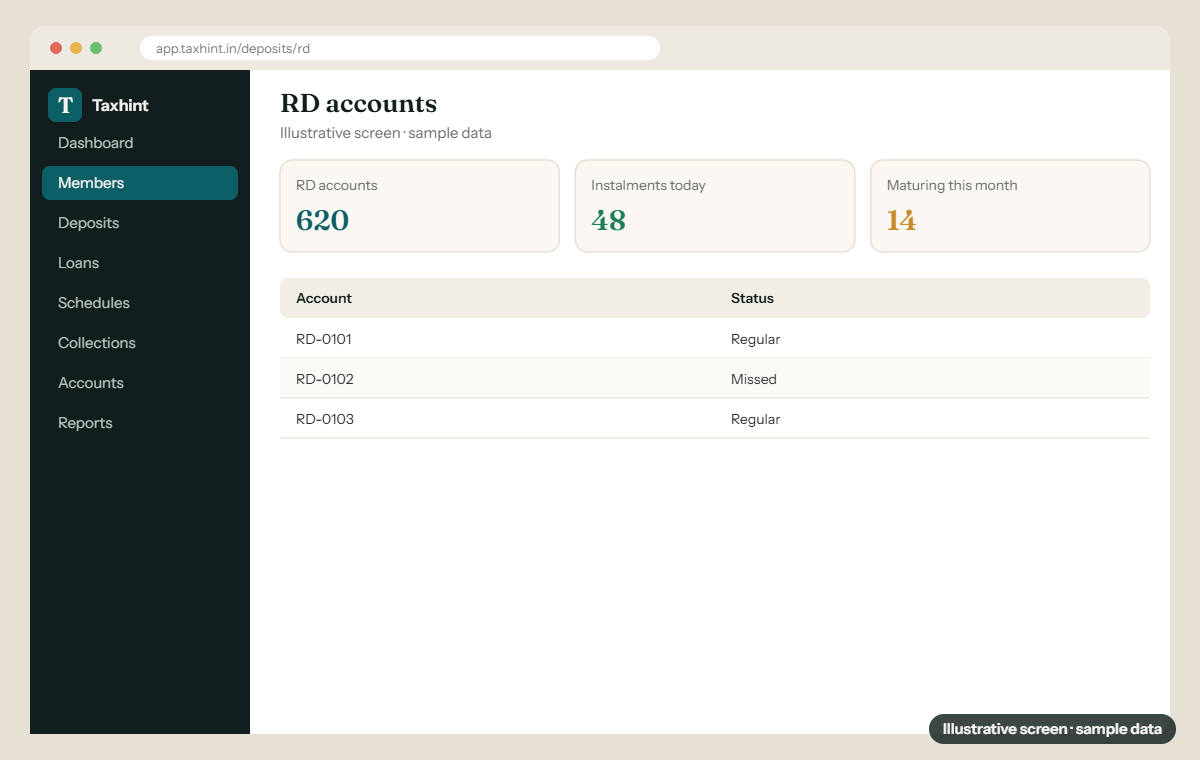
- Schedule of instalments with due dates and reminders.
- Receipts and passbook.
- Maturity alerts and payout. See payout options.
- Defaulter list by days late.
See Nidhi software and credit and thrift society software. Rules differ by entity type and change over time, so please verify with your CA or CS.
| Term | Meaning |
|---|---|
| Instalment | Fixed monthly amount |
| Tenure | Months of saving |
| Maturity | Principal plus interest |
A simple example
A member deposits a fixed amount every month for a set number of months. At maturity the member receives the total deposits plus the interest as per the scheme. If an instalment is missed, the scheme rules decide what happens, and the member should know them at the start.
Common misunderstandings
- An RD is not the same as a fixed deposit, where a lump sum is deposited once.
- Interest depends on the scheme, not on a universal rate.
- Missing instalments can change the maturity amount.
Why it matters in daily work
RDs are popular with members who save regularly. Software must track each instalment, the interest and the maturity date, and show the member a clear passbook.
Quick checklist
- Write the scheme rules in simple words.
- Test instalment and maturity calculations.
- Show missed instalments in the passbook.
- Send maturity reminders.
Related terms to read next
This term links to other parts of your process. These guides cover them.
- Nidhi FD and RD (Hindi)
- RD default penalty
- Deposit maturity alerts
Please verify with your CA, CS or lawyer before you rely on it.
Questions people ask
Can I stop an RD in the middle? Usually yes, but the scheme rules decide the interest and any charge, so read them first.
What if I miss one instalment? The scheme may charge a small amount or adjust maturity. Ask for the rule in writing.
Is the maturity amount fixed? It is fixed by the scheme at the start if all instalments are paid on time.
FAQs
Is RD better than FD?
They serve different needs: RD for regular saving, FD for lump sum.
Can I stop an RD midway?
Yes, usually with reduced interest.
Is RD interest fixed?
Usually fixed for the tenure at opening.
Who can offer RDs?
Banks, and societies or Nidhis within their rules. Please verify.
Want RD instalments and maturity alerts handled automatically? Book a demo of Taxhint software. Talk to Taxhint on +91 93117 95484 or [email protected], or visit taxhint.in.