November 25, 2026 · Guides
What Is Share Capital in a Cooperative Society? Meaning and Records

Share capital is the amount members contribute to a cooperative society in return for shares. It is the owned fund of the society and gives each member a stake.
Unlike a company, a cooperative usually follows the principle of one member, one vote, regardless of the number of shares held. The exact rules are in the cooperative law and the society’s bye-laws.
Here is how it works.
In this guide
How it works
Basics.
- A person becomes a member by paying for shares as per bye-laws.
- Share value and minimum holding are set by the society.
- Shares are generally not traded; refunds happen on withdrawal under rules.
Why it matters
The capital base.
- It funds lending and operations.
- It supports reserves and borrowing power.
- Dividend on share capital is limited by rules. See dividend in a cooperative society.
Records to keep
Registers and proofs.
- Share register with member, number of shares and dates.
- Share certificates where issued. See share transfer register.
- Allotment and refund approvals by the board.
- Reconciliation with the share capital ledger.
Common mistakes
Avoid these.
- Allotting shares without proper receipt.
- Refunding without board approval.
- Register not matching the ledger.
In software
What helps.
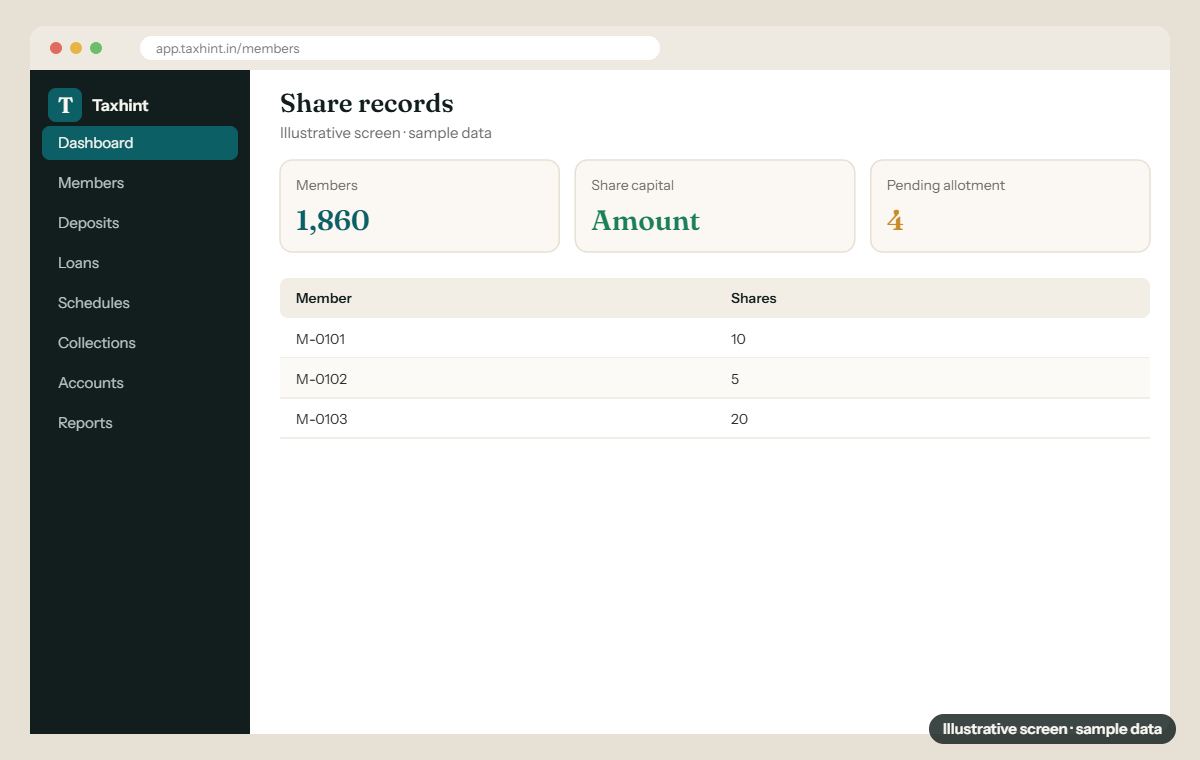
- Share register linked to member master.
- Allotment, transfer and refund workflows.
- Share capital report for the auditor.
See credit and thrift society software. Rules differ by entity type and change over time, so please verify with your CA or CS.
| Item | Evidence |
|---|---|
| Allotment | Board approval and receipt |
| Register | Matches ledger |
| Refund | Approval and voucher |
A simple example
A person joins a co-operative society by buying shares of a fixed face value. The total of all shares forms the share capital. Members get a share certificate or entry in the register, and may be paid a dividend as per the bye laws and the law.
Common misunderstandings
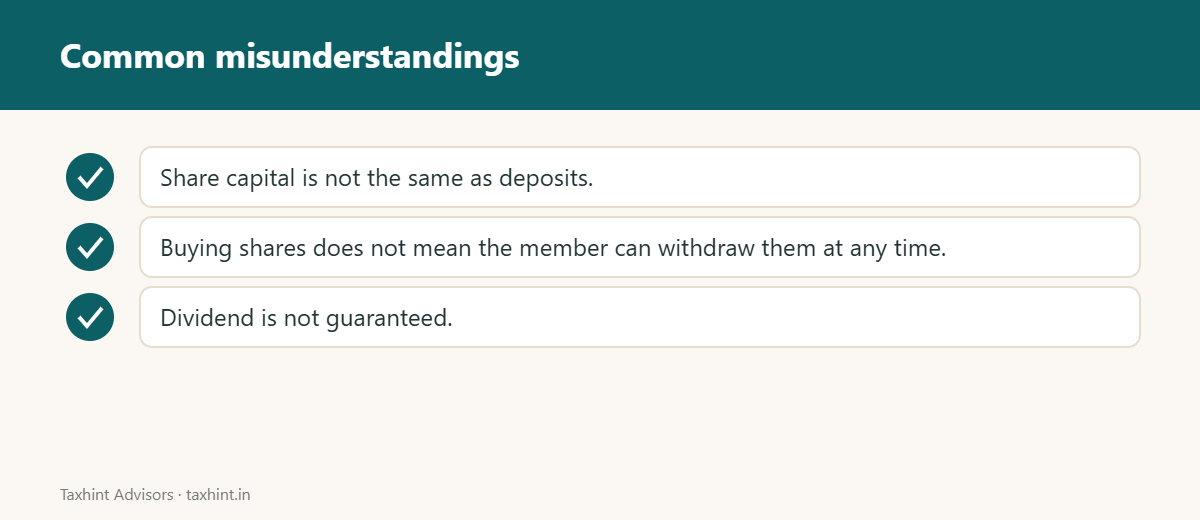
- Share capital is not the same as deposits.
- Buying shares does not mean the member can withdraw them at any time.
- Dividend is not guaranteed.
Why it matters in daily work
Share capital shows the ownership of members and is part of the funds of the society. Records must be accurate, as they affect voting and dividend.
Quick checklist
- Keep a clear share register.
- Issue certificates as per bye laws.
- Link shares to member records in software.
- Reconcile share capital with the books.
Related terms to read next
This term links to other parts of your process. These guides cover them.
- Dividend in cooperative society
- Society reserve tracking
- Credit society basics (Hindi)
Please verify with your CA, CS or lawyer before you rely on it.
Questions people ask
Can I sell my shares? Only as the bye laws and the law allow, often back to the society.
Is share capital refundable? On leaving, subject to the bye laws and the law.
Does more share capital give more votes? Usually voting follows the bye laws, often one member one vote.
Practical tip
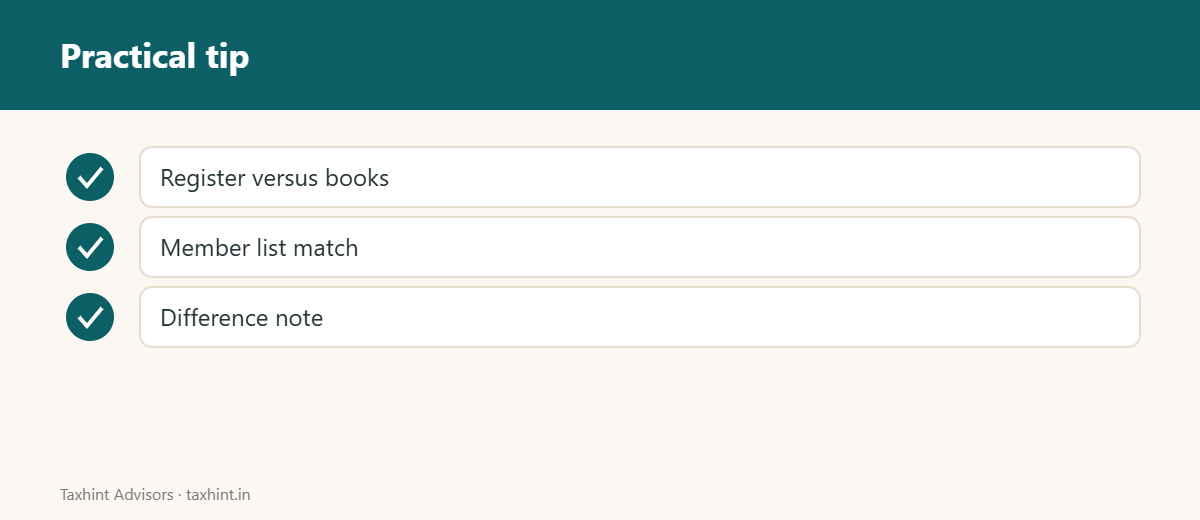
At each year end, reconcile the share register with the books and with the member list, and note any difference and its cause. Put it in your written procedure so that every new staff member follows it from the first day.
- Register versus books
- Member list match
- Difference note
FAQs
Do members get voting power by shares?
Usually one member, one vote. Please check your bye-laws.
Is share capital refundable?
Yes on withdrawal as per rules and bye-laws.
Is it the same as a deposit?
No, it is ownership capital, not a deposit.
Who sets the share value?
The society through bye-laws within the law.
Want share registers tied to ledgers? Book a demo of Taxhint society software. Talk to Taxhint on +91 93117 95484 or [email protected], or visit taxhint.in.