November 25, 2026 · Guides
What Is a CASA Account? Current and Savings Accounts Explained
CASA stands for current account and savings account. These are low cost deposit accounts that allow regular deposits and withdrawals, unlike fixed or recurring deposits that lock money for a term.
For banks, a high CASA share means cheaper funds. For societies, savings accounts are the daily relationship with members.
Here is how they differ.
In this guide
Savings account
For individuals.
- Meant for personal savings with interest.
- Deposits and withdrawals within limits.
- Passbook or statement provided.
Current account
For businesses.
- Meant for frequent business transactions.
- Usually no interest.
- Higher transaction limits.
Why CASA matters
Cost of funds.
- Interest on CASA is lower than on term deposits.
- A large CASA base lowers an institution’s funding cost.
- They also give a stable base of day to day customers.
Who can offer them
Not everyone.
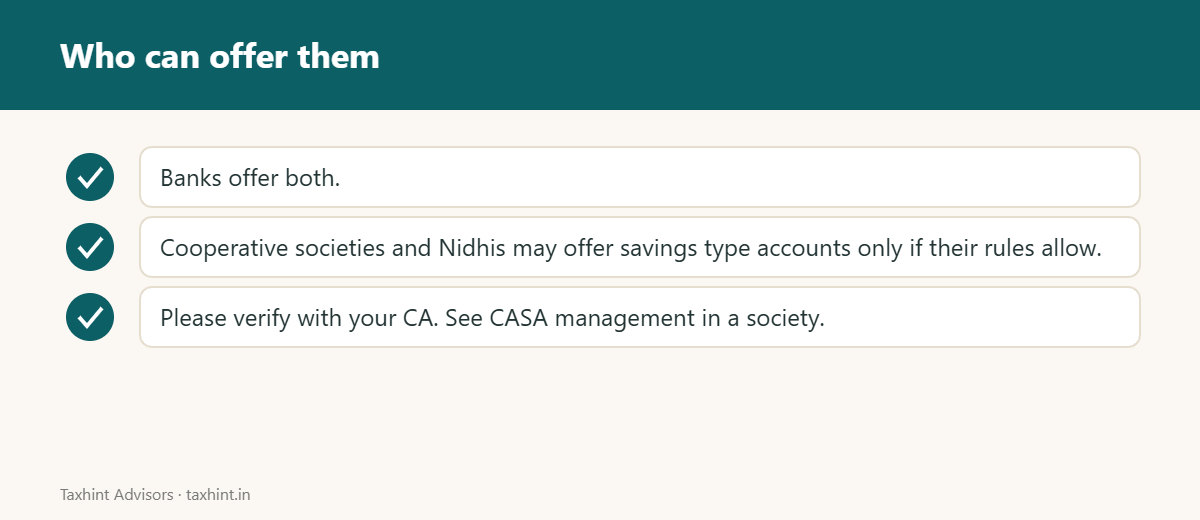
- Banks offer both.
- Cooperative societies and Nidhis may offer savings type accounts only if their rules allow.
- Please verify with your CA. See CASA management in a society.
In software
What helps.
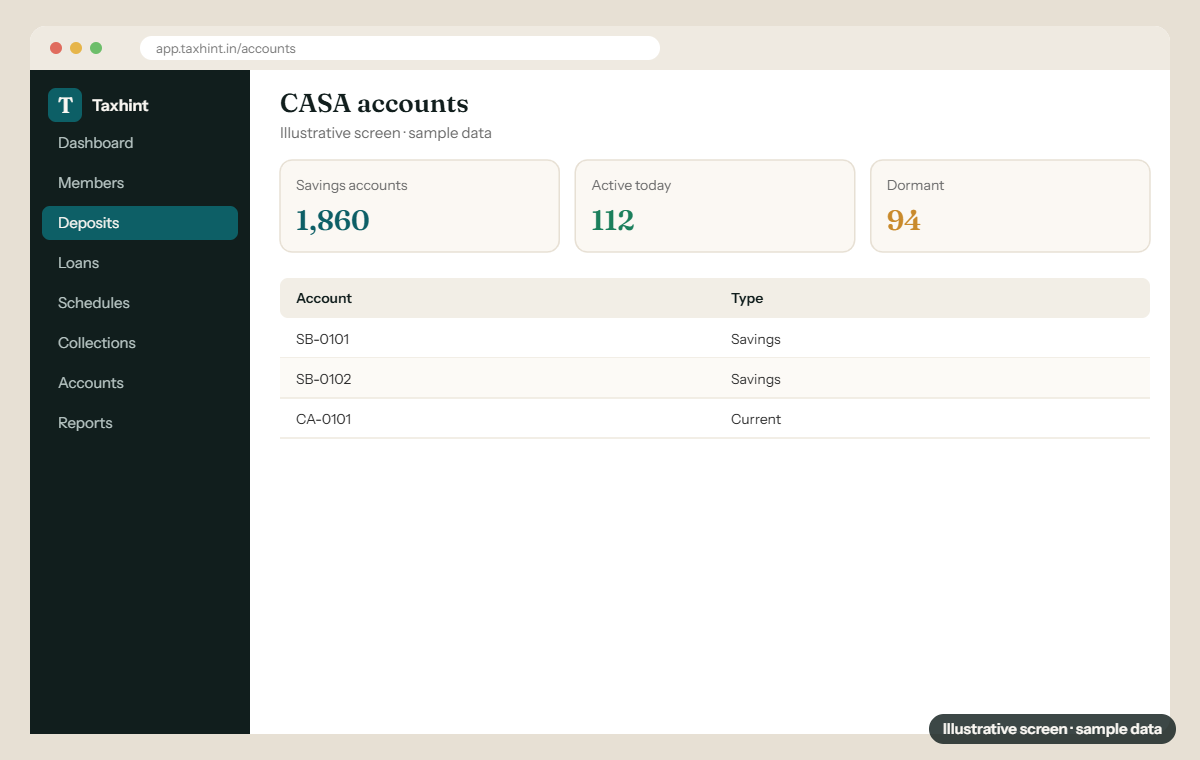
- Account opening with KYC and nominee.
- Daily deposits and withdrawals with receipts.
- Interest posting and dormant account alerts.
See credit and thrift society software. Rules differ by entity type and change over time, so please verify with your CA or CS.
| Feature | Savings |
|---|---|
| Purpose | Personal savings |
| Interest | Usually yes |
| Use | Individuals |
A simple example
A member keeps a savings account for daily balances and receives interest. A trader keeps a current account for frequent deposits and withdrawals without interest. Both are called CASA accounts, which stands for current and savings accounts.
Common misunderstandings
- CASA does not mean fixed deposits.
- Not every institution may offer these accounts.
- Interest and charges depend on your scheme.
Why it matters in daily work
CASA balances are low cost funds for an institution that is allowed to offer them, but they need strong controls and clear rules.
Quick checklist
- Confirm that your institution may offer such accounts.
- Write the scheme and charges.
- Set interest and minimum balance rules in software.
- Review dormant accounts.
Related terms to read next
This term links to other parts of your process. These guides cover them.
- CASA account management in society
- Core banking system
- Day end controls
Please verify with your CA, CS or lawyer before you rely on it.
Questions people ask
Does a current account pay interest? Usually not, but it allows frequent transactions.
Can any society offer CASA? Not necessarily. Confirm with your CA or the authority.
What is a dormant account? An account with no transactions for a long period as defined by the institution policy.
Practical tip
Prepare a one page note on rates, minimum balance and charges and hand it to every customer who opens an account. Put it in your written procedure so that every new staff member follows it from the first day.
- Rates
- Minimum balance
- Charges
Where CASA fits in daily banking
CASA stands for current account and savings account. Both hold money that the customer can take out on demand, so banks and cooperatives treat them as low cost, flexible deposits.
Small lenders such as societies and Nidhi companies may offer similar savings products, but the exact permission depends on the entity and the law. Please verify with your CA or CS.
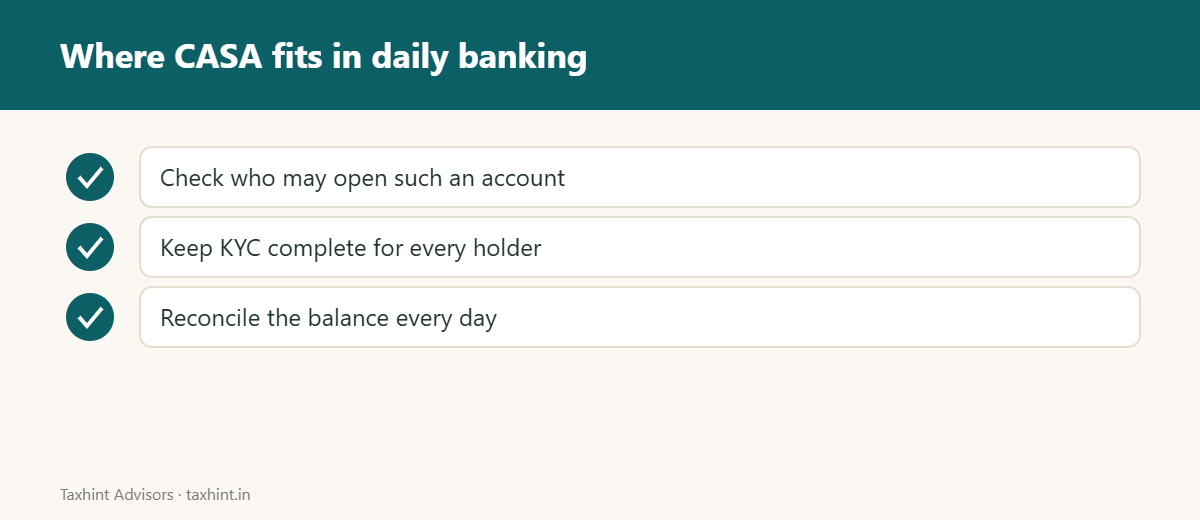
- Check who may open such an account
- Keep KYC complete for every holder
- Reconcile the balance every day
FAQs
Is CASA a loan?
No, it is a deposit product.
Does a current account earn interest?
Usually not.
Can a society offer current accounts?
Depends on its bye-laws and law. Please verify.
What is a dormant account?
One with no transactions for a long period.
Want savings accounts with passbook and interest? Book a demo of Taxhint society software. Talk to Taxhint on +91 93117 95484 or [email protected], or visit taxhint.in.