Section 8 or NBFC-MFI: which is better for you?
Section 8 or NBFC-MFI which is better depends on your capital, dividend plans and growth. Answer six quick questions and see which microfinance route fits. Nothing is saved or sent.
Answer six questions
Indicative only. Nothing you select here is stored or sent anywhere. Confirm the structure with your CA before you incorporate.
Section 8 or NBFC-MFI which is better: how we score it
There is no universal winner between the two routes. The right one depends on how much capital you can bring, whether anyone wants dividends, and how big the loan book will get. The checker above turns those facts into a recommendation using the same tests a CA would apply.
It is a rule-based checker, not a score out of 100. It applies a short sequence of hard tests and picks the first one that decides the answer.
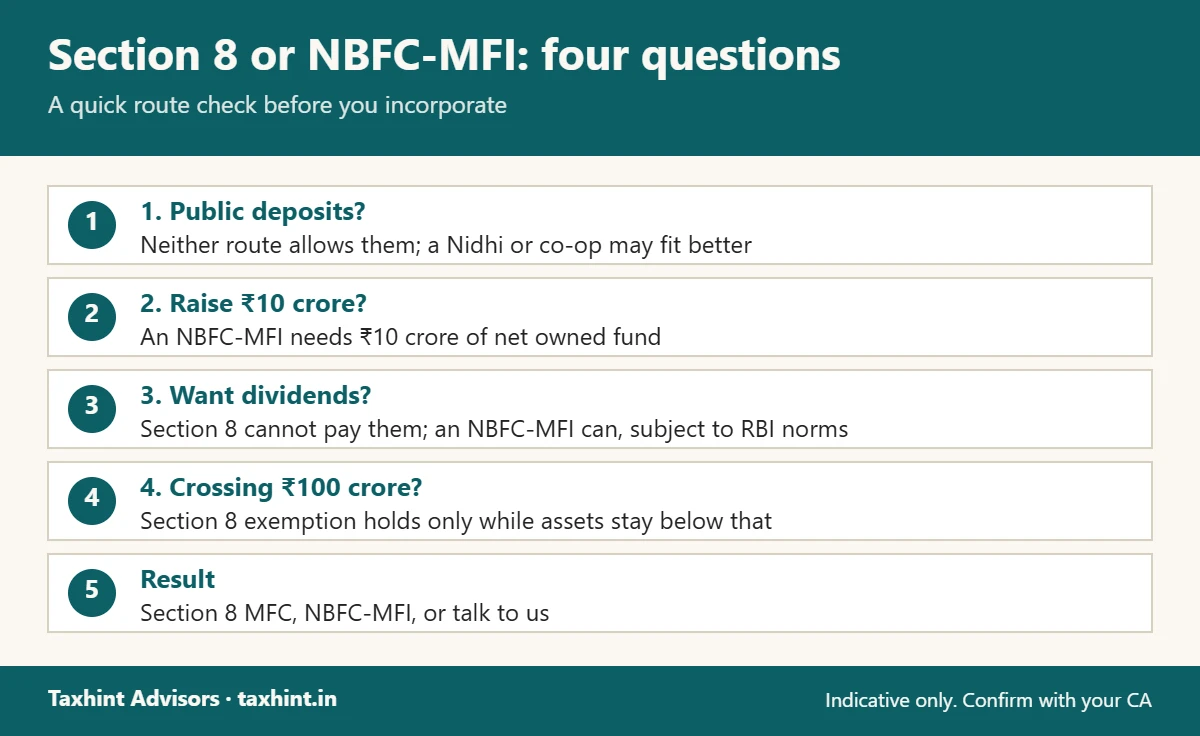
Deposits first
If you want public deposits, neither route works. A Section 8 microfinance company must take none to stay exempt, and an NBFC-MFI is a non-deposit-taking NBFC.
Capital and profit next
Section 8 companies pay no dividend. An NBFC-MFI needs ₹10 crore of net owned fund. Promoters who want dividends but cannot raise that amount need a different conversation.
Size and growth last
The exemption from RBI registration holds only while assets stay below ₹100 crore. A plan that crosses it points to an NBFC-MFI from day one.
What the checker assumes
The tool assumes you will lend only microfinance loans, meaning collateral-free loans to households with annual income up to ₹3,00,000. If your borrowers are mostly above that income, you are looking at an ordinary NBFC and this checker does not apply.
It also assumes you are choosing for a new company. Converting or restructuring an existing trust, society or company changes the picture.
An NBFC-MFI must also keep at least 60% of its assets, net of intangibles, in microfinance loans. If you want a broader lending mix than that allows, you can test it with our qualifying assets calculator.
Caveats. The result is indicative. Section 8 licensing, RBI norms and your own funding sources can all move the answer. Take a trust in Palwal running a livelihood programme: it may tick every box for Section 8 today, yet a donor with different expectations can change the plan in one meeting. Confirm with your CA before you incorporate anything.
Quick comparison of the two routes
| Point | Section 8 microfinance company | NBFC-MFI |
|---|---|---|
| RBI registration | Exempt while only microfinance loans, no public deposits, assets below ₹100 crore | Certificate of registration, applied on PRAVAAH |
| Minimum capital | No RBI NOF requirement while exempt | ₹10 crore NOF |
| Dividend | Not allowed | Possible, subject to RBI norms |
| Public deposits | Not allowed | Not allowed |
| Asset mix | Microfinance loans only to stay exempt | At least 60% in microfinance loans |
For the full reasoning, read our guide to starting a microfinance company in India and the pages on Section 8 microfinance company registration and NBFC-MFI registration.
Frequently asked questions
Is a Section 8 microfinance company better than an NBFC-MFI?
Neither is better in general. A Section 8 company needs no RBI capital while it stays within the exemption but cannot pay dividends. An NBFC-MFI needs ₹10 crore of net owned fund and an RBI certificate of registration but can distribute profit.
When is a Section 8 microfinance company exempt from RBI registration?
It is exempt when it lends only microfinance loans, holds a Section 8 licence, takes no public deposits and keeps its assets below ₹100 crore, as set out in para 51 of the RBI NBFC Registration, Exemptions and SBR Directions, 2025.
How much capital does an NBFC-MFI need?
An NBFC-MFI needs ₹10 crore of net owned fund. The certificate of registration is applied for on the RBI PRAVAAH portal.
What counts as a microfinance loan?
A collateral-free loan to a household whose annual income is up to ₹3,00,000. Monthly repayment obligations are capped at 50% of monthly household income.
Can either route take public deposits?
No. A Section 8 microfinance company must take no public deposits to remain exempt, and an NBFC-MFI is a non-deposit-taking NBFC.
Is this checker legal advice?
No. It is an indicative tool built on published rules. It stores nothing and sends nothing. Please confirm your structure with your CA before incorporating.
Want a CA to confirm your route?
Share your plan with our CA and CS team and we will tell you which structure fits, and what it takes to set it up. Get Free Consultation.