November 21, 2026 · Guides
How to Start a Microfinance Company in India (2026 Guide)

There are two legal answers to how to start a microfinance company in India. You can form a Section 8 (not-for-profit) company that lends only microfinance loans and stays exempt from RBI registration while its assets are below ₹100 crore, or you can set up an NBFC-MFI with ₹10 crore of net owned fund and an RBI certificate of registration. Most first-time promoters we meet start with Section 8. They look at the NBFC route only when they need investors or a bigger book.
In this guide
- What microfinance means in law
- The two routes: Section 8 and NBFC-MFI
- Which route to pick: a checklist
- Steps to start a Section 8 microfinance company
- Steps to start an NBFC-MFI
- Documents you will need
- Capital and funding sources
- RBI rules for microfinance loans
- Software and operations from day one
- Compliance calendar
- Common mistakes
- FAQs
Settle the legal route first. Capital, documents, software and yearly filings all follow from that one choice. We have handled company and NBFC work for promoters across 28 states since 2014, and this guide is written the way we explain it across the table. Hindi readers can find the same guide as microfinance company kaise khole.
What microfinance means in law
“Microfinance” is not a loose label for any small loan. RBI defines a microfinance loan as a collateral-free loan given to a household whose annual income is up to ₹3,00,000. A household here means husband, wife and their unmarried children.
Two more conditions sit inside the definition. The loan cannot be backed by a lien on the borrower’s deposit account or by hypothecation of any security. And the household’s total monthly loan repayments, counting all its loans and not just yours, cannot go above 50% of its monthly income.
So a ₹40,000 loan to a vegetable seller in Palwal whose family earns ₹2.4 lakh a year qualifies. The same loan to a family earning ₹3.5 lakh does not, even if nothing else changes. A gold loan to that vegetable seller does not qualify either, because gold is collateral.
Promoters often skim past this definition, and it costs them later. The Section 8 exemption from RBI, and the 60% test for an NBFC-MFI, both depend on each loan meeting it.
The two routes: Section 8 and NBFC-MFI
The first route is a Section 8 company under the Companies Act, 2013. It is formed for charitable objects such as poverty relief, it cannot pay dividends, and it gets its licence from the Central Government at the time of incorporation. RBI exempts such a company from registration under Sections 45-IA, 45-IB and 45-IC of the RBI Act when four conditions hold together: it gives only microfinance loans, it holds a Section 8 licence, it takes no public deposits, and its assets stay below ₹100 crore. We have set out the full process on our Section 8 microfinance company registration page.
The second route is an NBFC-MFI. This is a regular private limited company that applies to RBI for a certificate of registration (CoR) and keeps at least 60% of its total assets, net of intangibles, in microfinance loans on an ongoing basis. It needs ₹10 crore of net owned fund before it applies. In return, it can pay dividends, raise equity from investors and grow without the ₹100 crore ceiling.
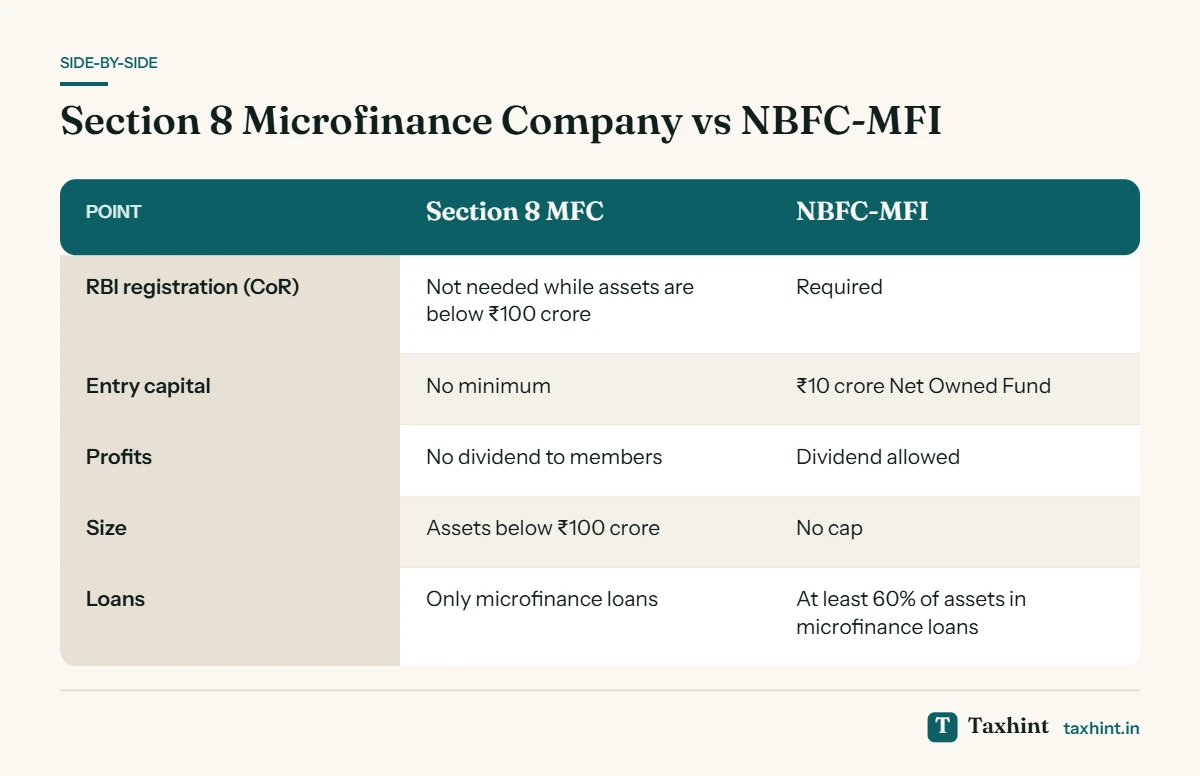
| Point | Section 8 microfinance company | NBFC-MFI |
|---|---|---|
| RBI registration | Not needed while all four exemption conditions hold | CoR required under Section 45-IA |
| Entry capital | No statutory minimum | ₹10 crore net owned fund |
| Loan mix | Only microfinance loans | At least 60% of assets in microfinance loans |
| Size limit | Assets below ₹100 crore | No such ceiling |
| Dividends | Not allowed | Allowed |
| Public deposits | Not allowed | Not allowed (non-deposit-taking) |
| Who regulates day to day | MCA (Companies Act), with RBI conditions for the exemption | RBI and MCA |
| Typical promoter | NGO, trust, society, CSR-minded founder, livelihood programme | Investor-backed team planning to scale |
We go deeper into the trade-offs, including tax and exit, in Section 8 vs NBFC-MFI.
Which route to pick: a checklist
We usually ask promoters five questions before anything is filed. Your answers almost always point to one route.
- Can you put ₹10 crore of owned funds into the company before you lend a rupee? If not, the NBFC-MFI route is closed for now. Section 8 is the practical start.
- Do you or your investors expect dividends, or a share sale at a profit? A Section 8 company cannot pay dividends. If returns matter, plan for an NBFC-MFI.
- Will every loan be collateral-free and within the ₹3 lakh household income limit? If you also want gold loans, property loans or business loans to larger borrowers, the Section 8 exemption will not hold. Look at an NBFC instead.
- Do you plan to raise donations or grants? A Section 8 company can register under 12A and 80G, which helps donors. An NBFC-MFI is a commercial lender and does not fit that model.
- Do you expect assets to cross ₹100 crore within a few years? A Section 8 company must register with RBI once it crosses that line. If you expect to get there fast, it may be cleaner to plan for the NBFC route from the beginning.
A trust in Faridabad running SHG loans out of donor money, for example, would answer “no” to the first two questions and “yes” to the fourth. That is a Section 8 case. Now take a team with a ₹12 crore commitment from an investor who wants returns in seven years. That one belongs on the NBFC-MFI route, and we would not suggest Section 8 even as a stepping stone.
How to start a microfinance company in India through Section 8
The Section 8 route runs entirely on the MCA V3 portal. Licence and incorporation are now done together in one filing, which saves a lot of back and forth compared with the old two-stage process.
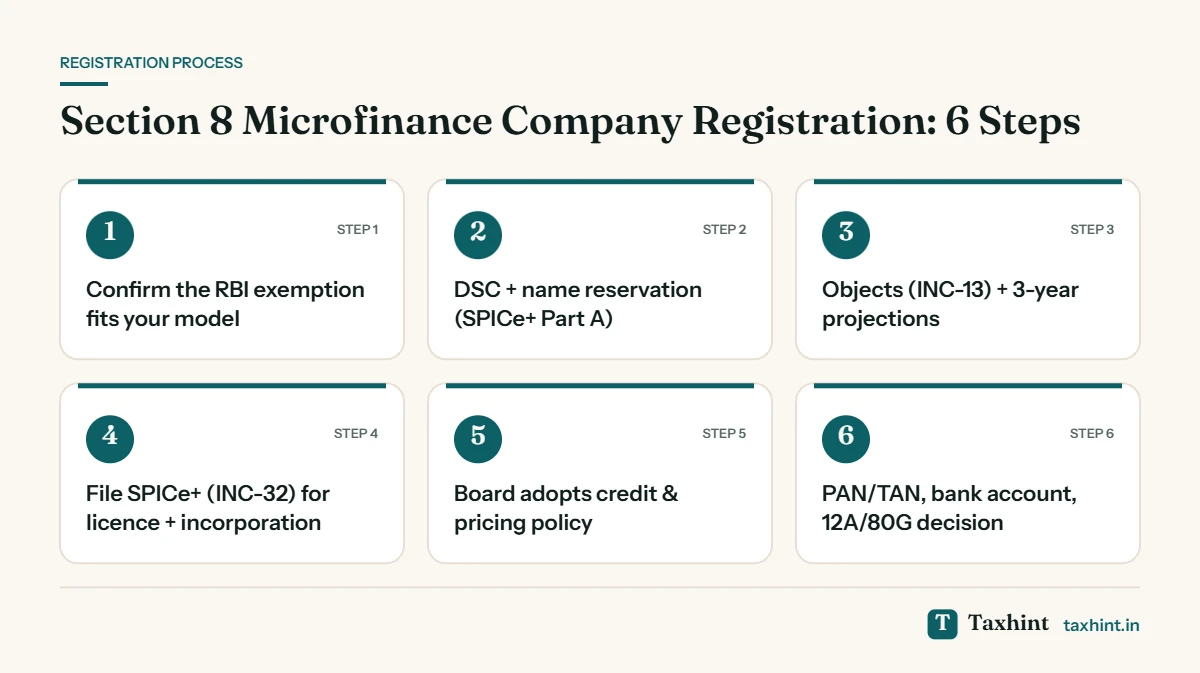
- Confirm the exemption fits. Write down your loan products and check each one: collateral-free, household income up to ₹3 lakh, repayments within 50% of monthly income, no deposits. If any product fails, fix it now.
- Get DSCs and reserve the name. Every proposed director needs a digital signature certificate. The name is reserved through SPICe+ Part A on the MCA portal.
- Draft the memorandum in Form INC-13. The objects must cover microfinance and poverty relief, and the memorandum must bar payment of dividends to members.
- Prepare the three-year income and expenditure estimate. This projection goes with the licence application, along with declarations from a professional and from each applicant.
- File SPICe+ (INC-32). Under Rule 19 of the Companies (Incorporation) Rules, 2014, the Section 8 licence and the certificate of incorporation are issued through this single application.
- Set up before the first loan. The Board adopts a credit policy and a pricing policy, and you put household income checks in place. Then decide whether to apply for 12A and 80G.
A full checklist of papers for this route is in documents for a Section 8 microfinance company. One practical note: MCA looks closely at whether the objects and the budget actually match a charitable purpose. A projection that shows large surpluses and no welfare spending tends to draw questions.
Steps to start an NBFC-MFI
The NBFC-MFI route has two stages. First you form a company, then you ask RBI for permission to lend. Do not disburse a single loan until the CoR is in hand.
- Test the numbers. Confirm you can raise ₹10 crore of net owned fund and that your business plan keeps 60% or more of assets in microfinance loans.
- Incorporate a private limited company. File SPICe+ on the MCA V3 portal with lending and microfinance objects in the memorandum.
- Bring in the NOF. Issue shares for the capital and get it certified by the statutory auditor. Net owned fund is not the same as paid-up capital; we explain the calculation in what net owned fund means.
- Draft Board policies. You will need a pricing policy for microfinance loans, a policy on the 50% household repayment limit, KYC and fair practices policies, and a business plan with projections.
- Apply on RBI PRAVAAH. The CoR application is filed online on RBI’s PRAVAAH portal. RBI sets no fixed time for its decision, so budget for queries and a wait.
- After the CoR. Join at least one RBI-recognised self-regulatory organisation for NBFC-MFIs, become a member of the credit information companies, and set up loan software that tracks household income and repayment limits.
Our team handles this end to end under NBFC-MFI registration, including the PRAVAAH filing and RBI queries.
Documents you will need
Both routes start with the same promoter papers. The NBFC-MFI route then adds a heavier set of financial and policy documents.
For every director and subscriber
- PAN and Aadhaar
- Passport-size photograph
- Recent bank statement or utility bill as address proof
- DIR-2 consent to act as director
- Digital signature certificate
For the registered office
- Utility bill not older than two months
- Notarised rent agreement with rent receipt, or ownership proof
- No-objection letter from the owner
Extra for a Section 8 company
- Draft objects covering microfinance and poverty relief
- Three-year estimate of income and expenditure
- Declarations by a professional and by each applicant
- Draft credit policy that tests the ₹3 lakh income and 50% repayment limits
Extra for an NBFC-MFI
- Board resolution approving the RBI application
- Shareholding pattern and details of group entities
- Bank certificate and auditor’s certificate for the ₹10 crore NOF
- Fit-and-proper declarations and profiles of directors showing finance experience
- Business plan with three-year projections and the Board-approved policies
Capital and funding sources
Companies law sets no minimum capital for a Section 8 company. Your loan book, though, can only be as big as the money you bring in. We usually ask promoters to plan the first year’s disbursements month by month and work backwards from there.
For a Section 8 company, money usually comes from three places. Promoters put in share capital. Donors and grant-makers give funds, and 12A and 80G registration make that easier. Later, once there are audited accounts and a repayment track record, some promoters look at borrowings from lenders. What a Section 8 company cannot do is take public deposits. Deposits are one of the four exemption tests, so take advice before accepting money from members or anyone else in a form that could look like a deposit.
An NBFC-MFI starts with ₹10 crore of owned funds from promoters or investors, and then typically borrows from banks and financial institutions to grow the book. Because it can pay dividends, it can attract equity investors, which a Section 8 company cannot.
Setting-up costs are separate from lending capital. Government charges include ₹1,000 for name reservation, a SPICe+ fee linked to authorised capital, state stamp duty on the MoA and AoA, and DSCs. We break this down further in microfinance company registration cost.
RBI rules for microfinance loans
Once you lend, a handful of RBI rules shape every loan file. These come from RBI’s microfinance framework, and RBI’s own FAQs on microfinance loans are worth reading in full.
- The household’s annual income must be up to ₹3,00,000. Assess it at household level, using a method set out in your Board-approved policy.
- Its monthly repayments on all loans, microfinance and others, cannot exceed 50% of its monthly income.
- You cannot ask for a deposit, margin or security, and the loan cannot be backed by a lien on the borrower’s deposit account.
- There is no prepayment penalty. Borrowers can repay early without a charge.
- RBI does not fix one interest rate. An NBFC needs a Board-approved pricing policy, and any rate change is notified in advance and applies only going forward.
- Recovery calls to borrowers with overdue loans cannot be made before 9 am or after 6 pm, and penal charges apply only to the overdue amount.
For a Section 8 company, the income and repayment limits sit inside the definition of a microfinance loan, so the exemption survives only if every loan meets them. We cover the rest of the framework in RBI microfinance rules explained.
Software and operations from day one
Most write-ups on how to start a microfinance company in India stop at registration. Software deserves a place in the plan too. A lot of new microfinance companies run the first year on registers and Excel, then struggle when the auditor asks for loan-wise ledgers. In our experience, putting proper software in place before the first disbursement costs far less than rebuilding a year of records later.
At a minimum, your system should handle member KYC (Aadhaar, PAN, photo), group and centre lending for JLG or SHG models, loan schedules, field collection through a mobile app, receipts, and reports your auditor and Board can use. You also need a way to record household income and existing EMIs at the time of application, because the 50% cap is checked on every loan.
Taxhint’s microfinance software covers group and centre setup, a collection app for field staff, Aadhaar and PAN verification, CIBIL checks, branch and user controls, and statutory reports. It is cloud-based and starts at ₹15,000.
On operations, decide early who does KYC, who sanctions, who collects and who reconciles cash. Separating these roles is the simplest fraud control a small lender has. Picture a field officer in a Bihar SHG cluster who both sanctions and collects. Even if that person is honest, nobody can show it when the auditor asks.
Compliance calendar
The yearly filings decide whether the company stays in good standing and, for Section 8, whether the RBI exemption holds.
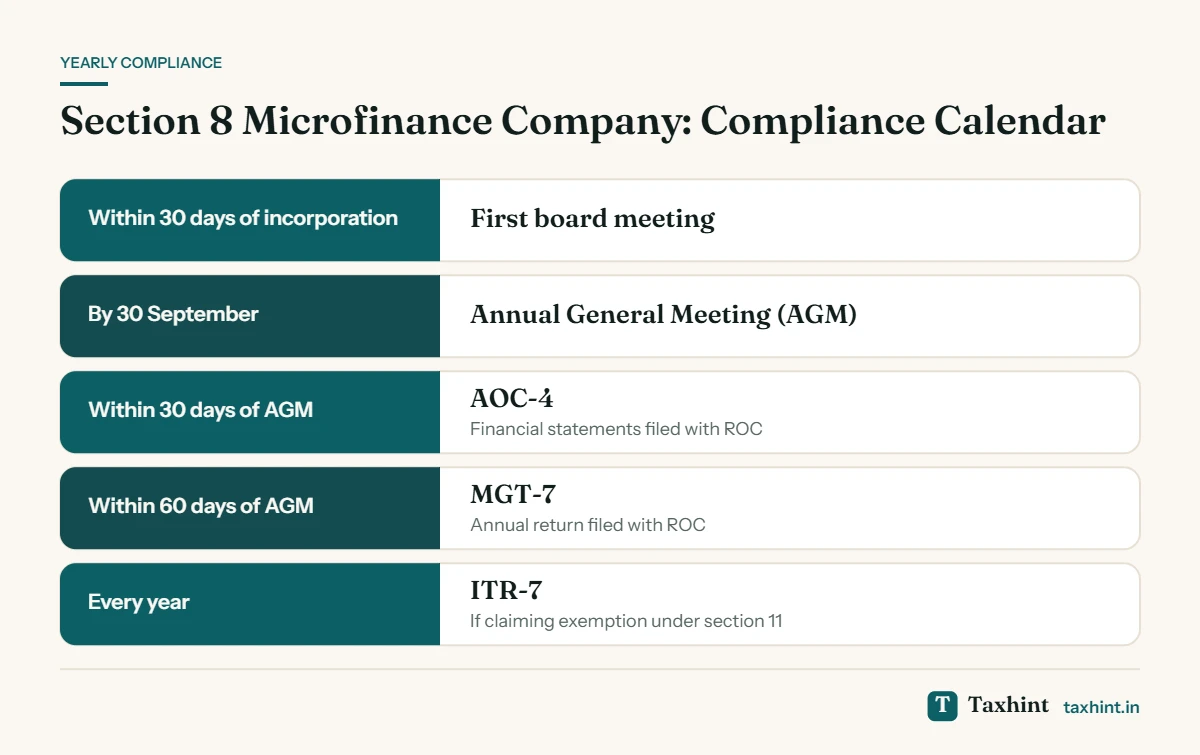
| When | Section 8 microfinance company | NBFC-MFI |
|---|---|---|
| Within 30 days of incorporation | First Board meeting (Section 173(1)) | First Board meeting |
| Every quarter | Check total assets against ₹100 crore and confirm all loans are microfinance loans | Check the 60% microfinance test and file RBI returns |
| Through the year | At least one Board meeting every six calendar months (if ROC filings are up to date) | Board meetings as per the Companies Act; credit bureau reporting |
| By 30 September | AGM | AGM |
| Within 30 days of AGM | AOC-4 (financial statements) | AOC-4 |
| Within 60 days of AGM | MGT-7 (not MGT-7A) | MGT-7 |
| Income tax due date | ITR-7 if Section 11 exemption is claimed, otherwise ITR-6 | ITR-6 |
For FY 2025-26, CBDT extended the due date for audit cases to 21 November 2026, so check each year’s date rather than relying on memory. Our Section 8 compliance service covers the full annual cycle.
Common mistakes
These are the problems we see most often when a microfinance company comes to us after a year or two of running on its own.
- Adding a gold loan “just for a few members”. Even one collateral-backed product breaks the Section 8 exemption, however small it is.
- Taking savings from members. Collecting weekly savings into the company’s account can look like a deposit. Keep SHG savings with the group’s own bank account, not in the company.
- Writing income on the form without checking it. The ₹3 lakh test is only useful if your staff actually assess it. Record how you reached the figure.
- Ignoring the household’s other loans. The 50% cap counts every loan the household has. A credit bureau check is the practical way to see them.
- Lending before the CoR. On the NBFC route, lending as a principal business before RBI registration breaches Section 45-IA.
- Treating Section 8 filings as optional. Missed AOC-4 and MGT-7 filings attract fees, and a Section 8 company that breaks its licence conditions can face revocation under Section 8(6). Penalties under Section 8(11) run from ₹10 lakh to ₹1 crore for the company and ₹25,000 to ₹25 lakh for each officer in default.
- Not watching asset size. A company growing quickly can cross ₹100 crore before anyone notices. Track it every quarter.
FAQs
Can I start a microfinance company in India without ₹10 crore?
Yes, through a Section 8 company. Companies law sets no minimum capital for it, and RBI exempts it from registration while it gives only microfinance loans, takes no public deposits and keeps assets below ₹100 crore. The ₹10 crore NOF applies only to an NBFC-MFI.
Does a Section 8 microfinance company need an RBI licence?
No, as long as all four exemption conditions hold: only microfinance loans, a Section 8 licence, no public deposits and assets below ₹100 crore. If any condition fails, the company needs an RBI certificate of registration before it lends.
What is the income limit for a microfinance loan?
The borrower’s household must have annual income up to ₹3,00,000. A household means husband, wife and their unmarried children.
Can a Section 8 microfinance company charge interest?
Yes. It can charge interest, but it cannot distribute profits as dividends. Any surplus has to be used for its charitable objects.
Can a microfinance company accept deposits?
No. A Section 8 company loses its exemption if it takes public deposits, and an NBFC-MFI is a non-deposit-taking NBFC.
How long does registration take?
The Section 8 route depends on MCA processing of the SPICe+ application and any resubmissions. The NBFC-MFI route takes longer because RBI sets no fixed time to decide a CoR application after the company is formed.
Can a Section 8 microfinance company later become an NBFC-MFI?
There is no automatic switch. A Section 8 company that crosses ₹100 crore in assets must register with RBI, and it still cannot pay dividends. Promoters who want dividends or investors usually set up a separate private limited company for the NBFC route. Take advice on the structure before you plan the move.
Which ITR does a Section 8 microfinance company file?
ITR-7 if it claims exemption under Section 11 of the Income-tax Act (which needs 12A registration), and ITR-6 otherwise.
If you want help choosing the route and getting registered, Taxhint Advisors is a CA and CS firm in Faridabad that has worked with 5,000+ businesses since 2014. Everything runs 100% online, and a CA or CS handles each file. Get Free Consultation: WhatsApp or call +91 93117 95484, or email [email protected].