Section 8 to NBFC-MFI Conversion: Routes, Rules and Process
Section 8 to NBFC-MFI conversion means moving a not-for-profit microfinance company into a for-profit lender registered with RBI. It needs Regional Director approval under Rules 21 and 22, then ₹10 crore of net owned fund and an RBI certificate of registration. We handle both sides.
Who this is for
Section 8 to NBFC-MFI conversion is usually considered when a Section 8 microfinance company is nearing the ₹100 crore asset limit of its RBI exemption, wants to raise equity from investors who expect a return, or needs products that a Section 8 lender cannot offer. Others want to borrow from banks on terms that a regulated NBFC-MFI gets more easily.
It is a big decision. A Section 8 company was licensed on the promise that its income would go to its objects, not to members. Undoing that promise needs government approval and usually comes with conditions. If your aim is only to grow, read our page on NBFC-MFI registration and compare both routes below before deciding.
Two routes from Section 8 to NBFC-MFI
Route A: convert
The Section 8 company itself converts into an ordinary company with Regional Director approval, then raises ₹10 crore NOF and applies to RBI for a certificate of registration.
Route B: new NBFC-MFI
Promoters set up a fresh company, capitalise it, get RBI registration, and the Section 8 company winds down or transfers its portfolio on fair terms while keeping its proceeds for its objects.
Either way
RBI registration is required for the for-profit lender, and the Section 8 company’s past tax and donation benefits have to be dealt with honestly.
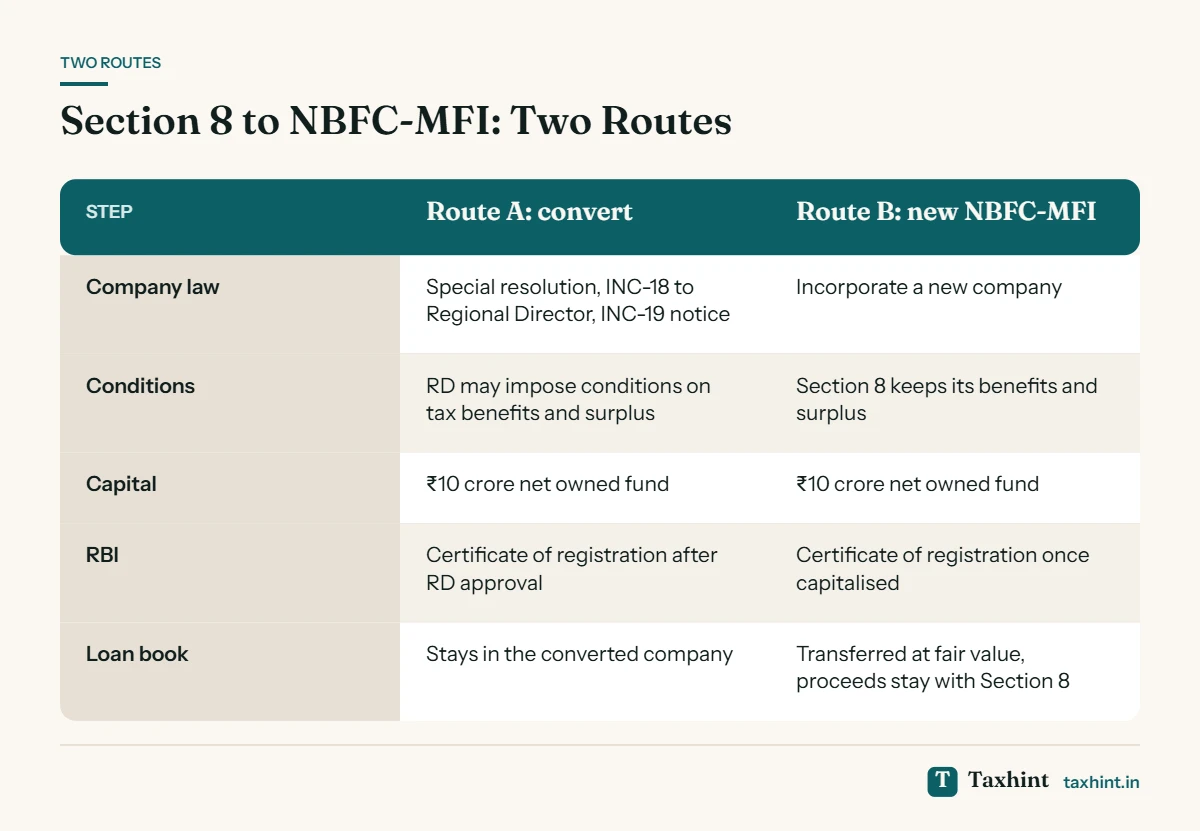
Route A: convert the Section 8 company
Section 8(4)(ii) of the Companies Act, 2013 lets a Section 8 company convert into any other kind of company only after meeting prescribed conditions. Those conditions are in Rule 21 and Rule 22 of the Companies (Incorporation) Rules, 2014, as substituted in January 2023. In outline:
- Special resolution. Members pass a special resolution at a general meeting. The explanatory statement must set out the reasons in detail, including the date of incorporation, any change in objects, the privileges and concessions the company has enjoyed, such as tax exemptions, approvals for donations including foreign contributions and land, and the impact on members, including any benefit they would get.
- MGT-14 and INC-18. The resolution is filed with the Registrar in MGT-14, and the application goes to the Regional Director in Form INC-18 with the fee, the resolution and the notice. A copy is filed with the Registrar.
- Public notice and authorities. Within a week of applying, the company publishes a notice in Form INC-19 in a vernacular and an English newspaper and on its website. Notice also goes to the authorities under whom it operates, such as the Income-tax department, who may make representations to the Regional Director.
- Certificate and review. A practising CA or CS certifies compliance with the Act and Rules. The Regional Director may ask for the concurrence of any authority and a report from the Registrar, and must hear the company before imposing conditions or rejecting the application.
- Approval and filings. After approval, members amend the MoA and AoA by special resolution, and the company files the order within 30 days, the amended documents and a directors’ declaration that the conditions imposed have been met.
The Regional Director can attach conditions on the facts of each case. In practice these usually deal with the tax benefits and donations the company has received and with what happens to the surplus it built up as a not-for-profit. Plan for that before you file, not after.
Route B: new NBFC-MFI, with a planned transfer
Many promoters find it cleaner to leave the Section 8 company as it is and start a new company for the for-profit business. The new company is capitalised with the net owned fund, applies to RBI, and once registered starts lending on its own or takes over loans from the Section 8 company.
Any transfer of loans from the Section 8 company must be at a fair value, documented, and approved by its board. The money the Section 8 company receives stays with it and goes to its objects; it cannot pass to promoters. On the NBFC side, RBI’s directions on transfer of loan exposures apply to the loans it acquires.
The Section 8 company can then keep working on grants or non-lending activity, or move toward voluntary winding up, where its remaining assets go to another Section 8 company or similar body as the law requires.
The RBI side: ₹10 crore NOF and the certificate of registration
Whichever route you take, the for-profit lender must register with RBI as an NBFC before lending. Under RBI’s NBFC-MFI Directions, 2025, an NBFC-MFI is a non-deposit-taking NBFC with at least 60% of its total assets, net of intangibles, in microfinance loans on an ongoing basis.
An NBFC-MFI needs ₹10 crore of net owned fund before applying. RBI looks closely at promoters, the source of capital, the business plan and governance. Our NOF and qualifying asset calculator helps you check the numbers, and our guide to the NBFC-MFI licence and RBI CoR walks through the application.
Which route fits
| Question | Route A: convert | Route B: new NBFC-MFI |
|---|---|---|
| Keeps the same company and history | Yes | No, new company |
| Needs Regional Director approval | Yes, with possible conditions | No (unless the Section 8 company later converts or winds up) |
| Past tax and donation benefits | Dealt with in the conversion | Stay with the Section 8 company |
| Speed to RBI application | After RD approval | As soon as the new company is capitalised |
| Best when | The company has few concessions and members want continuity | The Section 8 company holds grants, 12A/80G benefits or FCRA funds |
There is no single right answer. We map your company’s registrations, funds, assets and loan book first, then recommend a route in writing.
Starting from a trust or society
Many microfinance programmes still run inside trusts or societies. The usual first step is to set up a Section 8 company and move the lending into it, which keeps the work not-for-profit while giving it a corporate form. Our page on Section 8 company registration covers that, and the same planning applies if you go straight to a new NBFC-MFI instead.
A trust or society cannot simply hand its loan book to a for-profit company. Transfers need a fair price, trustee or governing body approval, and the proceeds stay with the NGO for its objects.
What to prepare
Health check
Registrations (12A, 80G, FCRA if any), funds received, assets, loan book quality and the last three years’ accounts.
Route decision
A written recommendation on Route A or B, with the likely conditions and costs.
Company law filings
For Route A: notice, special resolution, MGT-14, INC-18, INC-19 and authority notices. For Route B: incorporation of the new company.
Capital and RBI
₹10 crore NOF, business plan, policies and the RBI application for the certificate of registration.
Transfer and after
Portfolio transfer or conversion follow-up filings, then RBI returns, bureau reporting and software set-up.
Frequently asked questions
Can a Section 8 microfinance company convert into an NBFC-MFI?
Yes, but in two steps. It first converts into an ordinary company with Regional Director approval under Rules 21 and 22, then brings in ₹10 crore of net owned fund and gets an RBI certificate of registration. Many promoters instead set up a new NBFC-MFI.
Which form is used to convert a Section 8 company?
The application goes to the Regional Director in Form INC-18, after a special resolution filed in MGT-14. A public notice in Form INC-19 follows within a week of applying.
Will the Regional Director impose conditions?
The Regional Director can impose conditions on the facts of each case, and must give the company a hearing first. They usually relate to tax benefits, donations received and the use of accumulated surplus.
How much capital does an NBFC-MFI need?
₹10 crore of net owned fund. It must also keep at least 60% of its total assets, net of intangibles, in microfinance loans under RBI’s 2025 NBFC-MFI Directions.
Can a Section 8 company sell its loan book to a new NBFC-MFI?
It can transfer loans at a fair value with board approval, and the proceeds stay with the Section 8 company for its objects. The NBFC follows RBI’s rules on acquiring loans.
Do you handle both the MCA and RBI sides?
Yes. Our CA and CS team handles the company law filings, the NOF planning, the RBI application and, after registration, compliance and software.
Talk to us before you decide
Thinking about Section 8 to NBFC-MFI conversion? Send us your last accounts, registrations and loan book summary. A CA or CS will map both routes and tell you which fits, in writing. Call +91 93117 95484, email [email protected], or use the form.