November 23, 2026 · Guides
What Does an NBFC MFI License Involve? How RBI Grants the CoR
An NBFC MFI license is not a separate permit. It is a Certificate of Registration (CoR) that RBI grants to a company, with the category recorded as NBFC-MFI. A new applicant needs ₹10 crore of Net Owned Fund, has to keep at least 60% of its assets in microfinance loans, and files the application on RBI’s PRAVAAH portal. It suits promoters with real capital and a plan to scale; for smaller starts, a Section 8 company usually fits better.
In this guide
- What the NBFC MFI license actually is
- Who qualifies: the conditions RBI checks
- How RBI grants the CoR on PRAVAAH
- Documents to keep ready
- What binds you after the CoR arrives
- Who this license suits, and who should wait
- FAQs
What the NBFC MFI license actually is
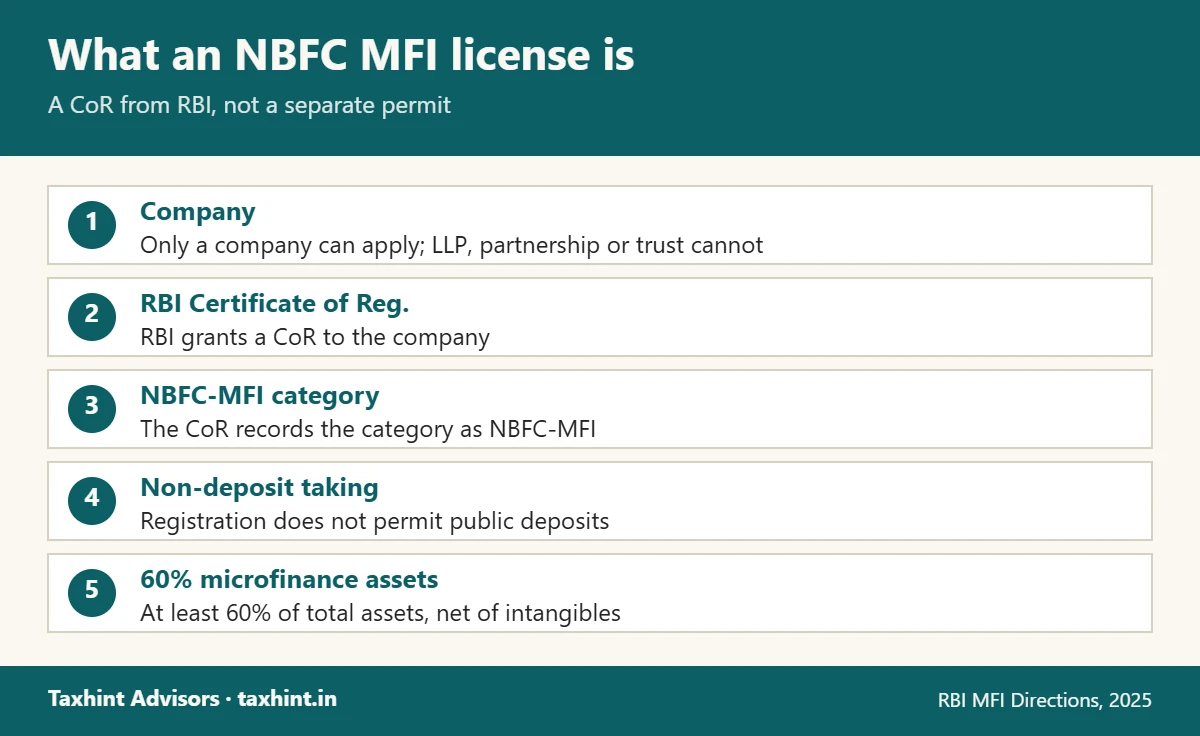
Section 45-IA of the RBI Act, 1934 says a company cannot carry on NBFC business without a Certificate of Registration from RBI, unless an exemption applies. When people say “NBFC MFI license”, they mean that CoR, issued in the NBFC-MFI category.
The category matters because it decides your capital, your asset mix and the conduct rules you live under. RBI’s Microfinance Institution Directions, 2025 (28 November 2025) define an NBFC-MFI as a non-deposit-taking NBFC that keeps at least 60% of its total assets, net of intangibles, in microfinance loans on an ongoing basis (para 8(3)).
Only a company can apply. An LLP, a partnership or a trust cannot. If you are still choosing between structures, our page on NBFC-MFI registration sets out the full route from incorporation to CoR.
Who qualifies: the conditions RBI checks
There is no fixed formula that guarantees a CoR, but these are the tests that show up in every file.
| Condition | What it means in practice |
|---|---|
| Company incorporated in India | Private or public company under the Companies Act, 2013, with financial activity written into its objects |
| Net Owned Fund of ₹10 crore | Para 39 of RBI’s Registration Directions fixes ₹10 crore for NBFC-ICC, NBFC-MFI and NBFC-Factor. It is not the same as authorised share capital and needs an auditor’s certificate |
| 60% microfinance assets | Measured on total assets net of intangibles, on an ongoing basis (para 12 of the MFI Directions) |
| Non-deposit taking | Registration does not permit you to accept public deposits |
| Capital adequacy | At least 15% of risk-weighted assets (para 16 of the MFI Directions) |
| Promoters and directors | RBI looks at experience, financial standing, credit history and regulatory record, and wants the source of capital traceable |
The ₹10 crore is where most first-time promoters stop. Existing NBFC-MFIs were given a glide path from ₹5 crore to ₹10 crore by 31 March 2027 (para 42), but that is for companies already registered. A new applicant should plan for ₹10 crore from the start. Our note on how Net Owned Fund is calculated shows what RBI counts and what it deducts.
Take a promoter group in Faridabad with ₹6 crore to put in. On paper, that looks like a good start. For an NBFC-MFI CoR it is not enough, and we would rather say so in the first meeting than after the incorporation fee is spent.
How RBI grants the CoR on PRAVAAH
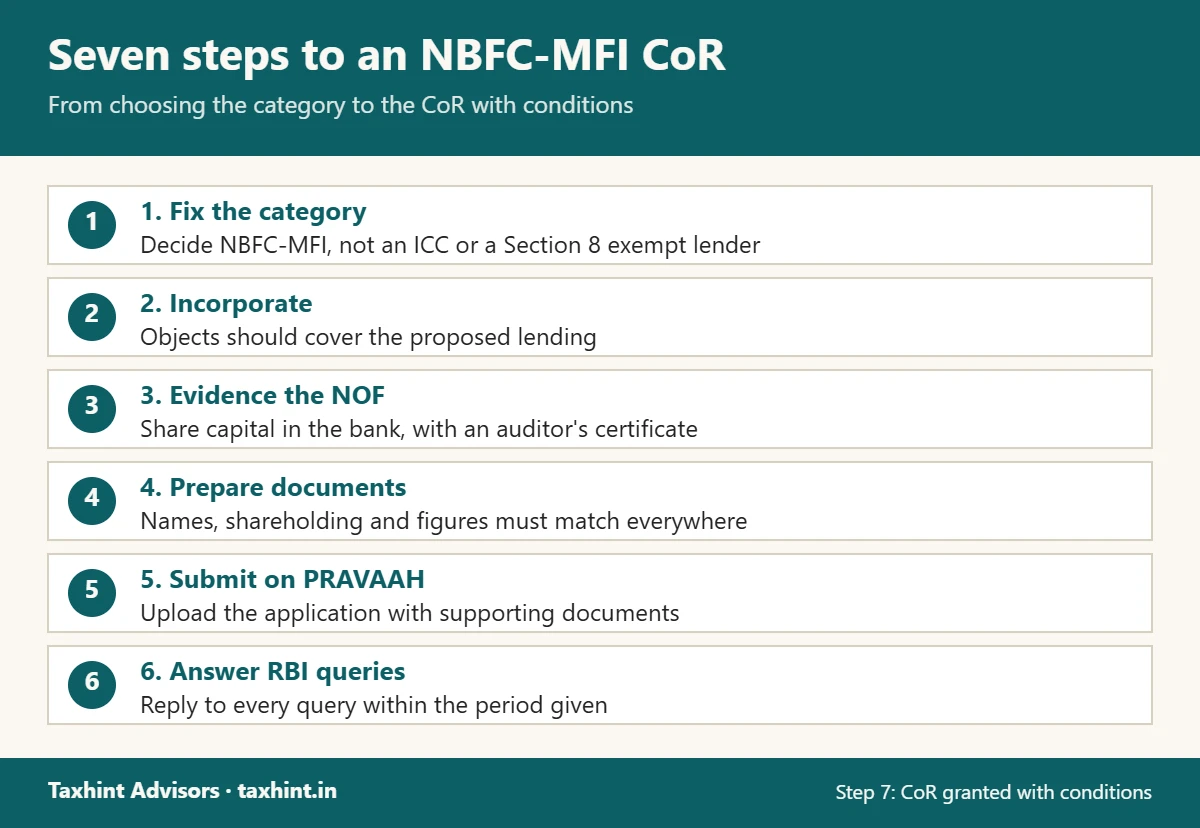
PRAVAAH is RBI’s online portal for applications and approvals. The registration application goes through it, and you keep the acknowledgement and reference number it gives you.
- Fix the category. Decide that you are an NBFC-MFI and not an ICC or a Section 8 exempt lender. The business plan has to match.
- Incorporate the company. Objects should cover the proposed lending. The MoA and AoA are part of the file.
- Arrange and evidence the NOF. Share capital must actually be in the bank, with a certificate from the auditor.
- Prepare documents and policies. RBI’s checklist for the category applies. Names, shareholding and figures must match across every paper.
- Submit on PRAVAAH. Upload the application with the supporting documents.
- Answer RBI’s queries. This is where most of the time goes. RBI may ask about promoters, funding sources, the business plan, governance and any litigation.
- Receive the CoR. If RBI is satisfied, it grants registration with conditions. Read the approved category and conditions before you lend a rupee.
RBI does not publish a fixed processing time that we can rely on, so we do not quote one to clients. A clean, consistent file with queries answered within the stated period moves faster than a hurried one.
Documents to keep ready
The exact RBI checklist depends on category, but these are the core papers we gather before touching the portal.
- Certificate of Incorporation, MoA, AoA, PAN and registered office proof
- Details of every director and shareholder, with ownership charts where a company or trust sits above the individuals
- Audited financial statements and bank statements showing the capital contributed
- Auditor’s NOF certificate
- Identity, address and profile documents for promoters and directors, with declarations on litigation and defaults
- Board resolution authorising the person who signs and submits
- Business plan: target areas, borrower profile, sourcing, collections, funding, technology and projections
- Board-approved policies, including the pricing policy and fair practice code
A business plan that says “we will serve the poor” gets queries. One that says which blocks, which loan sizes, how field staff are paid and how collections are recorded reads like a lender that has done the thinking.
What binds you after the CoR arrives
The CoR is the beginning. From day one an NBFC-MFI works under four sets of RBI directions, which we have laid out in our explainer on RBI’s microfinance rules. The points that bite hardest:
- The 60% test never switches off. If qualifying assets stay below 60% for four consecutive quarters, you must go to RBI with a remediation plan (para 12).
- Provisioning is fixed. Under para 25, 50% of instalments overdue 90 to 180 days and 100% of those overdue 180 days or more must be provided for.
- Capital adequacy of 15% has to be maintained as the book grows.
- Microfinance loan rules apply: collateral-free lending to households earning up to ₹3,00,000 a year, with total monthly repayments within 50% of household income.
Keeping up with these needs software that can tag a loan as qualifying, flag a household that is over the cap and report portfolio quality. That is the reason most of our NBFC-MFI clients look at microfinance software before they apply, not after.
Who this license suits, and who should wait
The NBFC MFI license suits a promoter group that has ₹10 crore or more to commit, wants to lend in several districts or states, may later raise bank or institutional funding, and is ready for RBI supervision.
It is the wrong tool for a trust in Palwal that wants to start a livelihood loan programme with ₹50 lakh. That group is better served by a Section 8 company, which RBI exempts from registration while it lends only microfinance loans, holds a Section 8 licence, takes no public deposits and stays under ₹100 crore of assets (para 51 of the Registration Directions).
The exemption has a ceiling. Para 14 of the MFI Directions withdraws it for not-for-profit microfinance companies with assets of ₹100 crore and above, so a growing Section 8 lender eventually has to register as an NBFC-MFI. We compare the two routes side by side in Section 8 versus NBFC-MFI, and the NOF side can be tested in our NOF and qualifying asset calculator.
For wider NBFC categories and RBI work beyond MFI, see our NBFC registration service.
FAQs
Is there a separate NBFC MFI license?
No. RBI grants a Certificate of Registration to a company, and the category is recorded as NBFC-MFI. That certificate is what people call the license.
How much capital is needed for an NBFC MFI license?
A new NBFC-MFI needs ₹10 crore of Net Owned Fund under para 39 of RBI’s Registration Directions. Existing NBFC-MFIs have until 31 March 2027 to reach ₹10 crore from their earlier levels.
Where do I apply for the CoR?
On RBI’s PRAVAAH portal. Keep the acknowledgement and reference number, and reply to every RBI query within the period it gives.
Can a Section 8 company become an NBFC-MFI?
Yes. RBI’s MFI Directions contemplate not-for-profit companies registering as NBFC-MFIs, and a Section 8 lender with assets of ₹100 crore or more cannot stay exempt. Below that line, most Section 8 companies stay exempt and do not apply.
Can an NBFC-MFI accept public deposits?
No. An NBFC-MFI is a non-deposit-taking NBFC, and registration does not give permission to accept public deposits.
What happens if qualifying assets fall below 60%?
The company falls short of the ongoing 60% requirement for the category. If the shortfall lasts four consecutive quarters, it must approach RBI with a remediation plan.
How long does RBI take to grant the CoR?
There is no fixed period we can quote with confidence. It depends on completeness of the file, ownership structure, capital verification and how quickly you answer RBI’s queries.
Thinking of applying for an NBFC MFI license? Get Free Consultation, or WhatsApp us on +91 93117 95484. Our CA and CS team tests your capital and plan first, then handles the file online. Taxhint Advisors has served 5,000+ businesses since 2014.