Credit Policy Template for a Section 8 Microfinance Company
A credit policy template for Section 8 microfinance companies: RBI exemption conditions, household income and 50% repayment rules, bureau checks, sanction powers, pricing, recovery and monitoring. Download it free in Word.
On this page
Download the template
Free, editable and with no sign-up. Download the credit policy opens in Word, Google Docs or Excel. Replace every bracketed item before use.
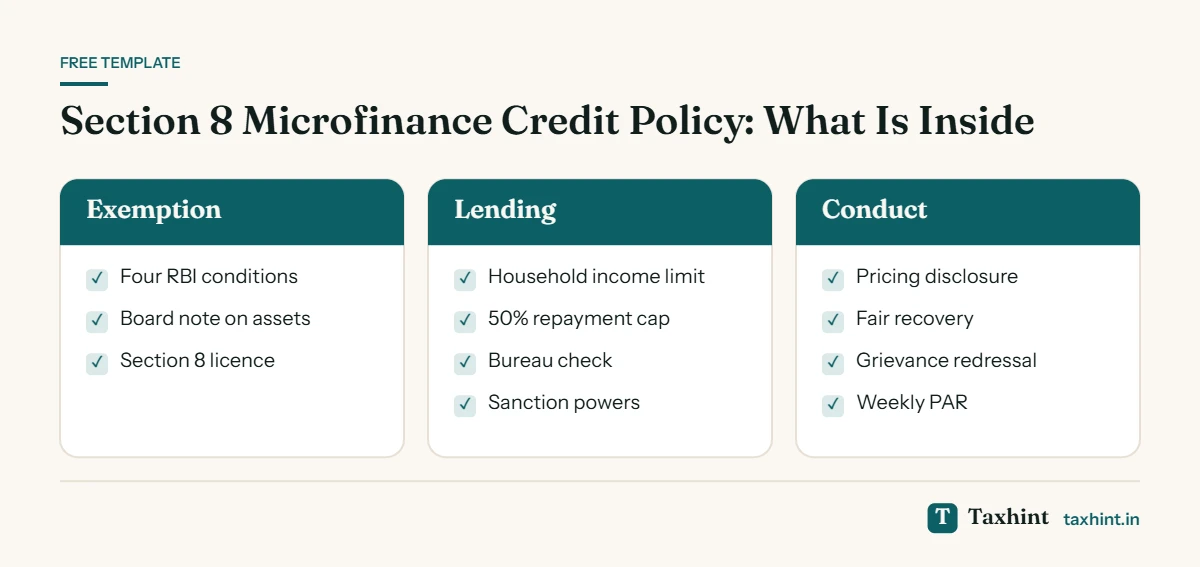
What is inside
Exemption guard-rails
The four conditions that keep a Section 8 lender outside RBI registration, with a board note on total assets at every meeting.
Lending rules
Eligible households, repayment capacity at 50% of income, credit bureau checks, product grid and sanction powers.
Conduct and monitoring
Pricing disclosure, disbursement rules, fair recovery, grievance redressal, weekly PAR tracking and annual review.
How to use it
Fill in your products
Add each product’s amount range, tenure, frequency and group or individual structure.
Set sanction powers
Decide who can approve what, and keep exceptions with a committee.
Add state requirements
Include any registration or conduct rule your state’s microfinance or money-lending law adds.
Adopt and review
Pass a board resolution adopting the policy and review it at least once a year.
Why the policy matters
A credit policy template is more than paperwork for a Section 8 microfinance company. It is the document that shows your board is enforcing the RBI conditions that keep the company exempt, and that every loan follows the household income and repayment rules.
Lenders, auditors and funders usually ask for it first. Pair it with our Section 8 compliance calendar for the board-meeting rhythm, and read Section 8 microfinance loan limits for the lending caps in detail.
Mistakes we see
- Copying another lender’s policy. A policy written for an NBFC-MFI with different products will not match how you actually lend, and auditors notice.
- No board note on the exemption. If minutes never mention total assets or the other RBI conditions, you cannot show the board was watching them.
- Limits that nobody follows. A policy that says one thing while branches do another is worse than none. Set limits you will enforce.
- Never reviewed. RBI directions and state laws changed in 2025 and 2026. Review the policy at least once a year.
- Pricing left vague. State the interest-rate range and ceiling clearly and publish them; vague pricing invites complaints.
Frequently asked questions
Is a credit policy mandatory for a Section 8 microfinance company?
A board-approved policy is how you show the RBI conditions and loan rules are being followed, and lenders and auditors expect one. We recommend adopting it before the first loan.
What income limit does the template use?
It uses the household income ceiling in the RBI microfinance directions in force, currently ₹3,00,000 a year, with total repayments capped at 50% of monthly income. Check the current directions when you adopt it.
Can we change the template?
Yes. It is a starting draft. Adapt products, powers and processes to your organisation and have it reviewed.
Do you draft custom policies?
Yes. We draft credit, pricing, grievance and fair-practice policies for Section 8 lenders as part of our registration and compliance work.
Want it adapted to your company?
Send us your draft or your lending model. A CA or CS will review the template against your products, the RBI directions and your state’s lending law. Call +91 93117 95484, email [email protected], or use the form.