November 23, 2026 · Guides
Section 8 Microfinance Loan Limit: Income, Repayment and Asset Rules
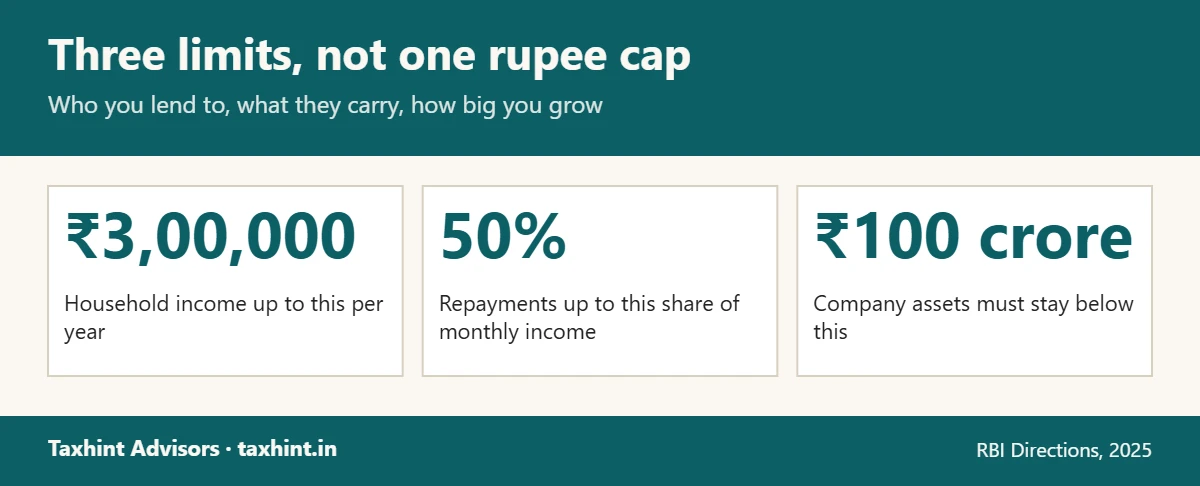
The Section 8 microfinance loan limit is not a rupee figure per borrower. RBI’s rules test the household, not the loan amount: a microfinance loan must be collateral-free, given to a household with annual income up to ₹3,00,000, and the household’s total monthly repayments must stay within 50% of its monthly income. Separately, the company itself must keep assets below ₹100 crore to stay exempt from RBI registration.
So the Section 8 microfinance loan limit is really three limits to manage: who you lend to, how much repayment a household can carry, and how big the company can grow. This post takes them one at a time.
In this guide
- Why the Section 8 microfinance loan limit has no fixed rupee cap
- The ₹3 lakh household income limit
- The 50% repayment rule: Section 8 microfinance loan limit by example
- Collateral-free means what exactly
- The ₹100 crore asset limit
- What your board policy must say
- FAQs
Why the Section 8 microfinance loan limit has no fixed rupee cap
The microfinance chapter of RBI’s Credit Facilities Directions, 2025 does not fix a maximum amount per borrower. What it does is define the borrower (a low-income household) and cap the repayment burden. The Section 8 microfinance loan limit works household by household: a ₹60,000 loan can be fine for one household and too much for another, and the rule is built around that.
For a Section 8 company, the same tests apply through the exemption condition. Under paragraph 51 of RBI’s NBFC Registration, Exemptions and SBR Directions, 2025, the company must give only microfinance loans, with household obligations kept within half of monthly household income. If you want the exemption conditions in one place, our Section 8 microfinance company registration page sets them out. For the wider rulebook, see RBI microfinance rules explained.
The ₹3 lakh household income limit
Paragraph 51 of the Credit Facilities Directions defines a microfinance loan as a collateral-free loan to a household with annual income up to ₹3,00,000. A household means an individual family unit: husband, wife and unmarried children.
The household is the unit, so a husband and wife cannot be treated as two separate borrowers with two separate incomes. The Directions also ask each lender to keep a board-approved policy on how household income is assessed (paragraph 52), and paragraph 54 requires the household income to be reported to credit information companies.
A practical point. If you lend to a household above ₹3,00,000 income, in our reading that loan is outside the microfinance definition. A Section 8 company that must give only microfinance loans should not do it. A quick screen helps, and our microfinance eligibility checker is built for that.
The 50% repayment rule: Section 8 microfinance loan limit by example
Paragraphs 55 to 57 of the Credit Facilities Directions say that total monthly repayments of a household, principal plus interest, on all its existing loans and on the new loan, must not exceed 50% of monthly household income. Income expected from the asset you are financing cannot be counted. If a household is already above 50%, its existing loans can run to maturity, but no new loan can be given until it is back within the limit.
Here is an example, only to show the arithmetic. Take a household in a Bihar village with monthly income of ₹18,000. Its annual income is ₹2,16,000, which is inside the ₹3,00,000 limit. Half of monthly income is ₹9,000.
| Step | Amount (₹) |
|---|---|
| Monthly household income | 18,000 |
| 50% ceiling on all repayments | 9,000 |
| Existing monthly instalments, all lenders | 4,000 |
| Room left for the new loan’s monthly instalment | 5,000 |
If your proposed instalment is ₹6,000, the loan does not pass. You either cut the amount, extend the tenure within policy, or decline. Note that the existing ₹4,000 must include loans from other lenders, and that is why a bureau check matters, which we cover in our post on credit bureau membership.
Repayment periodicity is part of this too. Paragraph 59 asks for a board-approved policy on flexible repayment frequency, so weekly, fortnightly or monthly schedules need to be converted to a monthly figure when you run the 50% test.
Collateral-free means what exactly
The definition says collateral-free. Paragraph 51 adds that the loan cannot be linked to a lien on the borrower’s deposit account or backed by hypothecation of any security. A gold loan, a vehicle loan against hypothecation or a loan secured by a mortgage is not a microfinance loan under this definition.
We do not read the Directions as barring a Section 8 company from other kinds of loans in principle, but its exemption depends on giving only microfinance loans, so the safe path is to keep the book clean. The interest side has its own rules, which we cover in microfinance interest rate rules.
The ₹100 crore asset limit
This is the company-level side of the Section 8 microfinance loan limit, and it is the one promoters forget.
The exemption from RBI registration under sections 45-IA, 45-IB and 45-IC of the RBI Act applies only where assets are below ₹100 crore. Paragraphs 14 and 15 of the NBFC-MFI Directions, 2025 say the exemption for not-for-profit companies at ₹100 crore and above is withdrawn. Such a company must apply to RBI to register as an NBFC-MFI. If it does not yet meet NBFC-MFI requirements, it must submit a board-approved plan with a roadmap along with the application.
The 2025 text we checked does not state a number of days for that application, so we do not give one. What we tell promoters is to plan well before the line. A company at ₹70 crore with a growing book should already be asking whether it can raise the net owned fund of ₹10 crore that an NBFC-MFI needs, and whether at least 60% of its assets can sit in microfinance loans.
Our posts on net owned fund and the NBFC-MFI licence and CoR walk through that move.
What your board policy must say
Your Section 8 microfinance loan limit policy should be approved by the board. The Credit Facilities Directions expect board-approved policies on household income assessment, the repayment limit, repayment flexibility and pricing. For pricing, paragraph 60 asks for an all-inclusive interest rate model, the cost components, the spread range by borrower category, and a ceiling on interest and all other charges. Paragraph 61 says rates and charges should not be usurious.
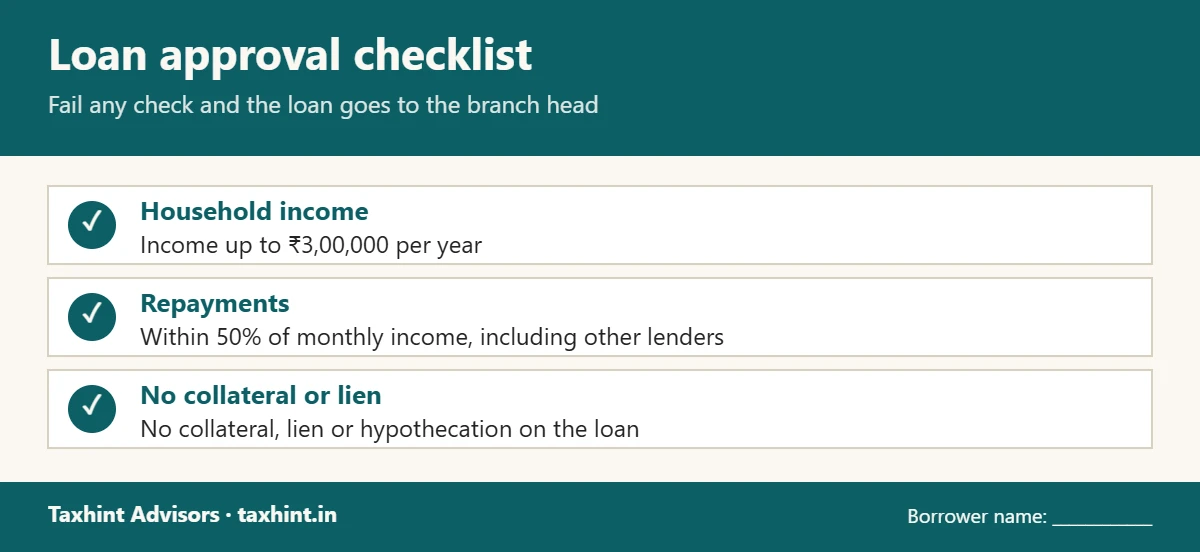
We usually write a one-page internal sheet for the Section 8 microfinance loan limit for the field team with three checks: income up to ₹3,00,000, repayments within 50% after counting other lenders, and no collateral or lien. A loan that fails any check goes back to the branch head. It saves arguments later.
The text of the Directions is on the RBI site: see the Credit Facilities Directions, 2025 and the NBFC-MFI Directions, 2025.
FAQs
What is the Section 8 microfinance loan limit per borrower?
The Directions we checked do not fix a rupee ceiling per borrower. The limits are the ₹3,00,000 household income test, the 50% repayment cap and the collateral-free requirement.
What is the household income limit for a microfinance loan?
Annual household income up to ₹3,00,000. A household is a husband, wife and unmarried children.
How is the 50% repayment limit calculated?
Add the monthly principal and interest on all existing loans of the household to the proposed instalment. The total cannot exceed 50% of monthly household income.
Can a Section 8 company lend against collateral?
A loan with collateral, a lien on deposits or hypothecation is not a microfinance loan under the definition. Since the exemption requires only microfinance loans, we advise against it.
Does the Section 8 microfinance loan limit change at ₹100 crore of assets?
The exemption from RBI registration is withdrawn, and the company must apply to register as an NBFC-MFI. A board-approved roadmap goes with the application if it does not yet meet the NBFC-MFI rules.
Is there a cap on the interest rate?
The Directions require a board-approved pricing policy with a ceiling on interest and charges, and say rates should not be usurious. They give no single numeric cap in the text we read.
Do I have to report household income to credit bureaus?
Paragraph 54 of the Credit Facilities Directions requires NBFCs to report household income to credit information companies. We suggest a Section 8 company records it the same way.
Need a lending policy that keeps your Section 8 company inside these limits? Get Free Consultation from our CA and CS team, or WhatsApp +91 93117 95484.