November 23, 2026 · Guides
Build vs Buy Microfinance Software: A Practical Way to Decide
Build vs buy microfinance software is a question every growing lender asks once spreadsheets stop coping. Building feels like control; buying feels like speed. The right answer depends less on budget than on how much ongoing work you are ready to own.
Here is how we help lenders think it through. We sell software, so weigh our view accordingly, but the test below works whatever you choose.
We have seen both paths up close, and the build vs buy microfinance software choice usually gets made on the wrong numbers: the first-year cost instead of the five-year cost.
In this guide
- What building really involves
- Comparing the cost honestly
- A simple decision test
- The middle path
- Questions to ask any vendor
- A worked example
- Mistakes we see
- How we help
- FAQs
What building really involves
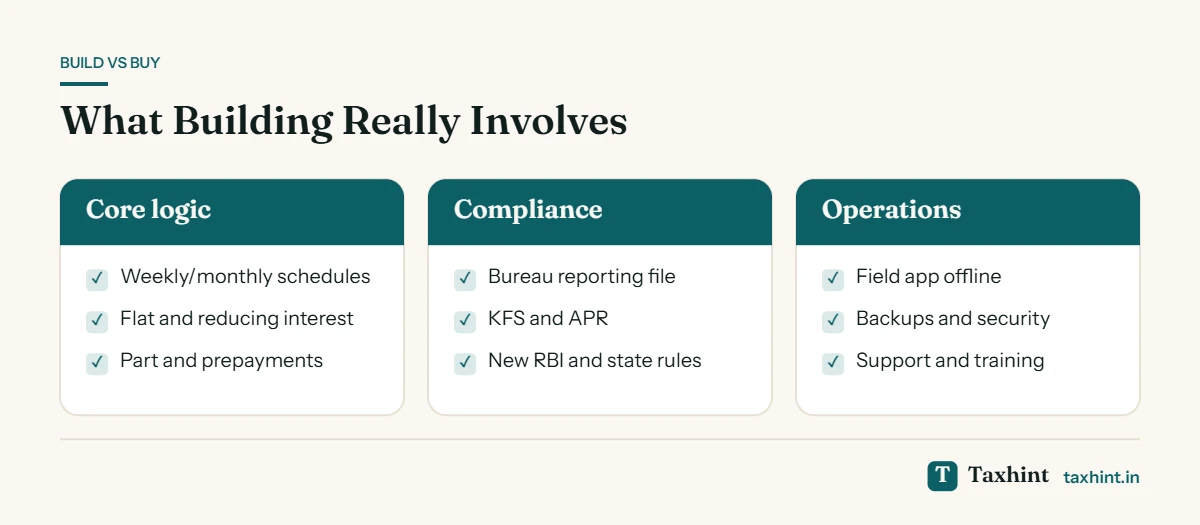
The first version is the easy part. A microfinance system has to handle weekly, fortnightly and monthly schedules, flat and reducing interest, group and individual loans, part payments, prepayment without penalty, restructuring, centre-wise collection, PAR, accounting entries and the credit bureau reporting file.
Then rules change. In two years India has had a new KFS format, new digital lending and co-lending directions, state microfinance laws in Karnataka and Tamil Nadu, and director KYC changes. Each change means more development, testing and data fixes. Someone has to own that forever.
Comparing the cost honestly
For building, count developer salaries or agency fees, hosting, security, backups, a mobile app for field staff, and the time your managers spend writing requirements and testing. Count the cost of mistakes too: a wrong interest calculation across a portfolio is expensive to unwind.
For buying, count the licence or subscription, set-up and data migration, training and annual support. Our microfinance software starts at ₹15,000; see our note on microfinance software cost in India for what drives price.
A simple decision test
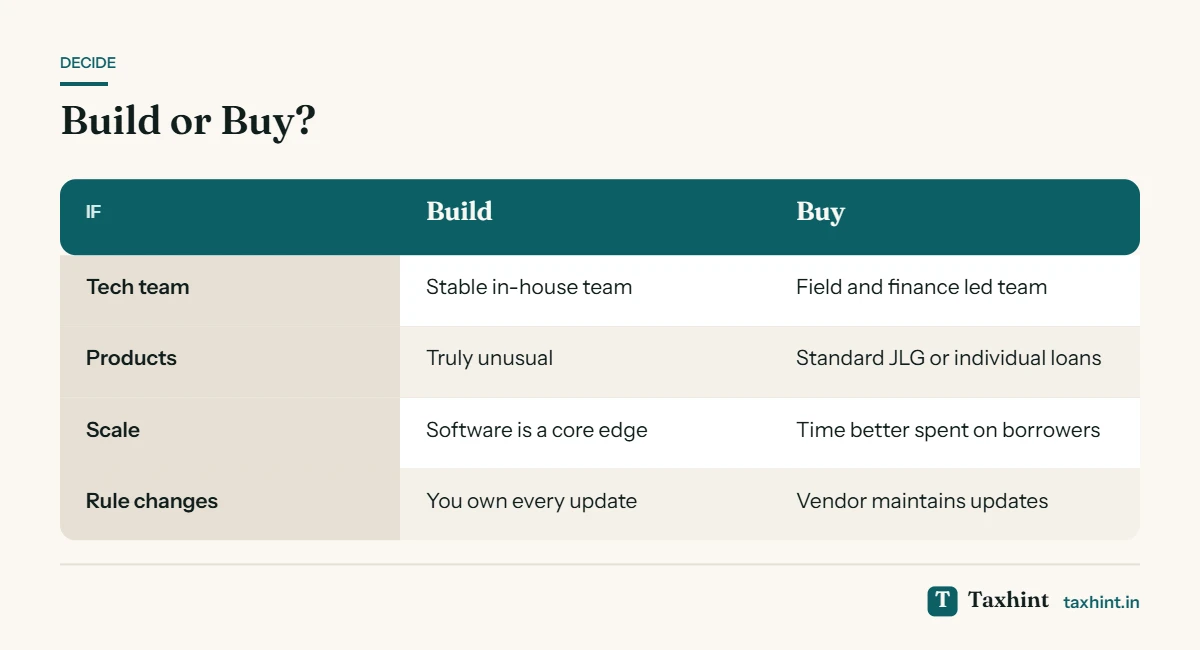
Build if most of these are true: you have an in-house tech team that will stay, your product is truly unusual, and you are large enough that software is a core advantage. Buy if most of these are true: your products are standard JLG or individual loans, your team is field and finance led, and you would rather spend management time on borrowers than bugs.
For most Section 8 lenders and small NBFC-MFIs, buying and configuring wins on time and risk.
The middle path
Many lenders buy a core system and build small tools around it: reports for their board, an integration with their accounting package, or a custom dashboard. That keeps the hard, regulated part with a vendor who maintains it, and the flexible part in-house.
Questions to ask any vendor
- Does it support our loan products and repayment frequencies today?
- Does it generate the credit bureau file and the KFS?
- How fast are regulatory changes released, and at what cost?
- Can field staff collect offline and sync later?
- Who owns our data, and can we export it any time?
- What does migration from Excel involve? See our implementation checklist.
A worked example
Picture a Section 8 lender with 3 branches and 4,000 borrowers. Building means hiring or contracting at least one developer for about six months, then keeping someone on call for fixes, rule changes and the field app. Buying means a set-up fee, migration of existing loans and an annual support charge.
In year one the two may look similar. By year three, the built system needs a rewrite of its interest engine for a new product, a KFS change and bureau file updates, while the bought system received those as routine releases. That gap is what the build vs buy microfinance software decision really turns on.
Mistakes we see
- Hiring a freelancer for the first version with no plan for who maintains it.
- Buying generic loan software that cannot handle weekly group collections.
- Skipping data export terms in the vendor contract.
- Choosing on price without a demo using your own loan products.
How we help
We give a live demo using your own products, a written migration plan and a clear annual cost. If building suits you better, we will say so. Book a demo of our microfinance software.
FAQs
Is it cheaper to build microfinance software in-house?
The first version can look cheaper. Over several years, maintenance, regulatory changes, security and staff turnover usually make building costlier for small lenders.
When does building make sense?
When you have a stable in-house tech team, unusual products and enough scale for software to be a core advantage.
How much does ready microfinance software cost?
Ours starts at ₹15,000; the final price depends on branches, users and migration.
Can we switch later if we buy?
Yes, if the vendor lets you export all data. Ask for that in writing before signing.
Running loans on spreadsheets? Book a free demo of our microfinance software, starting ₹15,000, or WhatsApp +91 93117 95484.