November 27, 2026 · Guides
Can a Co-operative Society Accept Deposits?

A credit co-operative society can take deposits, but only from its own members and only as its law and bye-laws allow. It cannot take money from the public the way a bank does.
RBI has issued public warnings about societies that cross this line. Here is where the line sits.
In this guide
- Members only
- No bank in the name
- No deposit insurance
- Starting a credit society
- How we help
- A worked example
- What the board should check
- In short
- FAQs
Members only
A credit society pools savings from members and lends to members. RBI has noted that some societies take deposits from non-members, nominal members or associate members, and said this amounts to banking business without a licence, in breach of the Banking Regulation Act.
For multi-state societies the law is explicit: section 67 of the MSCS Act allows deposits only from voting members. See can an MSCS accept deposits.
No bank in the name
Since the Banking Regulation (Amendment) Act, 2020 came into force on 29 September 2020, co-operative societies cannot use the words bank, banker or banking in their names, except as the Act or RBI allows. RBI has said such societies are not licensed for banking business.
No deposit insurance
DICGC insurance is not available for deposits placed with these societies. Members depend on the society’s own reserves, governance and audit. That is why clean books matter more for a credit society than almost any other business.

Starting a credit society
State member rules differ: 15 in Delhi and Rajasthan, 10 in UP, MP, Bihar, Maharashtra, Gujarat and Punjab. See credit co-operative society registration for the state table.
How we help
We draft deposit bye-laws, register the society and keep it compliant. See credit society rules and our co-operative society software for deposits and passbooks.
A worked example
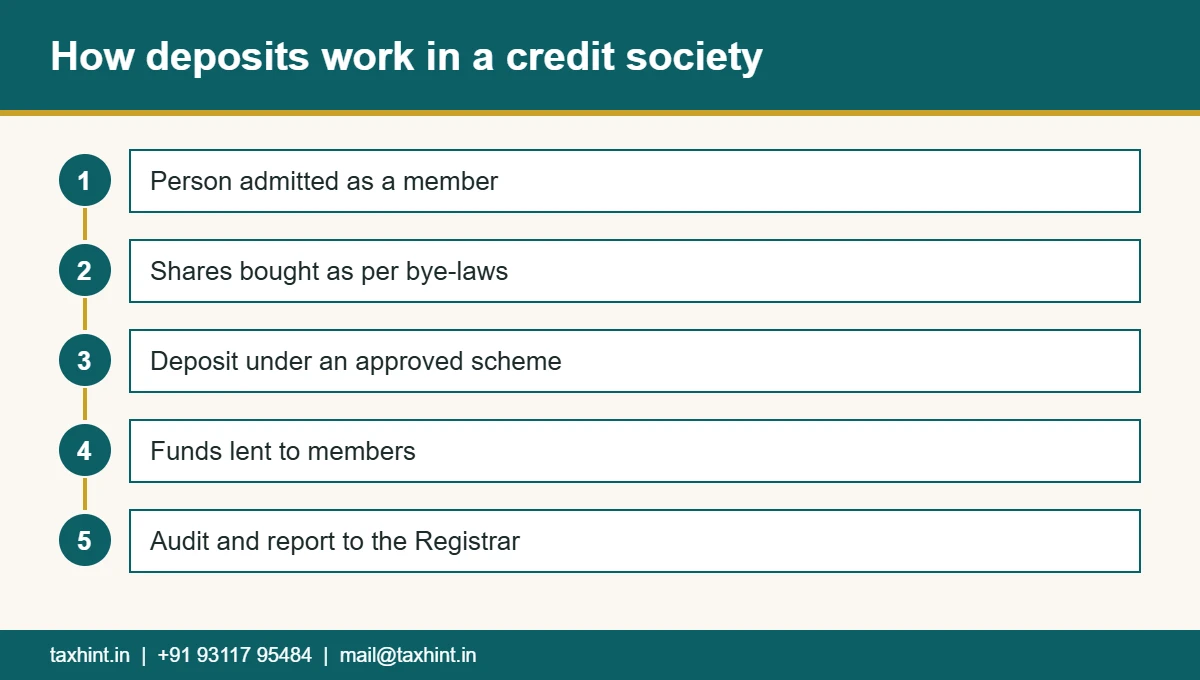
A credit society in a market town runs a monthly savings scheme for members. A shopkeeper who is not a member asks to open a fixed deposit. The right answer is to admit him as a member first, with his share money and KYC, and only then take the deposit.
If the society instead opens an “associate member” scheme just to take public deposits, it is doing what RBI has warned against. It also risks its tax deduction and the Registrar’s action.
What the board should check
- Every new depositor appears in the member register
- Deposit schemes and rates match the bye-laws
- No advertisement offers deposits to the public
- Loans go only to members
- The auditor confirms these points every year
In short
- Deposits only from admitted members
- No bank, banker or banking in the name since 29 September 2020
- No DICGC insurance on society deposits
- Multi-state societies: voting members only, under section 67
- Clean books and yearly audit keep member trust
Frequently asked questions
Can a co-operative society take deposits from the public?
No. It can take deposits only from its members.
Can nominal or associate members deposit?
RBI has said accepting deposits from non-members, nominal or associate members amounts to banking business without a licence.
Can a credit society call itself a bank?
No. Since 29 September 2020, co-operative societies cannot use bank, banker or banking in their names unless allowed.
Are society deposits insured?
No. DICGC cover is not available for deposits with these societies.
What about multi-state societies?
Section 67 of the MSCS Act allows deposits only from voting members.
Need help? Starting a credit society? Get Free Consultation or call +91 93117 95484.