November 27, 2026 · Guides
Co-operative Society Audit and Annual Return: A Practical Guide
Every registered co-operative society gets its accounts audited once a year and sends returns to the Registrar. For a credit society, the audit is also what members and the Registrar trust most.
This guide covers the yearly cycle for a society under a state Act. Multi-state societies have their own process, explained in our MSCS audit and annual return guide.
In this guide
- Who audits a society
- Records the auditor will ask for
- The yearly cycle
- Common audit points
- Audit and income tax
- How we help
- A worked example
- Tips for a smooth audit
- FAQs
Who audits a society
State Acts provide for audit by auditors approved by the Registrar or the state government, often from a panel. After the 97th Constitutional Amendment, most states amended their Acts to bring in fixed timelines for audit and general meetings. Check your state Act for the exact period and the panel rules.
Records the auditor will ask for
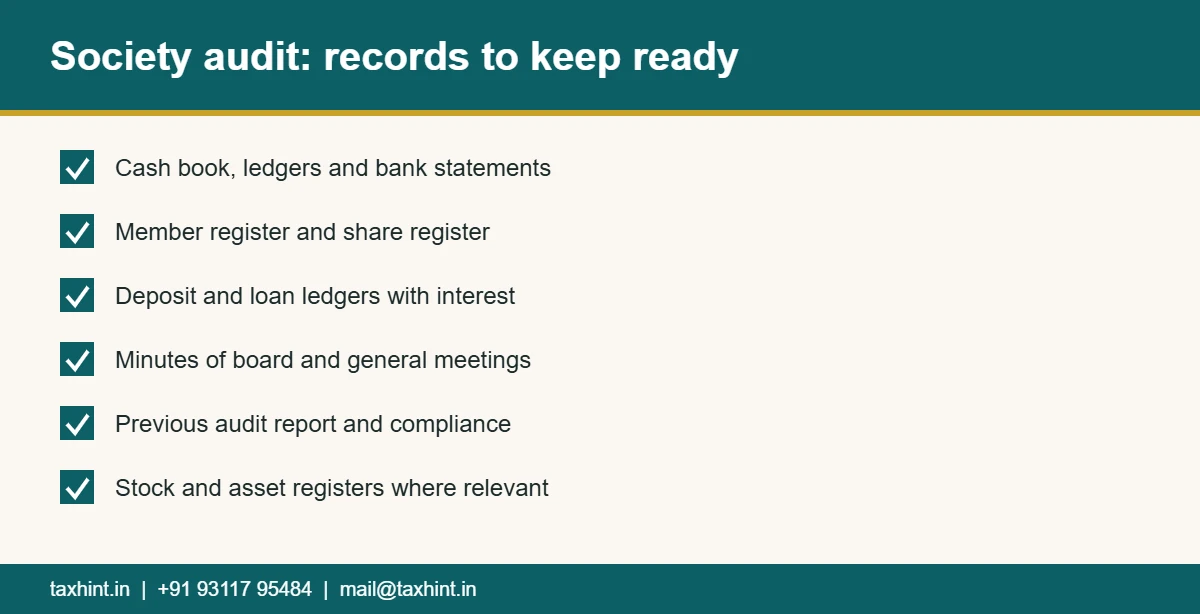
Get these in order before the auditor arrives. Missing registers are the most common reason audits drag on.
The yearly cycle
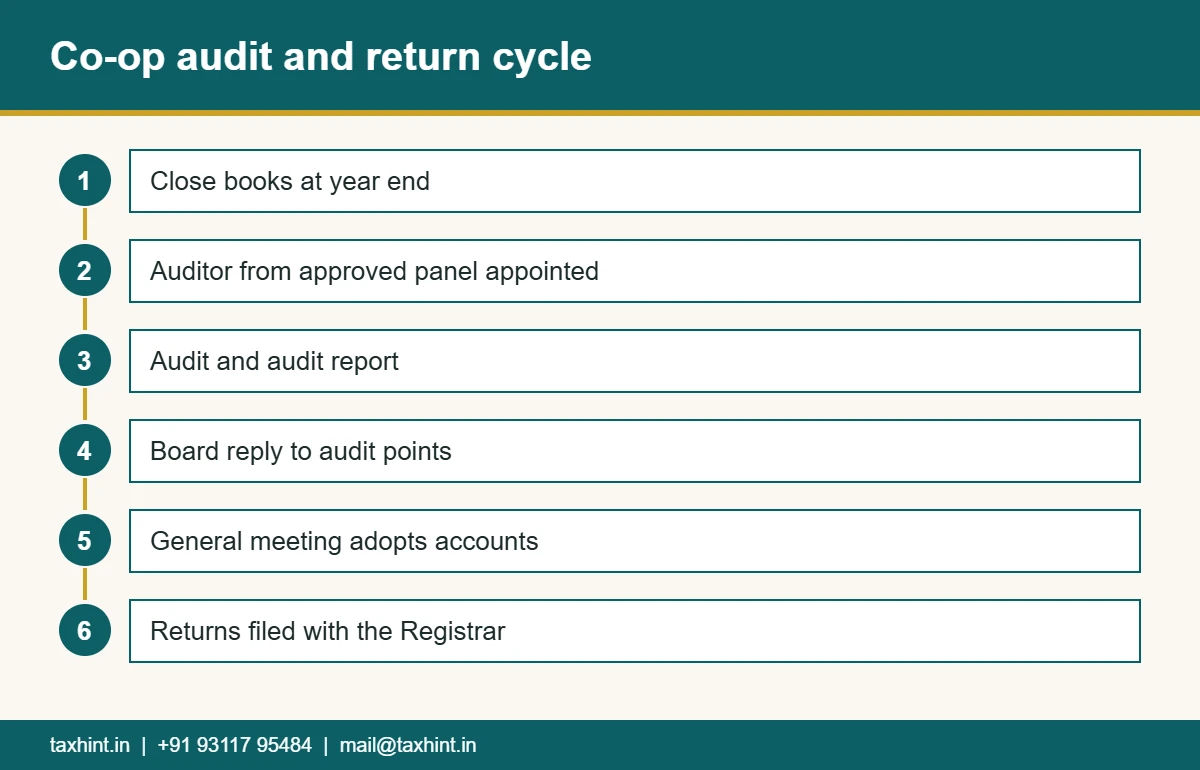
The year-end close leads to the audit, the audit report goes to the general meeting, and the returns go to the Registrar with the audited accounts and the action taken on audit points.
Common audit points
Loans without proper security or sanction. Every loan needs a sanction record and documents as the bye-laws require.
Interest worked out by hand. Errors pile up quickly. Use software that applies the same rule every time.
Overdues not classified. Old overdues shown as good assets inflate profit.
Business with non-members. Draws an audit remark and can cost the 80P or section 149 deduction.
Audit and income tax
The audited accounts are the base for the income tax return and the deduction under section 80P (now section 149 for tax year 2026-27 onwards). See section 80P for co-operative societies.
How we help
We keep books audit-ready, coordinate with panel auditors and file returns. See co-operative society audit, annual compliance and co-operative society software.
A worked example
A thrift and credit society of 400 members closes its year. Its accountant reconciles the bank accounts, prints the member and share registers, and runs the interest and overdue reports from the software. The panel auditor finds two loans sanctioned above the bye-law limit without board approval and one overdue loan shown as standard.
The board ratifies one loan with reasons, recovers part of the other, and reclassifies the overdue loan. The general meeting gets the audit report with the board’s replies. The returns go to the Registrar with the action taken. Next year’s audit starts from a cleaner base.
Tips for a smooth audit
- Reconcile bank and cash every month, not only at year end
- Keep sanction papers with every loan file
- Close the previous year’s audit points before the new audit
- Give the auditor read access to the software
Frequently asked questions
How often is a co-operative society audited?
Once every year.
Who can audit a co-operative society?
An auditor approved under the state Act, often from a panel kept by the Registrar or state government.
Is the audit report placed before members?
Yes. The general meeting considers the audited accounts and the audit report.
What happens to audit objections?
The board replies and acts on them, and the action is reported with the returns.
Does the audit affect income tax?
Yes. The audited accounts are used for the return and the 80P or section 149 claim.
Need help? Want your society audit-ready? Get Free Consultation or call +91 93117 95484.