November 27, 2026 · Guides
Converting a State Co-operative Society to a Multi-State Society
Many societies start in one state and later find members across the border. A state society cannot simply add members from another state; once members come from two or more states, the multi-state law applies.
There are two practical routes. Here is how each works.
In this guide
- The two routes
- Extra points for credit societies
- Steps for a fresh MSCS
- Check eligibility first
- How we help
- A worked example
- Common mistakes
- In short
- FAQs
The two routes
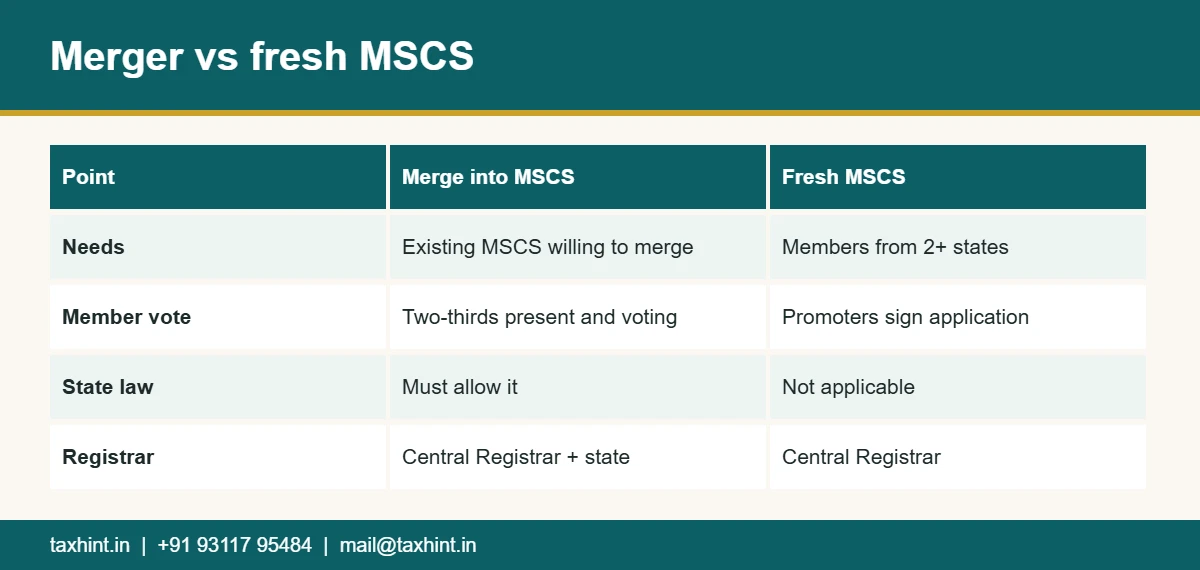
Merge into an existing multi-state society. The 2023 amendment to the MSCS Act lets a state co-operative society merge into an existing multi-state society, subject to the state law, if at least two-thirds of the members present and voting at its general meeting pass a resolution.
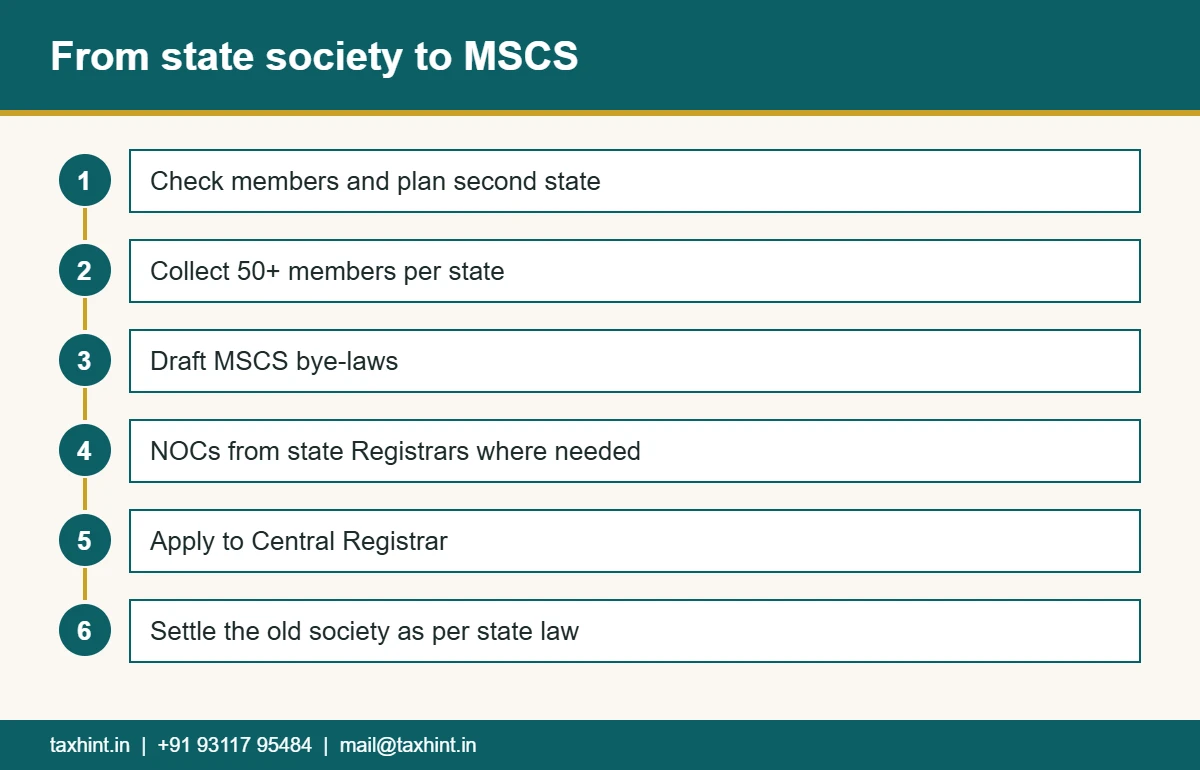
Register a new multi-state society. Gather members from at least two states, 50 from each when all are individuals, and apply to the Central Registrar.
Extra points for credit societies
A credit or multi-purpose primary MSCS is first registered with two states as its area of operation, and the application needs no objection certificates from the state Registrars concerned. Its bye-laws must also carry the capital and prudential norms under the 2023 rules. See MSCS deposit rules.
Steps for a fresh MSCS
Use the state society’s experience and members as the base, then build the second state.
Check eligibility first
Run the MSCS eligibility checker and read MSCS rejection reasons before you start.
How we help
We plan the route, draft bye-laws and resolutions, and file with the Central Registrar. See multi-state society registration and the Hindi guide.
A worked example
A credit society registered in Uttarakhand now has many members who have moved to western UP. It cannot simply admit them as members, because that would take it across a state line. The board looks at two options. An existing credit MSCS covering both states is willing to merge it in; if the state law allows, the general meeting can pass the merger resolution by a two-thirds majority of members present and voting.
The other option is to form a new MSCS with at least 50 members from each state, draft fresh bye-laws with the capital and prudential norms, and get NOCs from both state Registrars. The board picks the route that protects members’ deposits best and is realistic on numbers.
Common mistakes
Adding out-of-state members quietly. This breaks the state law and the MSCS Act.
Merging without checking state law. The 2023 merger route is subject to state law.
Copying old bye-laws. An MSCS needs bye-laws under the MSCS Act and Rules.
In short
- Members from two or more states means the MSCS Act applies
- Route 1: merge into an existing MSCS, with a two-thirds vote and state law permitting
- Route 2: register a fresh MSCS with 50 members per state
- Credit societies need state NOCs and 2023 prudential norms
Frequently asked questions
Can a state society just add members from another state?
No. Once members come from two or more states, the MSCS Act applies.
Can a state society merge into a multi-state society?
Yes, under the 2023 amendment, subject to state law, with a two-thirds resolution of members present and voting.
How many members does a fresh MSCS need?
Members from at least two states, 50 from each where all are individuals.
Do credit MSCS need state NOCs?
Primary credit or multi-purpose MSCS applications need NOCs from the state Registrars concerned.
Who registers the MSCS?
The Central Registrar of Co-operative Societies.
Need help? Planning to go multi-state? Get Free Consultation or call +91 93117 95484.