November 26, 2026 · Guides
Co-operative Society vs Society: What Is the Difference?
People often use “society” for both, but a co-operative society and a society registered under the Societies Registration Act are very different bodies. One is a member-owned economic enterprise; the other is usually a non-profit body for charitable, educational, cultural or social work.
Here is how they differ and how to choose. For registration, see co-operative society registration or society registration.
In this guide
- The differences at a glance
- Co-operative society
- Society under the Societies Registration Act
- Which should you register?
- Two examples
- After registration
- Groups that want both
- FAQs
The differences at a glance
The short version first.
Co-operative society
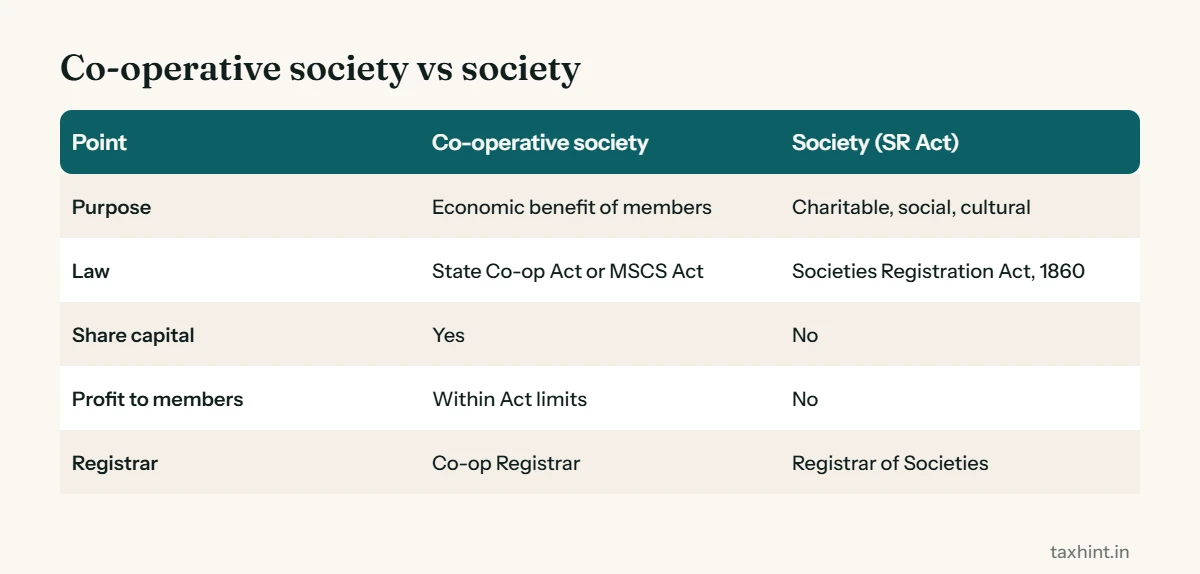
Registered under a state Co-operative Societies Act, or the Multi-State Co-operative Societies Act, 2002 for societies across states. Members buy shares, own the society and share its benefits: cheaper credit, better prices, shared housing. Surplus can be distributed within the limits set by the Act and bye-laws. Credit, housing, dairy and consumer societies all work this way. See types of co-operative society.
Society under the Societies Registration Act
Registered under the Societies Registration Act, 1860, as adopted or amended by each state, by seven or more persons for literary, scientific, charitable or similar purposes. It has no share capital and does not distribute profit to members; income is used for its objects. Schools, NGOs, cultural associations and welfare groups often register this way.
Which should you register?
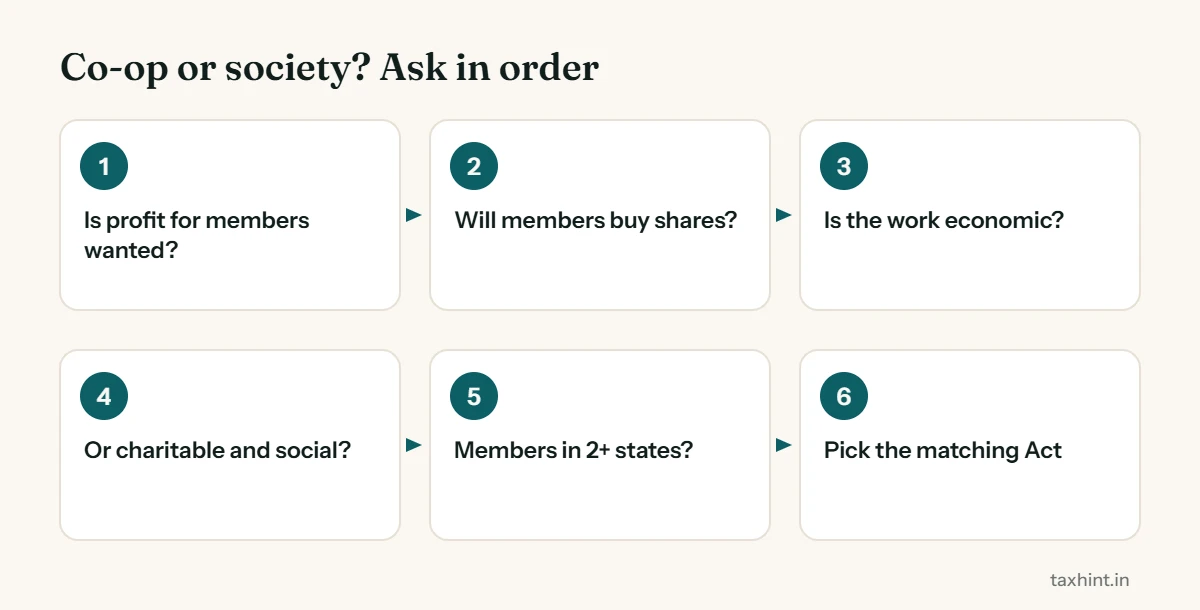
These questions usually settle it.
Two examples
A group of teachers wants to run a library and free coaching for poor students. They do not want profit and will raise donations. A society under the Societies Registration Act fits, and it can later apply for tax exemptions.
A group of factory employees wants to save every month and give each other small loans. They want a share in the surplus and a say in decisions. That is a credit co-operative society; see how to start a credit co-operative society.
After registration
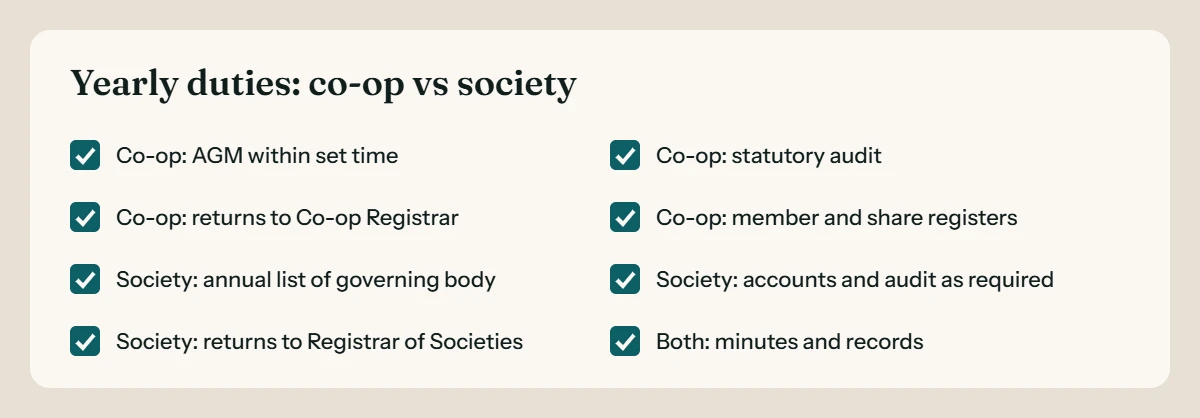
Both must keep records and file returns, but with different regulators. Co-operatives deal with the Registrar of Co-operative Societies and an annual statutory audit; see co-operative society audit. Societies deal with the Registrar of Societies; see society annual compliance.
What about groups that want both?
Some groups want to do charitable work and also run savings and loans for members. Mixing both in one body usually causes problems with the Registrar and with tax. The cleaner route is two separate bodies: a society, trust or Section 8 company for the charitable work, and a credit co-operative society for member savings and loans. Each keeps its own accounts and files its own returns.
If the plan is microloans to low-income households rather than member savings, look at a Section 8 microfinance company instead.
Frequently asked questions
What is the main difference between a co-operative society and a society?
A co-operative society is a member-owned economic body with share capital; a society under the Societies Registration Act is a non-profit body for charitable or social purposes.
How many members does a society need?
Under the Societies Registration Act, 1860, seven or more persons can form a society; states may add conditions.
Can a society give loans to members?
A society under the Societies Registration Act is not meant for member lending. For that, a credit co-operative society is the right structure.
Which is better for an NGO?
Usually a society, trust or Section 8 company, depending on the plan.
Can you help us choose?
Yes. The first consultation is free.
Next step: Not sure which body fits your group? Share your purpose and we will suggest the right one. Call +91 93117 95484, email [email protected], or use the form on our co-operative society services page.