November 24, 2026 · Guides
Top-Up on the Same Pledge: When and How to Offer It

When the gold rate rises, borrowers come back and ask for more money against the same ornaments. A top-up is quick income for you and useful for them, but it can also push the loan beyond safe limits if handled loosely.
Here is how to offer it with control.
In this guide
When a top-up makes sense
Allow it only when the numbers are clear.
- Customer has a clean repayment record.
- Current valuation supports a higher loan within your limit.
- The loan is not already near maturity or overdue.
Limits depend on your policy and rules, so please verify them.
The steps
Re-check the gold, not only the rate.
- Reopen the packet and re-verify weight and purity.
- Value at the current rate.
- Work out the room within your limit.
- Approve by someone other than the appraiser.
- Add the top-up as a new line or loan on the same pledge, with clear dates.
- Update interest from the top-up date.
Records and risk
Keep it traceable.
- Link the top-up to the original loan and packet.
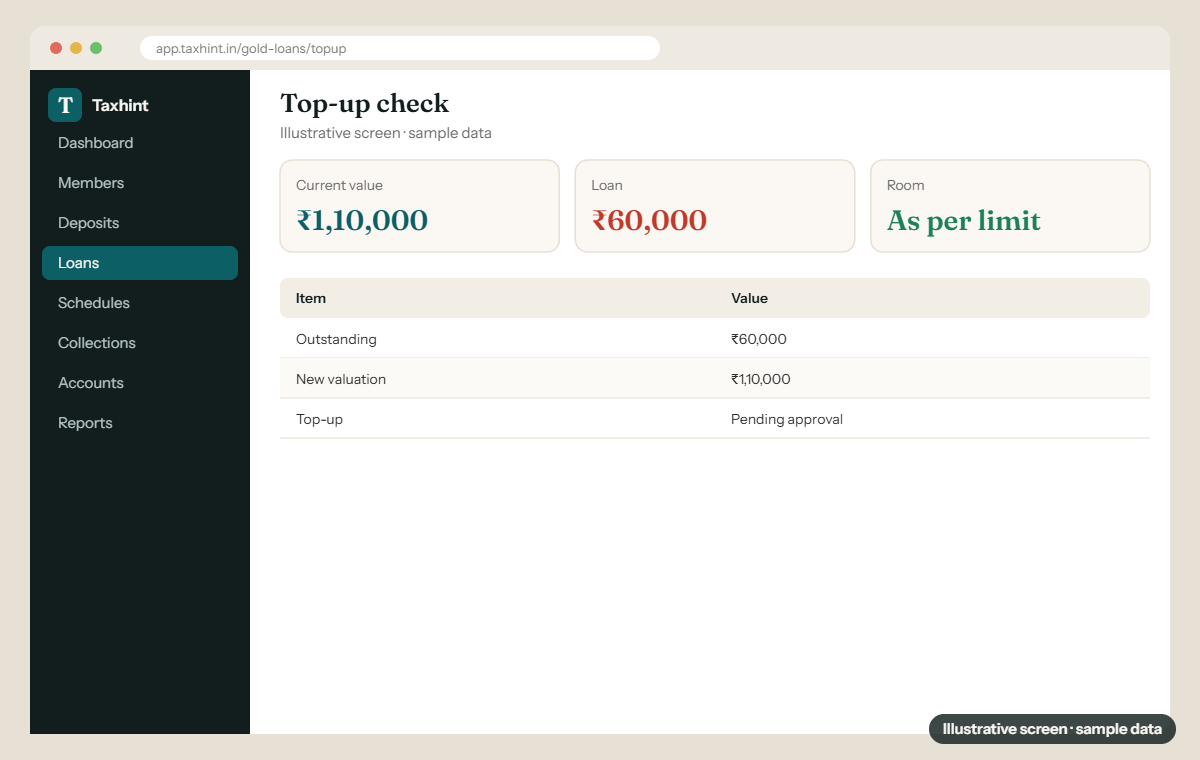
- Show total outstanding on one screen.
- Review top-ups in the weekly report.
- Watch the gold rate. Falling rates reduce the cushion.
See gold loan calculator and scheme design.
Alternatives
Sometimes a fresh loan is cleaner.
- Close the old loan and open a new one for the full amount.
- Offer a renewal with a higher amount.
- Decline when the pledge is already tight.
A worked example
A customer took ₹60,000 against 50 grams when the rate was lower. The rate has since risen and the same gold would support a bigger loan within your limit. The customer asks for ₹20,000 more. You re-test the gold, value it at the current rate and see there is room. You approve the top-up as a new line on the same packet, set interest from the top-up date and update the packet record with the new total.
When to say no
- The customer is already overdue or has repeated late payments.
- The gold test now shows lower purity than recorded.
- The new total would sit too close to your limit if the rate fell.
- The loan is within a few days of maturity; renew it instead.
Saying no politely is part of the job. Offer a renewal or a part payment option so the customer is not turned away empty-handed.
Top-up approval note
| Check | Result |
|---|---|
| Repayment record | Clean or not |
| Gold re-tested | Weight and purity same as recorded |
| Valuation at current rate | Value and room within limit |
| Total after top-up | Within policy limit |
| Approved by | Name and date |
Attach this note to the loan file. If a top-up goes wrong later, the note shows that checks were done.
When a top up makes sense
A top up gives a customer extra money against the same pledge when the gold value or the loan balance allows it. It is faster than a new loan but carries risk if the gold rate has fallen since the first loan.
Illustrative example: gold valued at 1,00,000 with a policy limit of 75 percent allows up to 75,000. If the customer has 60,000 outstanding, a top up of up to 15,000 may be possible, provided the current gold rate still supports the valuation.
Rules to set before you offer it
- Maximum number of top ups per pledge.
- Fresh valuation at each top up.
- Separate record of each top up amount and date.
- Interest on each amount from its own start date.
Top up checklist
- Current loan to value calculated.
- Gold re-weighed or rate refreshed.
- Customer consent signed.
- Revised schedule shared.
- System shows the combined balance clearly.
FAQs
Is a top-up allowed?
If your policy and rules allow and the value supports it. Please verify.
Do I have to re-check the gold?
Yes. Verify weight and purity again.
How is interest worked out?
On the old amount until the top-up date, then on the new total.
What if the gold rate falls?
The cushion shrinks. Review overdue and margin more often.
Want top-ups tracked against the original pledge? Book a demo of Taxhint software. Talk to Taxhint on +91 93117 95484 or [email protected], or visit taxhint.in.