November 24, 2026 · Guides
Loan Balance Transfer: Process for Lenders Taking Over a Loan
A borrower may ask you to take over a loan from another lender because your rate or service is better. For you it is a way to get a customer with a track record. For the borrower it is a way to save money, if the numbers work.
The steps need care, because you must pay off the other lender and take over the security.
In this guide
Assess the case
Check the borrower and the saving.
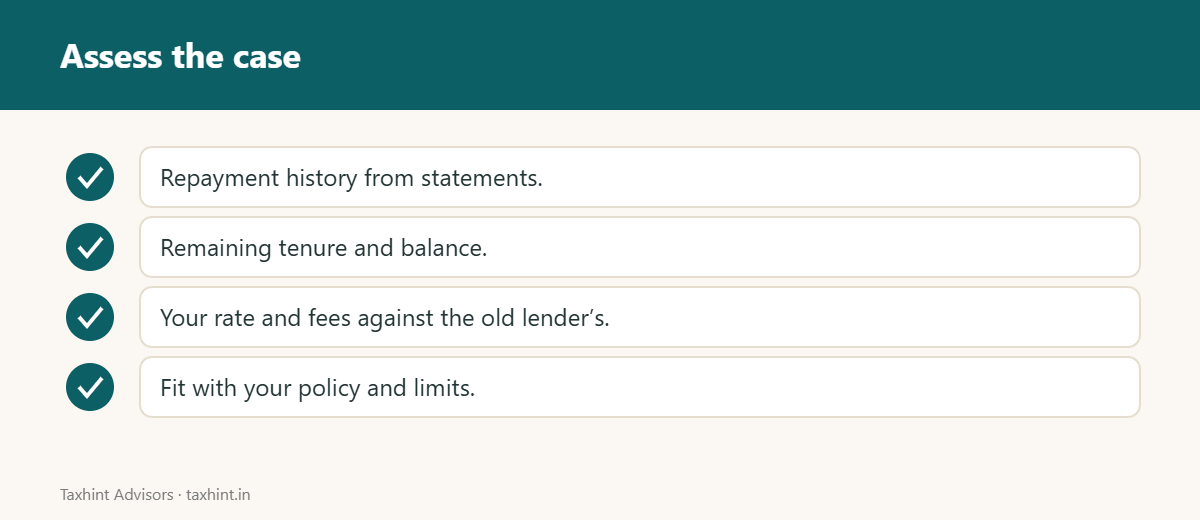
- Repayment history from statements.
- Remaining tenure and balance.
- Your rate and fees against the old lender’s.
- Fit with your policy and limits.
Documents needed
Ask in one list.
- Loan statement and foreclosure letter from the current lender.
- KYC and income documents.
- Security documents and list of papers held by the old lender.
- Consent to take over.
Requirements differ by loan type, so please verify with your CA or lawyer.
Disbursal and release
Do it in a safe order.
- Sanction the new loan. See sanction letter template.
- Pay the old lender directly against the foreclosure letter.
- Collect the original documents or proof of release.
- Update charge, hypothecation or lien records.
- Create the new schedule.
After the transfer
Close the loop.
- Obtain the no dues certificate from the old lender. See loan NOC letter.
- Keep file records of the old loan.
- Track the first few instalments closely.
See loan management software and loan EMI calculator.
A worked comparison
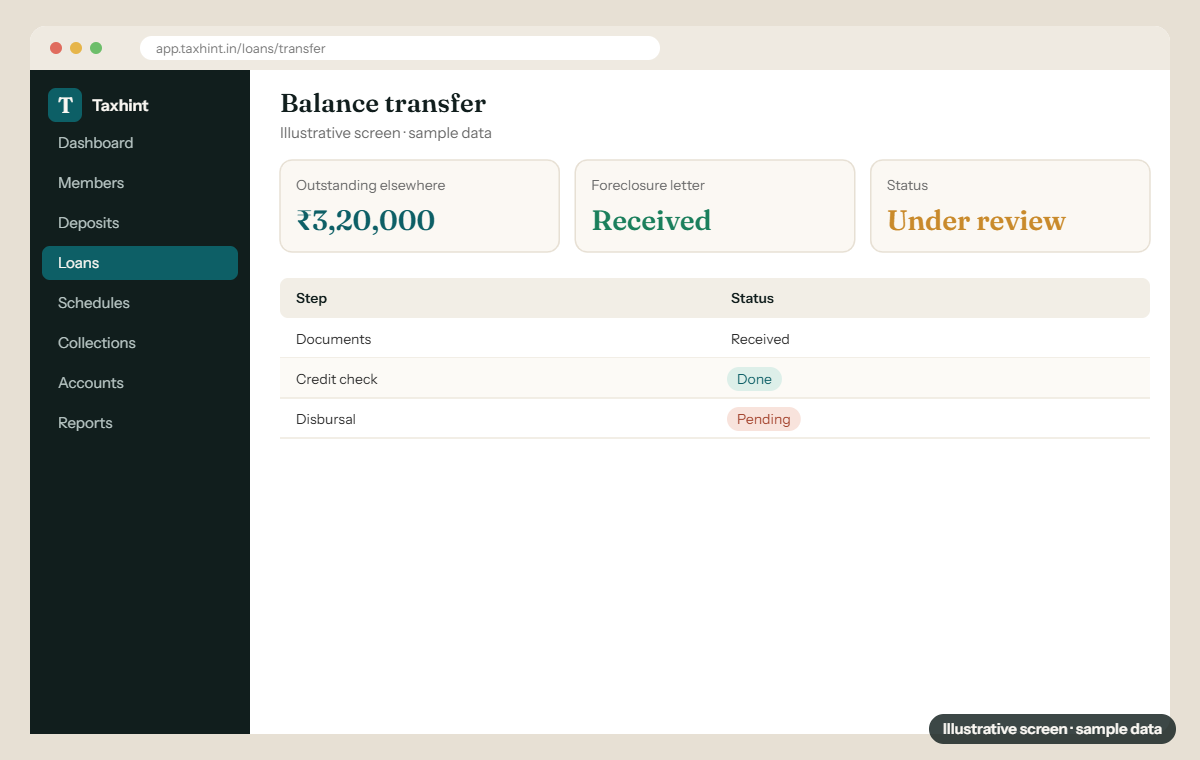
A borrower owes ₹3,20,000 to another lender at a higher rate with 30 months left. You offer a lower rate and a small processing charge. Work out total interest on both loans over the remaining period and subtract your fee. If the saving is meaningful, the borrower benefits. If it is tiny, advise honestly. Customers who move for a trivial saving often move again.
Risks to manage
- The old lender may take time to give the foreclosure letter and original documents.
- There may be charges for early closure at the old lender.
- The security may need fresh valuation or legal checks.
- Pay the old lender directly. Do not hand cash to the borrower to clear it.
Keep every letter and receipt on the file. A balance transfer file should show clearly that the old loan was closed and the security was released to you.
Balance transfer file checklist
| Item | Status |
|---|---|
| Statement and foreclosure letter | Yes or no |
| KYC and income documents | Yes or no |
| Security documents list | Yes or no |
| Sanction letter signed | Yes or no |
| Payment to old lender with proof | Yes or no |
| Release of security received | Yes or no |
Close the file only when the release of the old charge is on record.
What a balance transfer needs
In a balance transfer a customer moves an existing loan from another lender to you. You need a foreclosure statement from the other lender, a clear plan for how the old loan will be paid off and proof that it is closed. Until the other lender releases the documents and security, your risk is higher.
Illustrative example: the customer brings a foreclosure letter. You pay the old lender directly, collect the closure proof and then create your own loan record and security documents.
Mistakes to avoid
- Paying the customer instead of the old lender.
- Not collecting closure proof and original documents.
- Not checking the full balance including charges.
- Skipping fresh KYC.
Process checklist
- Foreclosure statement obtained.
- Payment made directly to the old lender.
- Closure proof and documents received.
- New agreement and schedule created.
- Please verify legal documents with your lawyer.
FAQs
What is a balance transfer?
Taking over a loan from another lender and paying it off.
Who pays the old lender?
The new lender, directly, against the foreclosure letter.
What is the key document?
The foreclosure letter and the release of security.
Is it worth it for the borrower?
Only if the saving after fees is meaningful.
Want balance transfers tracked from sanction to release? Book a demo of Taxhint loan software. Talk to Taxhint on +91 93117 95484 or [email protected], or visit taxhint.in.