November 24, 2026 · Guides
EMI Bounce and NACH Return: How Lenders Should Handle It

A bounced EMI is not always a bad borrower. Often it is an empty account on salary day, a changed bank account or a mandate that expired. How you handle the first bounce decides whether it becomes a habit.
Here is a simple routine.
In this guide
Know the reason
Reasons differ.
- Insufficient balance.
- Mandate expired or limit too low.
- Account closed or changed.
- Technical or bank-side failure.
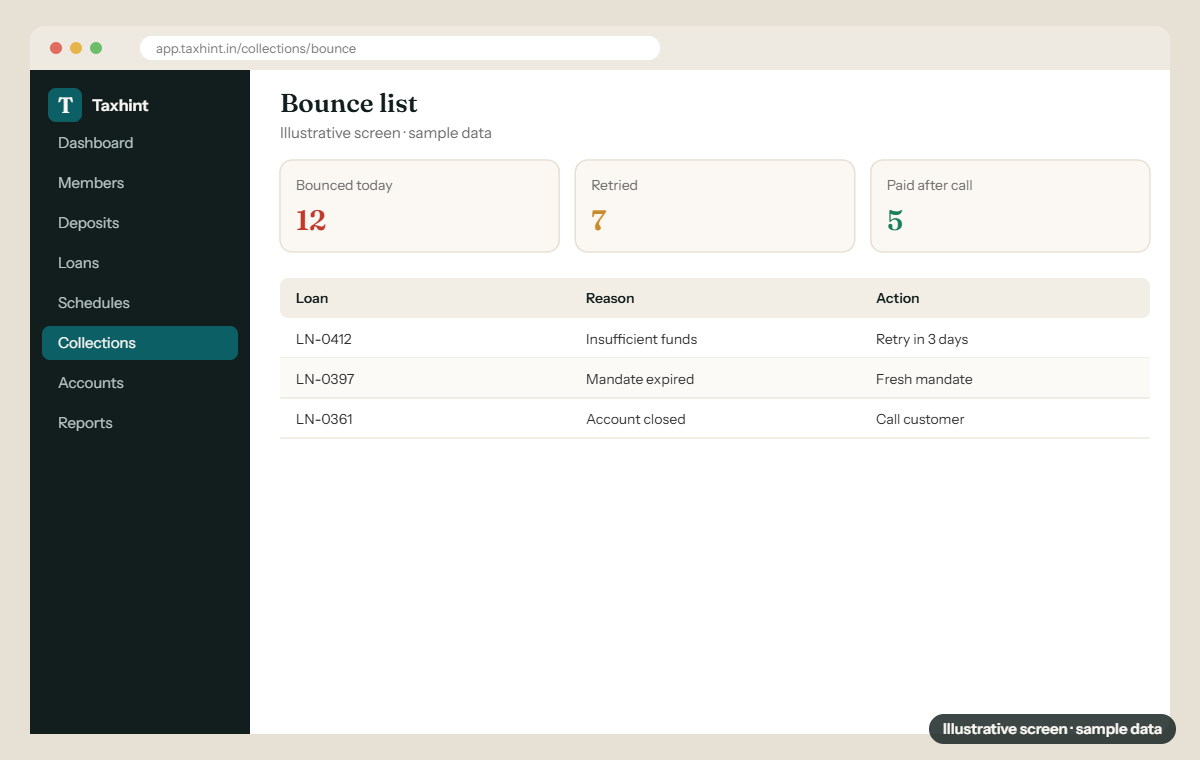
The routine
Act on the same day.
- Get the return file and the reason code.
- Message the borrower the same day with the amount and next steps.
- Call within one or two days.
- Retry only as the process allows, and record every retry.
- If the mandate is the issue, take a fresh one.
Charges and communication
Be fair and clear.
- Charge only what your agreement allows and show it on the statement.
- Do not threaten. Keep messages polite and factual.
- Offer a way to pay, such as UPI or branch.
Rules on charges and recovery conduct depend on your entity, so please verify with your CA or lawyer.
Records and reports
Make patterns visible.
- Bounce list by reason and by branch.
- Borrowers with repeat bounces.
- Collection after bounce within a week.
See overdue recovery and overdue notice format. See loan management software.
A sample week after a bounce
- Day 0: return file received. Message sent to the borrower with the amount and options.
- Day 1: call the borrower and note the reason and a promise date.
- Day 3: retry the debit if the process allows, or accept payment by UPI or at the branch.
- Day 7: if still unpaid, send a written reminder and review the case.
- Day 15: escalate to the manager and consider a meeting.
Reasons and responses
- Insufficient balance: ask for a date, retry after salary day.
- Mandate expired: take a fresh mandate quickly so future EMIs do not bounce.
- Account closed: collect new bank details and a new mandate.
- Technical failure: retry and check with your bank.
Track how many bounces were solved within a week. That number tells you how good your follow-up is.
Bounce log
| Loan | Date | Reason | Action | Result |
|---|---|---|---|---|
| LN-0412 | Date | Insufficient funds | Retry and call | Paid on day 3 |
| LN-0397 | Date | Mandate expired | Fresh mandate | Resolved |
| LN-0361 | Date | Account closed | Call, new account | Pending |
Review the log every week. Look for borrowers who appear more than once and talk to them before the third bounce.
A bounce handling routine
When an EMI debit fails, the first step is to find the reason from the return code and tell the customer the same day. Some returns are simple, like low balance. Others need a new mandate. Record the reason in the loan account and decide whether to represent the debit or collect another way.
Illustrative example: a debit fails on the due date. The system flags the account, sends a message, and the collection team calls the next morning. If the customer pays by another mode, the receipt is posted and the bounce is closed.
Mistakes to avoid
- Charging a bounce fee without a written rule.
- No follow up after the first message.
- Reusing a failed mandate without checking it.
- Mixing bounce records with payment records.
Checklist
- Return reason captured.
- Customer informed the same day.
- Bounce fee applied only as per your written policy.
- Alternate collection method offered.
- Weekly report of repeated bounces.
FAQs
Why do EMIs bounce?
Insufficient funds, expired mandate, closed account or technical failure.
Should I retry the debit?
As the process allows, and record each retry.
Can I charge a bounce fee?
Only as per your agreement. Please verify.
What is the best first step?
Contact the borrower the same day.
Want a daily bounce list with reasons and actions? Book a demo of Taxhint loan software. Talk to Taxhint on +91 93117 95484 or [email protected], or visit taxhint.in.