November 24, 2026 · Guides
Microfinance Accounting: GL Mapping and Tally Export Explained

A loan system that does not post cleanly to the books creates month-end work for the accountant. Good microfinance accounting software posts every disbursement, collection, fee and write-off to the right ledger automatically.
This guide explains the posting logic and what to verify before you export to Tally or run a trial balance.
In this guide
- 1. Map products to ledger heads
- 2. What posts on each event
- 3. Accrual and month-end
- 4. Exporting to Tally
- 5. Checks before you trust the numbers
- 6. Keep an audit trail
- A worked illustration
- Mistakes that break reconciliation
- A month-end close routine
- FAQs
1. Map products to ledger heads
Each loan product should link to a set of ledgers: loan principal (asset), interest receivable, interest income, processing fee income, insurance payable and penalty income. Set this once per product so staff never choose a ledger by hand.
2. What posts on each event
| Event | Debit | Credit |
|---|---|---|
| Disbursement | Loan principal | Cash or bank |
| Collection (principal) | Cash or bank | Loan principal |
| Collection (interest) | Cash or bank | Interest income or receivable |
| Fee at disbursement | Cash or bank | Fee income or insurance payable |
| Write-off | Provision or expense | Loan principal |
Check the exact heads with your auditor; the table shows the logic, not a fixed chart of accounts.
3. Accrual and month-end
Interest earned but not yet collected should accrue at month-end. Ask whether the software runs accrual automatically and whether it can reverse and rebook cleanly if a date is corrected. Our MIS reports list shows which reports should tie to the ledger.
4. Exporting to Tally
Most lenders either export vouchers to Tally or keep books inside the loan system. If you export, confirm that ledger names match exactly, that dates and voucher types carry over, and that you can export by branch or by day. Run a small export first and compare totals.
5. Checks before you trust the numbers
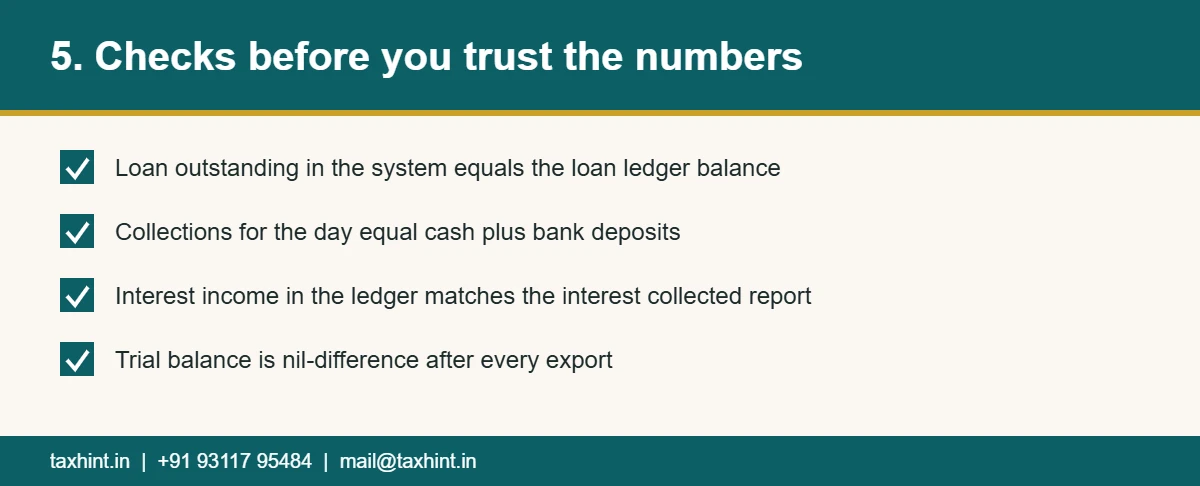
- Loan outstanding in the system equals the loan ledger balance.
- Collections for the day equal cash plus bank deposits.
- Interest income in the ledger matches the interest collected report.
- Trial balance is nil-difference after every export.
6. Keep an audit trail
Every posting should show who made it and when, and edits should be reversals, not overwrites. See our guide on audit trails and security.
A worked illustration
This example is illustrative, not a client case. A lender disburses ₹30,000 with a ₹300 processing fee and a ₹150 insurance premium. Good microfinance accounting software posts: debit loan principal ₹30,000 and credit bank ₹29,550 after deducting fees; credit fee income ₹300; credit insurance payable ₹150. Later, when the borrower repays ₹2,800 of which ₹2,500 is principal and ₹300 is interest, it debits cash ₹2,800, credits loan principal ₹2,500 and credits interest income ₹300. If any of these three lines is posted by hand, the trial balance will drift within weeks.
Mistakes that break reconciliation
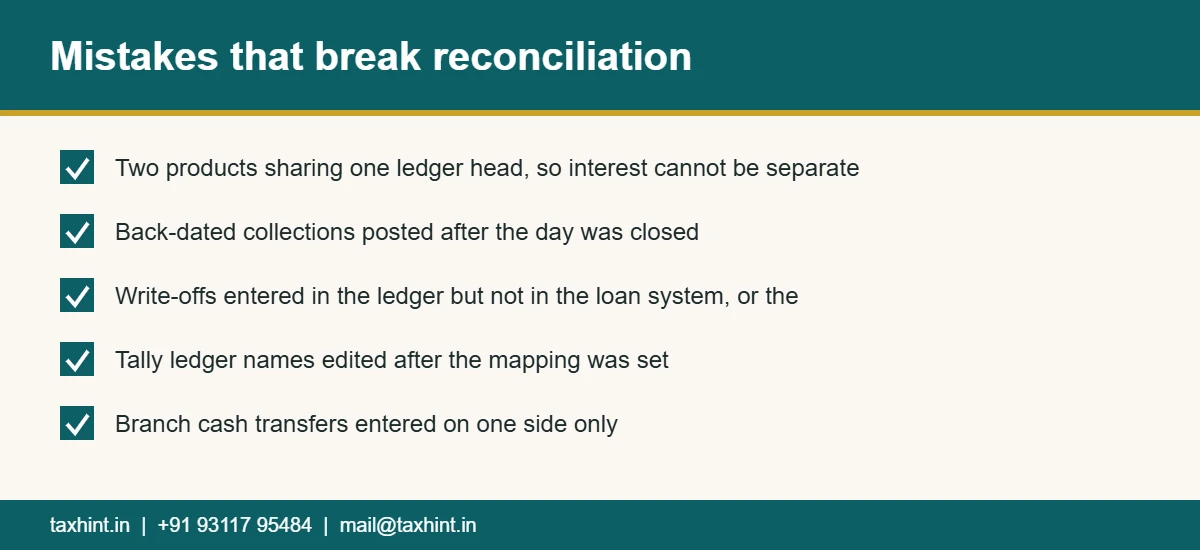
- Two products sharing one ledger head, so interest cannot be separated.
- Back-dated collections posted after the day was closed.
- Write-offs entered in the ledger but not in the loan system, or the reverse.
- Tally ledger names edited after the mapping was set.
- Branch cash transfers entered on one side only.
A month-end close routine
- Lock the month for branch users after the last collection is posted.
- Run interest accrual and review the accrual report.
- Compare loan outstanding with the ledger and clear differences.
- Export vouchers to Tally by branch and compare totals.
- Prepare the trial balance and note any suspense balance.
- Have the accountant sign the reconciliation before the MIS goes to the board.
FAQs
Can microfinance software replace Tally?
Some systems keep full books, others export to Tally. Either can work if postings are correct and reconcile.
What is a ledger mapping?
It links each loan product and event to the accounting heads that should be debited and credited.
How often should we reconcile?
Daily for cash and collections, monthly for loan outstanding and interest income.
Who should set the chart of accounts?
Your accountant or auditor, then the vendor configures it.
Should we keep books in the loan system or in Tally?
Either works. Pick one source of truth, reconcile it daily and never maintain two sets of ledgers by hand.
What is suspense and why is it dangerous?
Suspense holds entries that could not be mapped. A growing balance means postings are going wrong and should be cleared every month.
Running loans on spreadsheets? Book a free demo of our microfinance software, starting ₹15,000, or WhatsApp +91 93117 95484.