November 24, 2026 · Guides
Microfinance MIS Reports: What to Review Daily, Weekly and Monthly
Good microfinance MIS reports turn thousands of small transactions into a handful of numbers a manager can act on. The goal is not more reports, but the right ones, at the right frequency, in the hands of the right person.
Here is a practical list, grouped by use.
If a report is not read and acted on, it is clutter. Keep the list of microfinance MIS reports short and review each one on a fixed schedule.
In this guide
- Daily reports (branch and loan officer)
- Weekly reports (area and branch manager)
- Monthly reports (management and board)
- Compliance and funder reports
- How to design a good report
- Reading a report: an example
- Mistakes in MIS
- Where to start
- FAQs
Daily reports (branch and loan officer)

- Collection sheet by centre: demand, collected, short and advance.
- Cash and bank position: cash with each officer, deposits made, differences.
- New disbursements: loans sanctioned and paid out.
Weekly reports (area and branch manager)
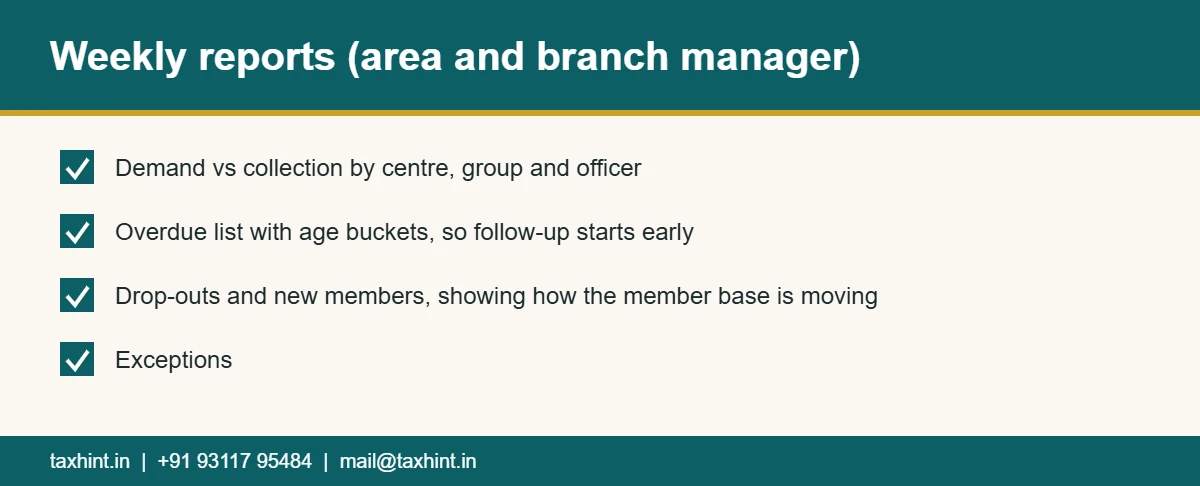
- Demand vs collection by centre, group and officer.
- Overdue list with age buckets, so follow-up starts early.
- Drop-outs and new members, showing how the member base is moving.
- Exceptions: reversals, edits after posting, late entries.
Monthly reports (management and board)
- Portfolio at risk above 30 and 90 days, by branch and product. See PAR explained.
- Portfolio outstanding and growth, with number of active borrowers.
- Disbursement by product and cycle.
- Branch and officer productivity: borrowers per officer, collection efficiency, cost per loan.
- Income and expense summary with provisioning.
Compliance and funder reports
Keep reports ready for what regulators, auditors and funders ask: qualifying-asset ratio for NBFC-MFIs, household income and indebtedness checks, credit bureau files and borrower-level data. For the first, see qualifying assets. For inspections, see our RBI inspection checklist.
How to design a good report
- One question per report, with a clear title.
- Filters by branch, centre, officer, product and date.
- Export to Excel and PDF.
- Drill-down from a total to the loan behind it.
- Same numbers in the report and in the books.
Our microfinance software includes these MIS reports; ask in the demo to see each one with sample data.
Reading a report: an example
Say the weekly overdue report shows one loan officer with a third of the branch’s 8-to-30-day overdue loans, all in two centres. The branch manager visits those centres that week. The cause turns out to be a market closure, not borrower intent, and a revised meeting day fixes it. Without the age-bucket view, the same problem would have appeared months later as PAR 90.
Mistakes in MIS
- Dozens of reports and no owner for any of them.
- PAR calculated differently in different branches.
- MIS that cannot be reconciled with the books.
- Reports only available at month end.
Where to start
If you are setting up for the first time, begin with four reports: daily collection sheet, weekly overdue by age, monthly PAR and monthly portfolio and disbursement summary. Add others as questions arise.
FAQs
Which MIS report matters most for a microfinance lender?
The overdue and PAR report by age bucket, because it shows trouble early enough to act.
How often should the board see MIS reports?
Monthly, with a short summary of portfolio quality, growth and compliance ratios.
Should MIS reports match the accounts?
Yes. Loan outstanding in MIS should reconcile with loan receivable in the books each month.
Can MIS reports be exported?
A good system exports every report to Excel and PDF so funders and auditors can use them.
Running loans on spreadsheets? Book a free demo of our microfinance software, starting ₹15,000, or WhatsApp +91 93117 95484.