November 21, 2026 · Guides
Microfinance Company Registration Cost in India: What You’ll Actually Pay
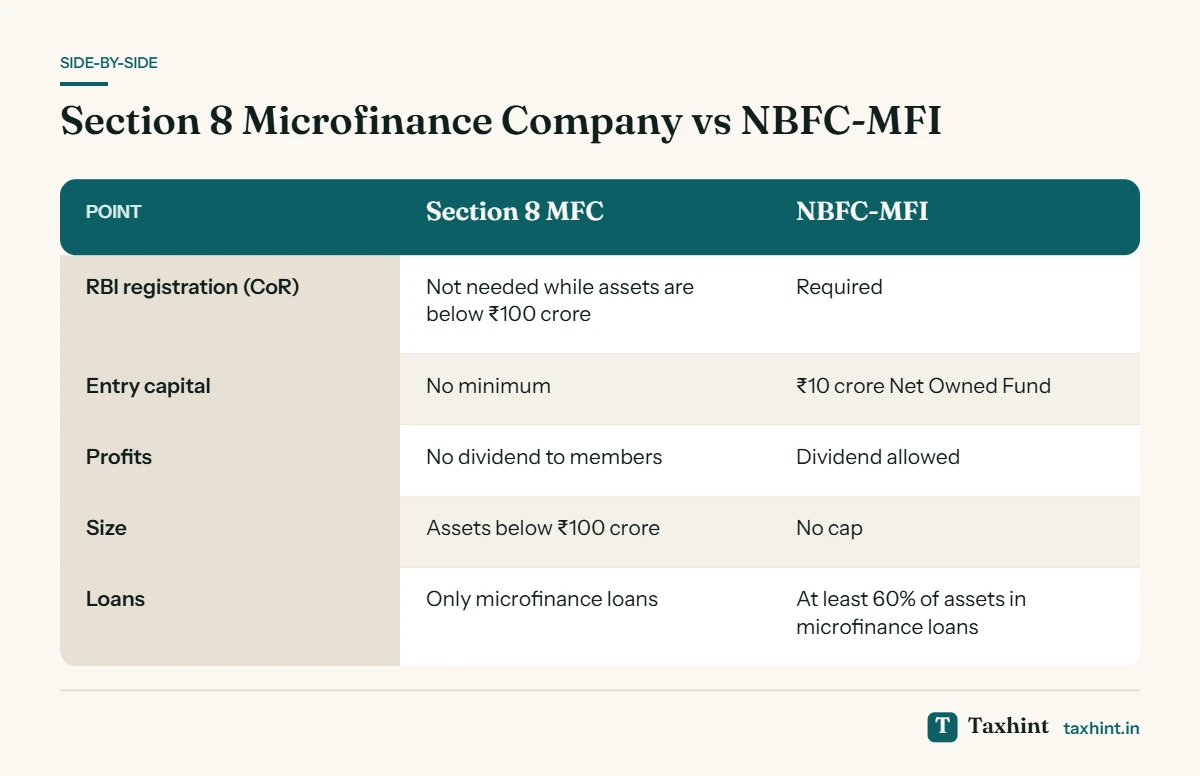
Microfinance company registration fees come in two very different sizes. A Section 8 microfinance company costs a modest amount in government charges: ₹1,000 for name reservation, a SPICe+ fee that depends on authorised capital, state stamp duty on the MoA and AoA, and a DSC for each director. An NBFC-MFI is a different budget altogether, because RBI wants ₹10 crore of net owned fund before it will issue a certificate of registration.
This post lists each cost component, who charges it and what decides the amount, so you can budget before you start. We do not quote a professional fee here, because it depends on the route and the state of your papers.
In this guide
- Cost components at a glance
- Section 8 route: government fees explained
- NBFC-MFI route: the ₹10 crore question
- Hidden and running costs after registration
- How to keep microfinance company registration fees down
- FAQs
Cost components at a glance
Most promoters who call us about microfinance company registration fees ask for “the total”. The honest answer is that four or five separate charges make up the total, and two of them change with your state and your capital. Here is the full list for the Section 8 microfinance company registration route, with the NBFC-MFI extras alongside.
| Cost component | Paid to | What decides the amount | Section 8 | NBFC-MFI |
|---|---|---|---|---|
| Name reservation (SPICe+ Part A) | MCA | Fixed at ₹1,000 | Yes | Yes |
| SPICe+ incorporation fee | MCA | Authorised capital | Yes | Yes |
| Stamp duty on MoA and AoA | State government | State where the registered office is, and capital | Yes | Yes |
| Digital signature certificates | Certifying authority or vendor | Number of directors and subscribers | Yes | Yes |
| Professional fee | Your CA or CS firm | Route, number of people, drafting work | Yes | Yes |
| Net owned fund | Your own company (capital, not a fee) | RBI minimum of ₹10 crore | No | Yes |
| RBI application and supporting certificates | Prepared with your auditor and adviser | Business plan, policies, auditor’s NOF certificate | No | Yes |
Section 8 route: government fees explained
Name reservation: ₹1,000
You reserve the name in SPICe+ Part A on the MCA V3 portal. The fee is ₹1,000. If the name is rejected and you apply again, you pay again, so a little effort on name choice saves money. Pick names that reflect a charitable purpose and do not copy an existing company.
SPICe+ fee: linked to authorised capital
The incorporation fee in SPICe+ follows the authorised capital you choose. When MCA cut incorporation charges in 2018, the government listed zero fee for companies with small authorised capital, and for companies without share capital that have up to twenty members, as one of its reforms (PIB summary of MCA reforms). Fee notifications change, so go by the figure the MCA portal computes when you fill the form.
Don’t assume a separate waiver just because the company is Section 8. The fee follows capital, and a Section 8 company with large authorised capital pays accordingly.
Stamp duty: varies by state
Of all the microfinance company registration fees, stamp duty is the one that varies most by location. It is a state levy on the MoA and AoA, collected through the MCA system at filing. Each state sets its own rates, and in many states the duty rises with authorised capital. A company with its office in Haryana and one with its office in Bihar will pay different amounts for the same capital. Your adviser should check the current schedule for your state before you fix the capital figure.
DSC: one per director and subscriber
Every director and subscriber signs the forms with a digital signature certificate. Vendors price DSCs differently based on validity and class, and people who already hold a valid DSC do not need a new one. Count your people early: a Section 8 company with three directors and two extra subscribers needs five DSCs.
Professional fee: varies
Drafting charitable objects, the three-year income and expenditure estimate, the INC-14 professional declaration and the credit policy is real work. The fee depends on how much of that is needed and how ready your documents are. Our Section 8 microfinance documents checklist shows what you can collect yourself to keep that work small. For an exact quote, use Get Free Consultation.
NBFC-MFI route: the ₹10 crore question
For NBFC-MFI registration, the incorporation charges above still apply, since you first form a private limited company through SPICe+. They are small next to the main requirement: ₹10 crore of net owned fund, certified by the statutory auditor, before RBI will consider the certificate of registration.
Strictly speaking, NOF is capital and not a fee. You keep the money in the company and lend it. But it has to be raised, usually through equity, and it has to be in place before the application, which is why we treat it as the real cost of this route. Our explainer on net owned fund (NOF) shows how RBI calculates it and what reduces it.
Alongside NOF, budget for:
- The application on RBI’s PRAVAAH portal, with a three-year business plan and Board-approved pricing, KYC, fair practices and household repayment policies.
- The statutory auditor’s certificate confirming NOF, and a bank certificate.
- Membership of an RBI-recognised self-regulatory organisation for NBFC-MFIs after the CoR, and membership of credit information companies.
- Waiting time. RBI sets no fixed decision period, and the capital sits idle while the application is reviewed.
For a Faridabad investor group with ₹2 crore to deploy, these numbers usually settle the question in favour of a different structure. RBI’s directions are on the RBI website.
Hidden and running costs after registration
Microfinance company registration fees are a one-time spend. These come back every year, and promoters often leave them out of the first budget.
| Running cost | Section 8 | NBFC-MFI |
|---|---|---|
| Statutory audit | Every year | Every year, plus the statutory auditor’s certificate due by 31 December |
| MCA annual filings | AOC-4 within 30 days of AGM, MGT-7 within 60 days (MCA filing fees apply) | AOC-4 and the annual return (MCA filing fees apply) |
| Income tax return | ITR-7 if section 11 exemption is claimed, otherwise ITR-6 | ITR-6 |
| RBI returns | None while the exemption holds | Quarterly returns such as DNBS02 for base layer NBFCs |
| SRO and credit bureau membership | Not mandatory for the exemption | Required |
| Loan management software | Needed once borrower numbers grow | Needed from day one for RBI and bureau reporting |
| Tax registrations (12A, 80G) | Optional, if you want tax exemption or donor deductions | Not applicable |
Software is the one line we can price for you. Taxhint’s microfinance software starts at ₹15,000. Our post on microfinance software cost in India compares how vendors in India price it.
Penalties are a cost too, and an avoidable one. A late AOC-4 or MGT-7 attracts additional fees per day of delay, and for a Section 8 company a breach of licence conditions can bring fines under Section 8(11) of ₹10 lakh to ₹1 crore on the company.
How to keep microfinance company registration fees down
A few choices made at the start change the bill more than anything else.
- Keep authorised capital realistic. Higher capital raises the SPICe+ fee and, in many states, the stamp duty. You can increase it later through Form SH-7 when you actually need it.
- Get every DSC and KYC document right the first time. Each resubmission costs time and sometimes a fresh name reservation.
- Pick the right route. A Bihar SHG federation lending grant money gains nothing from the NBFC-MFI route and would carry its compliance cost for years.
- Budget for year one compliance at the same time as registration, so the first audit and filings are not a surprise.
FAQs
What are the microfinance company registration fees charged by the government?
₹1,000 for name reservation, a SPICe+ incorporation fee that depends on authorised capital, state stamp duty on the MoA and AoA, and DSC charges for each director and subscriber.
Is a Section 8 company exempt from the SPICe+ fee?
Don’t plan on a blanket exemption. The SPICe+ fee follows authorised capital, and the MCA portal shows the exact amount when you fill the form.
How much capital does a Section 8 microfinance company need?
The Companies Act sets no minimum capital for a Section 8 company. You need enough funds to run your lending programme, usually from members’ capital, grants or donations.
What does NBFC-MFI registration cost?
Incorporation charges plus the main requirement: ₹10 crore of net owned fund, certified by the statutory auditor, before you apply for RBI’s certificate of registration on PRAVAAH.
Why does stamp duty differ from state to state?
Stamp duty is a state levy. Each state sets its own rate for the MoA and AoA, and many link it to authorised capital.
Does Taxhint publish its professional fee?
No. It depends on the route and the drafting needed. Use Get Free Consultation for a quote based on your papers.
What does microfinance software cost?
Taxhint’s microfinance software starts at ₹15,000.
What are the yearly compliance costs?
Audit, AOC-4 and MGT-7 filings with MCA fees, and the income tax return every year. An NBFC-MFI also files RBI returns and keeps SRO and credit bureau memberships.
Want a clear budget for your state and route before you commit? Get Free Consultation with our CA and CS team: call or WhatsApp +91 93117 95484, or mail [email protected]. We have worked with 5,000+ businesses across 28 states since 2014, 100% online.