November 21, 2026 · Guides
Section 8 Microfinance Company: Documents Checklist (2026)
The section 8 microfinance company documents fall into four groups: KYC papers for every director and subscriber, proof of the registered office, the licence papers for the Section 8 application, and the policies your Board must adopt before the first loan goes out. The first three go with SPICe+ on the MCA V3 portal. The fourth stays in your own files, but RBI’s exemption conditions make it just as important.
Below is the checklist of Section 8 microfinance company documents we use in practice, set out as tables you can tick off, followed by the reasons applications most often come back from the Registrar.
In this guide
- Why the document file decides your timeline
- Section 8 microfinance company documents from directors and subscribers
- Registered office documents
- Section 8 licence application papers
- Before the first loan: credit policy and board resolutions
- Common rejection reasons
- FAQs
Why the document file decides your timeline
A Section 8 microfinance company is incorporated and licensed in one filing. SPICe+ (INC-32) carries the licence application under Rule 19 of the Companies (Incorporation) Rules, 2014, and the memorandum goes in Form INC-13. If one paper is weak, the whole application comes back for resubmission, so the company and the licence get delayed together.
The documents also have to support the RBI position. A Section 8 company that gives only microfinance loans, takes no public deposits and keeps assets below ₹100 crore is exempt from RBI registration under paragraph 51 of RBI’s NBFC Registration, Exemptions and SBR Directions, 2025. Your objects clause and credit policy are where that promise first appears in writing. Our Section 8 microfinance company registration page explains the exemption in full; this post stays on the paperwork.
Section 8 microfinance company documents from directors and subscribers
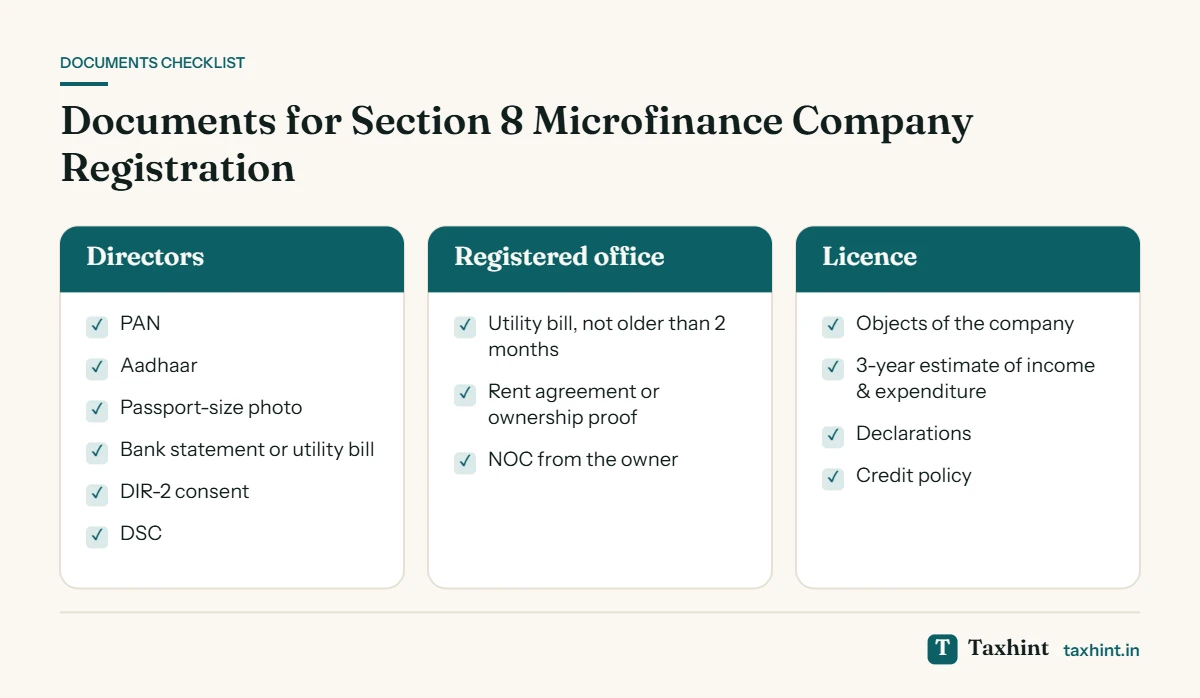
Every person who will sign the memorandum or sit on the Board gives the same basic set. Collect it from everyone at once. Chasing one director for a bank statement after the others are ready is the most common cause of a two-week slip that we see.
| Document | From whom | What to check |
|---|---|---|
| PAN card | Each director and subscriber | Name and date of birth must match Aadhaar exactly |
| Aadhaar | Each director and subscriber | Mobile linked, since OTP checks run on it |
| Passport-size photograph | Each director and subscriber | Recent, clear, plain background |
| Bank statement or utility bill | Each director and subscriber | Recent, showing the current residential address |
| Consent to act as director (DIR-2) | Each proposed director | Signed, with the same name spelling as PAN |
| Digital signature certificate (DSC) | Each director and subscriber | Valid, and in the same name as PAN |
A word on name spelling. If PAN says “Rakesh Kumar Yadav” and Aadhaar says “Rakesh Yadav”, fix one of them before you start. The MCA system cross-checks PAN, and a mismatch stops DIN allotment for a new director. For a Palwal livelihood programme run by retired bank staff, for example, this single issue can hold up an otherwise perfect file.
Foreign nationals and NRIs can be directors, but their papers need notarisation or apostille depending on the country. Plan extra time for that.
Registered office documents
The registered office can be rented, owned or provided free by a promoter or the parent trust. What matters is that the papers line up with each other.
| Document | When needed | What to check |
|---|---|---|
| Utility bill (electricity, water, gas or telephone) | Always | Not older than two months; address matches the rent or ownership paper |
| Notarised rent agreement with rent receipt | If the premises are rented | Landlord name matches the utility bill or the owner’s NOC |
| Ownership proof (sale deed, property tax receipt) | If a promoter or the trust owns the premises | Owner name matches the NOC signatory |
| No-objection letter from the owner | Always | Signed by the owner, permitting use as the registered office |
Where a Faridabad trust gives a room in its own building to the new company, the trust signs the NOC through an authorised trustee, and you attach the trust’s ownership proof. Keep a copy of the trust resolution authorising that trustee in your file even if the portal does not ask for it.
Section 8 licence application papers
This is the group that separates a Section 8 company from an ordinary private limited, and it is where most of the drafting time goes.
| Document | What it contains | Practical note |
|---|---|---|
| Memorandum in Form INC-13 | Charitable objects (microfinance, poverty relief), bar on dividends, use of income only for objects | Write objects around small loans to low-income households, not general lending |
| Articles of association | Internal rules, Board powers, membership | Keep consistent with the no-dividend clause |
| Estimate of income and expenditure for the next three years | Year-wise projected income (interest, grants) and spending | Figures should match the scale of lending you describe in the objects |
| Declaration by a practising professional (INC-14) | Confirms the papers are drawn up in line with Section 8 and the rules | Signed by a CA, CS, CMA or advocate |
| Declaration by each applicant (INC-15) | Each subscriber confirms the facts and the Section 8 conditions | One per subscriber, signed and dated |
| Draft credit policy | Household income test of ₹3,00,000 and the 50% repayment cap | Shows the licence is for microfinance as RBI defines it |
The three-year projection deserves more care than promoters usually give it. A Bihar SHG federation that plans to lend ₹40 lakh in year one should not show a surplus that looks like a commercial lender’s profit. The Registrar reads the projection against the charitable objects, and a mismatch invites questions.
For the filing itself, our walkthrough of the SPICe+ process for a Section 8 microfinance company covers each screen, and the general guide to the SPICe+ form explains Part A name reservation and the linked forms. The text of Section 8 is on India Code (Companies Act, 2013).
Before the first loan: credit policy and board resolutions
None of these go to the Registrar. They matter because the RBI exemption depends on how you actually lend, and an inspector, auditor or bank will ask to see them. We usually advise promoters not to disburse a rupee until this folder is complete.
| Document | Purpose | Timing |
|---|---|---|
| Board resolution adopting the credit policy | Fixes the ₹3,00,000 household income test, collateral-free lending and the 50% monthly repayment cap | Before the first loan |
| Board resolution adopting the pricing policy | Sets how interest and charges are decided | Before the first loan |
| Minutes of the first Board meeting | Records appointment of auditor, bank account, policies | Within 30 days of incorporation (Section 173(1)) |
| Board resolution opening the bank account | Names authorised signatories | At or soon after the first meeting |
| Household income assessment format | Records each borrower household’s income and existing repayments | Ready before the first loan |
| Borrower KYC and loan file checklist | Aadhaar, PAN or other ID, photo, signature, loan agreement | For every borrower |
| Note on funding sources | Confirms money comes from members’ capital, grants or donations, and any borrowing is checked against the public-deposit definition | Before you accept any money from outside |
Borrower records pile up fast once lending starts. A group of 200 borrowers means 200 KYC sets and 200 income assessments, plus repayment history for each. Paper registers break down quickly at that volume, which is why many Section 8 lenders move KYC and household income checks into microfinance software from the first month.
Common rejection reasons
These are the points on which we most often see Section 8 microfinance files sent back for resubmission. None of them is unusual, and all of them are avoidable.
- Objects that read like a commercial lender’s. “To carry on the business of lending money” is the wrong tone for a charitable licence. Tie the objects to poverty relief and small loans for low-income households.
- A projection that does not match the objects. A large surplus, salaries out of line with the programme, or income heads that have nothing to do with microfinance.
- A utility bill older than two months, or an address that differs by a house number between the bill and the rent agreement.
- Name mismatches between PAN, Aadhaar and DSC for a director or subscriber.
- A missing or unsigned owner’s NOC, or a NOC signed by someone who is not the owner.
- A proposed name that does not fit Section 8 conventions or is too close to an existing company. Names are reserved in SPICe+ Part A on the MCA portal, and a weak name choice costs a round.
- Declarations (INC-14, INC-15) signed with dates or details that do not match the rest of the file.
Each resubmission adds days, so it pays to have someone check your Section 8 microfinance company documents against this list before filing. Government fees are part of the budget too, and our post on what microfinance company registration actually costs breaks those down.
FAQs
What are the Section 8 microfinance company documents needed for registration?
PAN, Aadhaar, photo, a recent bank statement or utility bill, DIR-2 and DSC from each director and subscriber; a utility bill, rent or ownership proof and owner’s NOC for the office; and the licence papers: memorandum in INC-13, articles, a three-year income and expenditure estimate, INC-14 and INC-15.
Is there a minimum capital document to submit?
No. The Companies Act sets no minimum capital for a Section 8 company, and the ₹10 crore net owned fund rule for NBFC-MFIs does not apply while the paragraph 51 exemption holds.
How old can the registered office utility bill be?
Not older than two months at the time of filing. Older bills are a common reason for resubmission.
Do we need RBI documents to incorporate?
No RBI filing is needed while the company gives only microfinance loans, takes no public deposits and keeps assets below ₹100 crore. Keep your credit policy ready, because it shows you meet those conditions.
Can a trust or society be a subscriber?
Yes, a trust or society can subscribe through an authorised person. Keep the resolution authorising that person, along with the entity’s registration papers, in your file.
What is INC-14 and INC-15?
INC-14 is the declaration by a practising professional that the papers follow Section 8 and the rules. INC-15 is the declaration each applicant signs. Both go with the SPICe+ filing.
Which policies must be adopted before the first loan?
At minimum a credit policy covering the ₹3,00,000 household income test and the 50% monthly repayment cap, and a pricing policy. Adopt both by Board resolution and record them in the minutes.
When is the first Board meeting due?
Within 30 days of incorporation under Section 173(1) of the Companies Act, 2013.
Want us to check your papers before filing? Our CA and CS team has worked with 5,000+ businesses across 28 states since 2014, fully online. Get Free Consultation: call or WhatsApp +91 93117 95484, or mail [email protected].