November 24, 2026 · Guides
Loan Utilisation Check in Microfinance: How and Why

A microfinance loan utilisation check confirms that a borrower used the money for the purpose she stated. It protects the borrower, because a productive loan is easier to repay, and it protects the lender, because it shows whether appraisal is working.
This guide explains when to do it, what to ask, how to record the visit and what to do when the money was used differently.
In this guide
- Why check utilisation
- When to do it
- How to do the visit
- Sample questions
- If the money was used for something else
- Related reading
- Where this comes from
- A worked illustration
- Common mistakes
- FAQs
Why check utilisation
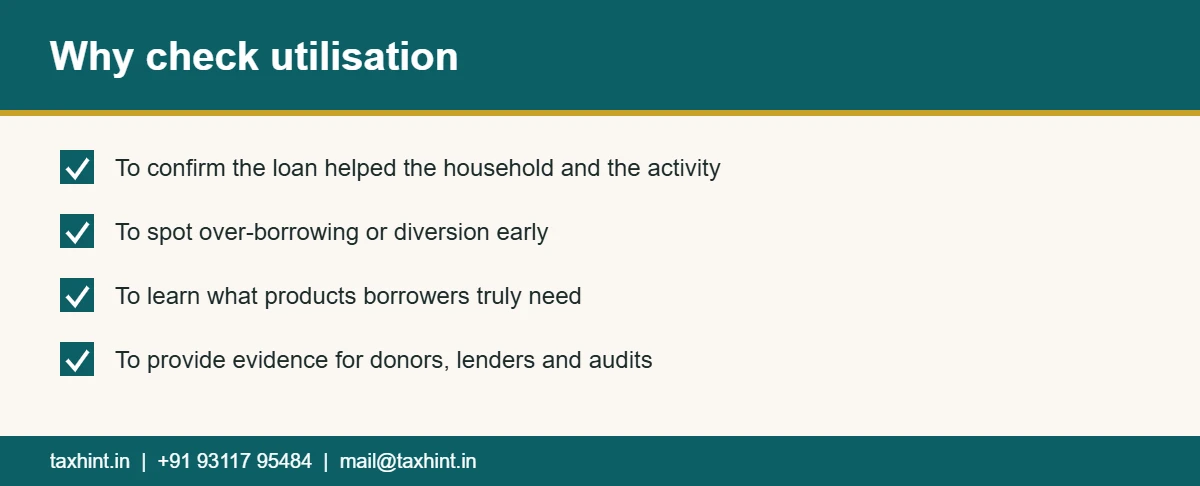
- To confirm the loan helped the household and the activity.
- To spot over-borrowing or diversion early.
- To learn what products borrowers truly need.
- To provide evidence for donors, lenders and audits.
When to do it
Within a short, fixed period after disbursement, for example the first few weeks, and then on a sample basis later in the cycle. Visit new borrowers first, then high-value loans and loans in groups with early overdue signs. The policy should state the percentage of loans to be checked.
How to do the visit
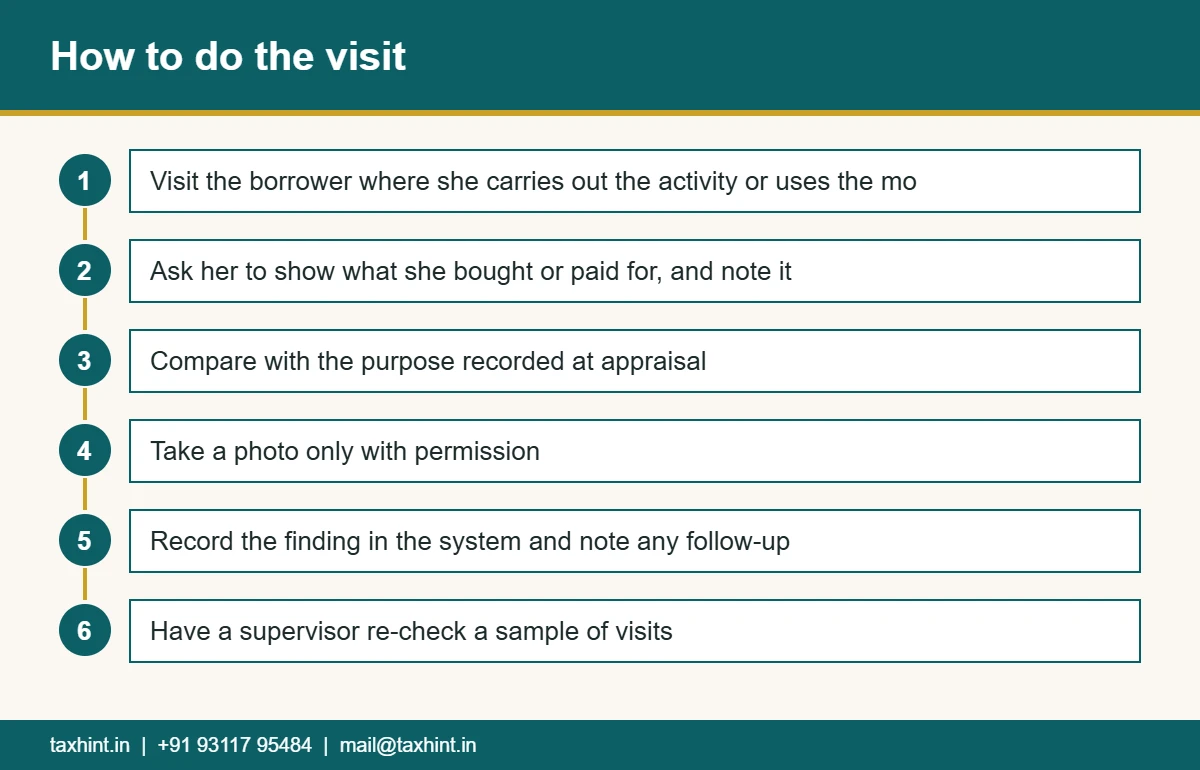
- Visit the borrower where she carries out the activity or uses the money.
- Ask her to show what she bought or paid for, and note it.
- Compare with the purpose recorded at appraisal.
- Take a photo only with permission.
- Record the finding in the system and note any follow-up.
- Have a supervisor re-check a sample of visits.
Sample questions
- What did you spend the loan on?
- How is the activity doing now?
- Do you need any support from us?
- Is anyone else in the household also repaying loans?
If the money was used for something else
Do not treat a different use as fraud by default. Many borrowers face an emergency such as health or a family event. Record the reason, check repayment capacity again and decide whether to continue as normal, restructure or stop further lending, as your policy provides. Keep the tone respectful.
Related reading
Utilisation sits inside the loan cycle. See fraud prevention and fair practices.
Where this comes from
Source: RBI (NBFC – Microfinance Institution) Directions, 2025. RBI updates these Directions from time to time, so confirm the current text before acting.
A worked illustration
This is illustrative, not a client case. A borrower takes ₹25,000 saying she will buy stock for a small grocery shop. The officer visits in the third week and sees new stock worth about ₹18,000 on the shelves, with the rest spent on a family medical bill. The note records the partial diversion and its reason, a supervisor reviews it, and the next loan amount is set after a fresh income check. The lender learns that health costs are driving borrowing, which may justify an emergency loan product.
Common mistakes
- Doing the visit only by phone.
- Treating every diversion as wilful default.
- Letting the same officer check loans he disbursed, with no sample re-check.
- Forgetting to feed findings back into appraisal rules.
FAQs
Is a utilisation check compulsory?
Policies usually require it. RBI expects sound appraisal and monitoring, and many funders ask for utilisation evidence.
Who does the check?
A loan officer or a supervisor. Some lenders use a separate team for independence.
Can the check be done by phone?
Phone checks are weaker. Use them to schedule a visit or for low-risk follow-up.
How do we record it?
In the loan system, with date, officer, finding and any photo with consent.
What percentage of loans should be checked?
Set it in policy. Many lenders check all first-cycle loans and a risk-based sample after that.
Can utilisation data be used for reporting?
Yes. Aggregate findings help boards and funders see how loans are used.
Running loans on spreadsheets? Book a free demo of our microfinance software, starting ₹15,000, or WhatsApp +91 93117 95484.