November 24, 2026 · Guides
The Microfinance Loan Cycle: From Sourcing to Closure

A clear microfinance loan cycle is the backbone of both service and control. When every loan follows the same steps, staff know what to do, borrowers know what to expect and an auditor can test each step.
This guide walks the cycle from first contact to closure and marks the control that belongs at every stage.
In this guide
- The cycle at a glance
- Sourcing and group formation
- Appraisal under RBI rules
- Sanction and disbursement
- Collection and monitoring
- Closure and repeat loans
- Where this comes from
- A worked illustration
- Where cycles usually break
- FAQs
The cycle at a glance
| Step | What happens | Key control |
|---|---|---|
| 1. Sourcing | Officer identifies an area and eligible households | Area approval and exposure limit |
| 2. Group formation | Women form a group and elect leaders | Group recognition test |
| 3. Appraisal | Household income, existing debt and use of loan assessed | Income and indebtedness check |
| 4. Sanction | Branch or credit head approves | Maker-checker and limits |
| 5. Disbursement | Loan paid to the borrower account | Direct bank transfer, KFS given |
| 6. Collection | Regular instalments at centre or digital | Receipt, daily reconciliation |
| 7. Monitoring | Utilisation and overdue follow-up | Overdue ladder |
| 8. Closure and renewal | Final payment, no-dues, repeat loan decision | Closure check, renewal policy |
Sourcing and group formation
Choose areas where you can serve and collect, and set exposure limits by area so one village does not dominate the book. Groups form among neighbours who know each other. The group recognition test checks that members understand the product and their responsibility. See GRT steps.
Appraisal under RBI rules
RBI’s microfinance framework expects a board-approved policy for assessing household income and a cap on the share of monthly household income that goes to loan repayments, set at 50 percent. The loan officer records income, existing loans and the purpose, and the system checks the limit before sanction. See borrower selection.
Sanction and disbursement
Sanction should sit with someone other than the officer who recommended the loan. Give the borrower the key fact statement and loan agreement in her language, and disburse through the bank wherever possible. See key fact statement and loan agreement documents.
Collection and monitoring
Collections happen at a centre meeting or digitally. Every receipt is issued on the spot and cash reconciles daily. Check how the loan was used, see loan utilisation check, and follow the overdue ladder when a payment is missed.
Closure and repeat loans
On the last payment issue a no-dues certificate and update the bureau. Repeat loans should follow a policy, not habit; see renewal policy.
Where this comes from
Source: RBI (NBFC – Credit Facilities) Directions, 2025, microfinance chapter. RBI updates these Directions from time to time, so confirm the current text before acting.
A worked illustration
This is illustrative, not a client case. A member asks for ₹30,000 for a tailoring business. The officer records her household income of ₹14,000 a month and existing instalments of ₹1,500. With a 50 percent cap, total monthly repayments must stay under ₹7,000, so a new instalment of ₹2,400 fits easily. The system confirms the limit, the branch manager sanctions, the money goes to her bank account, and she receives the key fact statement in her language. Every step is logged, so an auditor can replay the decision later.
Where cycles usually break
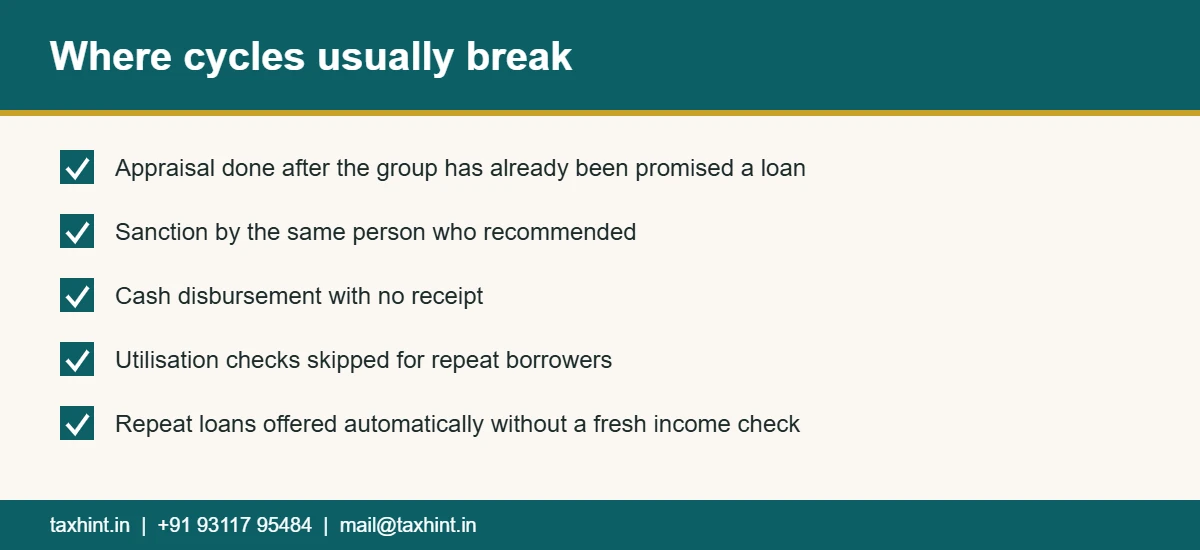
- Appraisal done after the group has already been promised a loan.
- Sanction by the same person who recommended.
- Cash disbursement with no receipt.
- Utilisation checks skipped for repeat borrowers.
- Repeat loans offered automatically without a fresh income check.
FAQs
How long is a typical microfinance loan cycle?
It depends on the product. Tenure and repayment frequency are set in your product design; see our loan product design guide.
Who approves a loan?
A person independent of the recommending officer, within a written limit.
Is the 50 percent cap mandatory?
For regulated lenders, RBI’s microfinance directions set a limit on monthly loan repayment obligations as a share of monthly household income. Check the current text.
Where do software controls help most?
At appraisal limits, maker-checker approvals and daily reconciliation.
Can steps be combined for small loans?
You can shorten paperwork, but appraisal, independent sanction and disclosure should stay for every loan.
What should the system enforce?
Mandatory fields at appraisal, limit checks, maker-checker approval and a lock on disbursement until documents are complete.
Running loans on spreadsheets? Book a free demo of our microfinance software, starting ₹15,000, or WhatsApp +91 93117 95484.